Money and payments in the United States: cards, cash and bank fees
Updated on
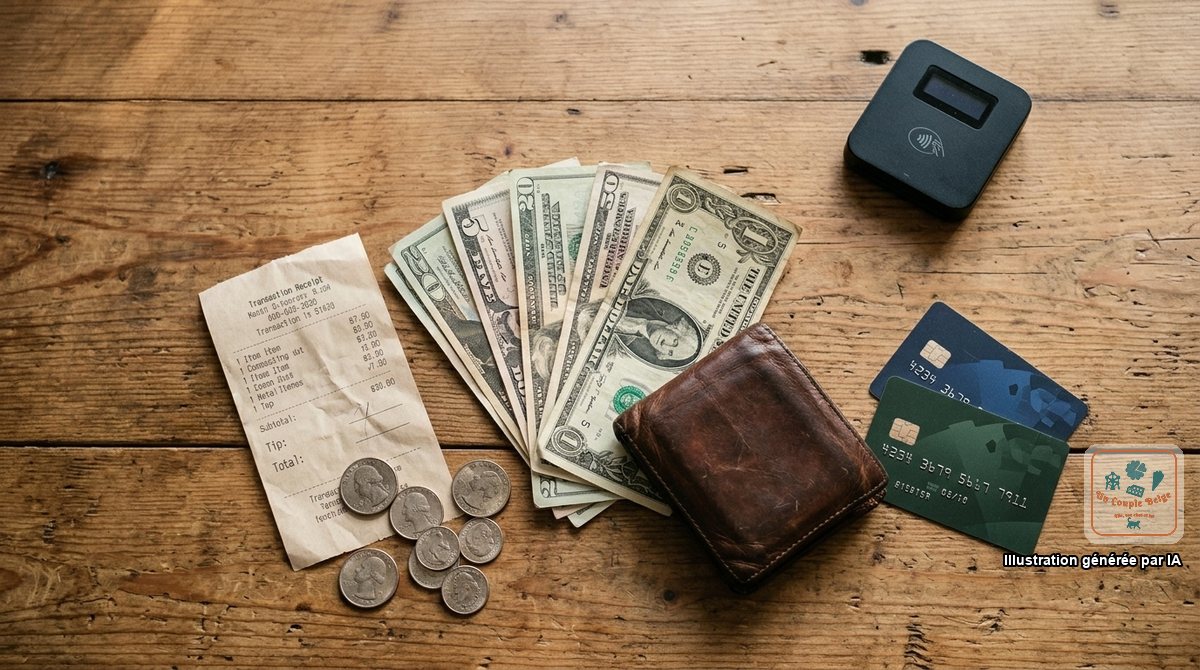
In the United States you pay for almost everything by card, even a 3-dollar coffee. But not with just any card, and not without fees if you aren’t careful. Here’s how we go about it.
The currency in brief
| The currency | Good to know |
|---|---|
| Currency | The US dollar (USD, $). |
| Notes | 1, 5, 10, 20, 50 and 100 dollars. They are all the same size and almost the same colour: check carefully before paying. |
| Coins | 1 cent (penny), 5 cents (nickel), 10 cents (dime), 25 cents (quarter). The quarter is the most useful (parking meters, laundromats, machines). |
| Exchange rate | Check it just before you leave. |
Bank cards
A real credit card is essential for:
- renting a car: the rental company blocks a deposit, often several hundred dollars, and many refuse debit cards;
- some hotels, which also block a deposit on arrival.
For the rental, the card must be in the name of the main driver.
The fees to know about
Your Belgian bank may charge, on every payment in dollars:
- foreign exchange fees (often 1.5 to 2% of the amount);
- fixed fees per cash withdrawal.
Over a three-week road trip, that can quickly add up to a hundred euros or so. Hence the appeal of cards with no foreign exchange fees, offered by neobanks and some online banks. They come on top of your usual card, which you keep as a backup.
For our part, we travel with several cards: an Extra World Mastercard, a Visa Gold and a Mastercard Gold. Banks sometimes block a card when they see unusual activity, and a terminal will occasionally accept one and refuse the other. The Extra World Mastercard has the lowest limit of the three, but you can load money onto it in advance: that lets us spend more without raising the limit, and it’s what we prefer.
The dynamic conversion trap
Cash
Cards work almost everywhere, but cash is still useful. We recommend allowing about 600 dollars for the trip, part of it in small notes (1, 5, 10, 20), mainly for:
- cash tips (hotel, porter, guides);
- small shops, markets and roadside stands;
- car parks or campgrounds that work with an envelope and a box (honor system or iron ranger);
- fuel, often a few cents a gallon cheaper when you pay cash (see fuel);
- laundromats, which sometimes take quarters.
You can order dollars from your bank in Belgium before you leave, or withdraw them from a cash machine (ATM) once you’re there. Choose the machines of the big banks (Chase, Bank of America, Wells Fargo) rather than those in petrol stations, which often add 3 to 5 dollars in fees.
The prices displayed are not the prices you pay
Two things to build into your budget:
- Sales tax isn’t included in the displayed price. It varies by state and city, from 0% (Oregon, Montana, Delaware, New Hampshire) to nearly 10%. At hotels, occupancy taxes are often added, and sometimes resort fees per night.
- The tip at restaurants, 18 to 20% on top. Everything is explained in our article on tipping.
A dish listed at 20 dollars therefore really costs around 25 dollars.
Contactless and mobile payments
Contactless and Apple Pay / Google Pay are widely accepted, especially in cities and at the big chains. They also work on the New York subway (OMNY) and in other cities.
Our advice
- At least two cards, on different networks if possible (one Visa, one Mastercard), kept in separate places.
- Tell your bank about your trip if it asks you to, and check your payment and withdrawal limits: a road trip burns through money fast (rental, hotels, fuel).
- Turn on payment notifications in your banking app so that you spot a suspicious transaction straight away.
- Note the numbers for blocking your cards (Card Stop, from abroad: +32 78 170 170, 24 hours a day). Be wary of calls claiming to come from Card Stop: you call them, never the other way round.
Our budget benchmark: it’s hard for us to go below 500 euros a day for two, flights included. The breakdown and how to estimate your own are in the budget for a road trip.