Wildlife in the United States: bears, bison, snakes and alligators
Updated on
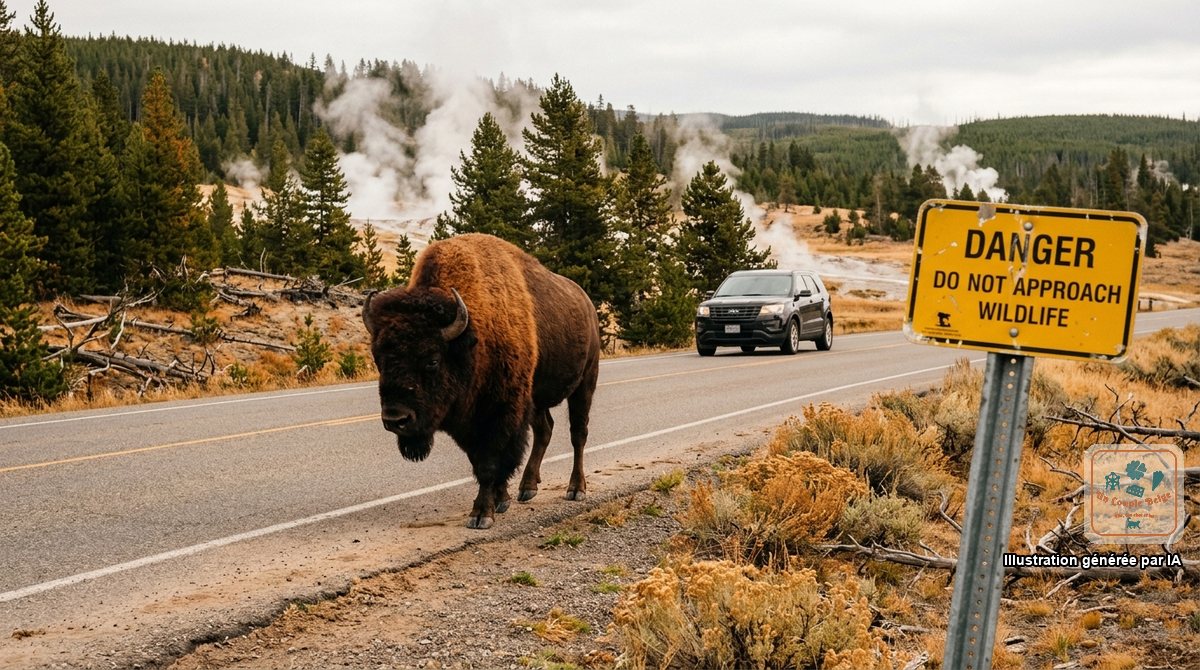
Seeing wild animals roaming free is one of the great pleasures of a trip to the United States. We’ve come across black bears in Sequoia, bighorn sheep, elephant seals on the Californian coast, dozens of alligators in Florida and manatees that had come to warm up in the tepid waters.
None of these animals is aggressive by nature. Accidents almost always happen for the same reason: someone got too close.
The distance rule
The National Park Service sets two minimum distances, valid in most parks:
- 25 yards, or 23 metres, for all animals: bison, elk, deer, bighorn sheep, coyotes.
- 100 yards, or 91 metres, for bears and wolves.
It’s up to you to back away if the animal approaches. If it stops eating, raises its head or changes direction because of you, you’re already too close. Fines exist and are enforced.
Bears
Two species live in the United States, outside Alaska:
| Black bear | Grizzly | |
|---|---|---|
| Where | Almost every wooded region: Sierra Nevada, Rockies, Appalachians | Yellowstone, Grand Teton, Glacier and the northern Rockies |
| Size | 60 to 200 kg | 150 to 350 kg |
| Distinguishing features | No hump, straight profile. Black, brown or cinnamon coat | Hump on the shoulders, dished face |
| Temperament | Wary, attracted by food | Defends its territory, its cubs and its kills |
Colour doesn’t tell them apart: many of California’s “black” bears are brown.
Storing food
This is the most important rule, and it’s enforced.
- Anything with a smell goes in the metal lockers (bear boxes) at campgrounds and car parks: food, cooler, rubbish, toothpaste, sun cream.
- At Yosemite, nothing stays in the car overnight. Bears recognise a cooler through the window and rip a door off without difficulty.
- In the tents at Curry Village, each one has its locker outside the door.
When hiking
- Make noise: talk, clap your hands as you approach a bend or a stream. A bear that has been warned moves away.
- Walk in a group, and not at dawn or dusk in grizzly country.
- Never run. A bear runs at 50 km/h.
If you meet one
- The bear hasn’t seen you: back away calmly, without taking your eyes off it, and make a wide detour.
- The bear has seen you: stay together, speak in a steady voice, back away slowly. Don’t turn your back.
- A black bear charges or approaches: make yourself look big, shout, throw stones. If it attacks, fight back.
- A grizzly charges: use the bear spray. If there’s contact, lie face down, hands on the back of your neck, backpack on your back, and don’t move.
Bear spray
It’s a very powerful pepper aerosol, carried on your belt and not at the bottom of your bag.
- Recommended at Yellowstone, Grand Teton and Glacier.
- Banned at Yosemite, where only black bears live.
- It costs 40 to 50 dollars, can be rented at Yellowstone and in the neighbouring towns, and can’t go on a plane.
- Ask to be shown how to remove the safety clip before you set off.
Bison, elk and moose
They look like big, placid cows, and they are the animals that injure the most visitors at Yellowstone.
- A bison weighs up to 900 kg and runs at 55 km/h. A raised tail signals a charge.
- Elk are dangerous in September and October, during the rut, and in spring, when the cows have their calves.
- A moose charges without warning if it feels cornered.
Snakes, scorpions and spiders
Rattlesnakes live throughout the West and the South. They don’t chase anyone and give warning before they bite.
- Watch where you put your feet and hands, especially near rocks and dead wood.
- Stay on the trails, and wear closed shoes.
- If you hear the rattle, stop, locate the snake, and back away.
- If you’re bitten: stay calm, immobilise the limb, take off rings and watch, and get to help (911). No tourniquet, no cutting, no sucking.
In the desert, shake out your shoes in the morning if they’ve spent the night outside: scorpions and spiders like to slip into them.
Mountain lions and coyotes
The mountain lion (also called a cougar) lives throughout the West, and almost nobody ever sees one. If it happens: don’t run, make yourself look big, keep children close to you, speak loudly and back away slowly. If it attacks, fight back.
Coyotes are common even in cities. They cause no problems as long as you don’t feed them.
Alligators and the wildlife of Florida
In the Everglades, at Shark Valley or in Big Cypress National Preserve, alligators bask beside the trails, sometimes on them. We saw dozens in January, the best season for watching them.
- Keep 5 to 6 metres away, more if the animal opens its jaws or hisses.
- Don’t go near the water’s edge at dusk, and don’t swim in freshwater lakes and canals.
- Keep children and dogs away from the banks.
- Feeding them is an offence.
Manatees are protected: you watch them without touching them, or giving them water from a hose. Stingrays hide in the sand on the Gulf beaches: you shuffle your feet as you walk to scare them off.
See our guides to the Everglades and the Florida Keys.
The little creatures, the real nuisances
- Ticks, especially in the Northeast and Midwest, transmit Lyme disease. Long trousers in tall grass, and a check in the evening.
- Mosquitoes: fearsome in Florida in summer, in Alaska and near the lakes of the North. Bring repellent.
- Poison ivy in the East and poison oak in the West cause severe itching. Three shiny leaflets: don’t touch.
- The squirrels and chipmunks of the parks bite and chew through bags to reach food.
On the coast
- Elephant seals, sea lions and seals: stay at least 15 metres away. At Piedras Blancas, on Highway 1, a boardwalk lets you watch the elephant seal colony without disturbing it.
- Whales: boat trips leave from Monterey, San Diego or New England, depending on the season.
Where and when to see them
- At dawn and dusk, everywhere.
- Yellowstone: the Lamar and Hayden valleys for bison, wolves and bears.
- Grand Teton: moose near the ponds.
- Sequoia and Yosemite: black bears in the meadows in spring.
- Everglades: alligators and birds from December to April.
- Florida: manatees near the warm springs and power plants in winter.
A pair of binoculars or a telephoto lens is better than ten extra steps.