Renting an electric car for a road trip in the United States: a good idea?
Updated on
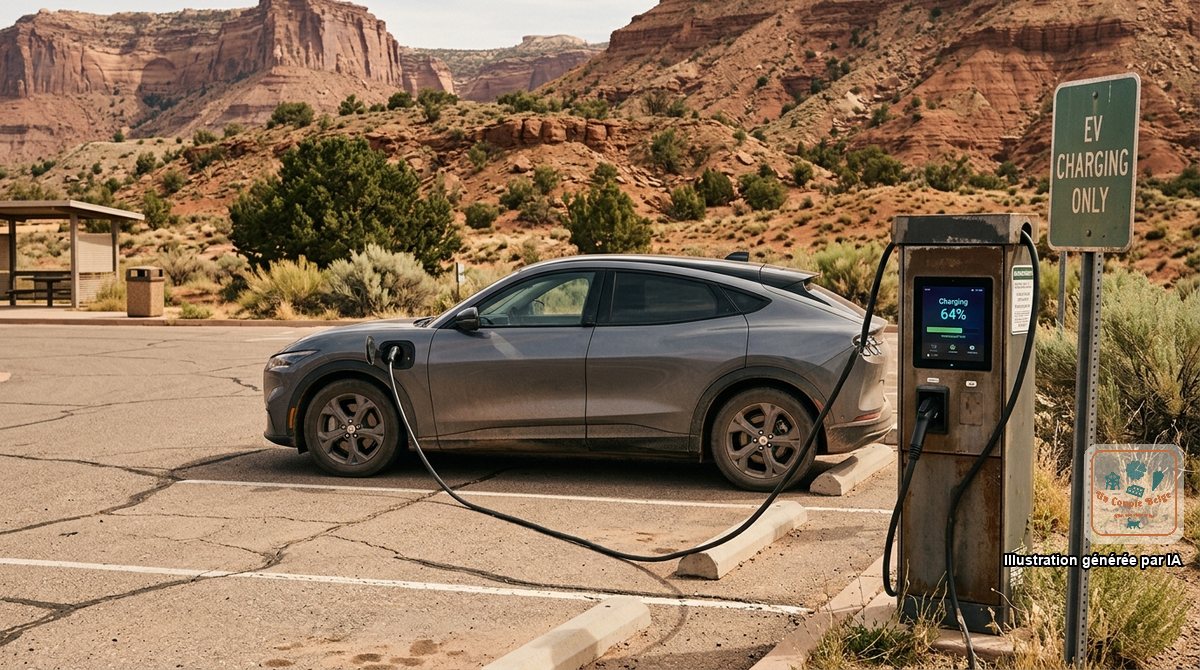
American rental companies offer more and more electric cars, sometimes for less than the petrol equivalent. On the motorway between Los Angeles and San Francisco, it’s a real comfort. Between Monument Valley and Capitol Reef, it’s another story. It all depends on your itinerary.
Where it works, where it gets tricky
| Region | Verdict |
|---|---|
| California, from San Diego to San Francisco | Very good: the best network in the country |
| The Boston – New York – Washington corridor, I-95 down to Florida | Very good |
| Florida | Good |
| Las Vegas, Phoenix, Salt Lake City, Denver and their motorways | Good |
| The Utah parks (Zion, Bryce, Moab) | Doable if you plan every stage |
| Page, Monument Valley, Capitol Reef, Escalante | Difficult: few fast chargers, long distances |
| Death Valley, US-50 in Nevada | Not advised |
| Yellowstone, Wyoming, Montana, the Dakotas | Doable on the main routes, complicated elsewhere |
The charging networks
Fast chargers (DC fast charging), for charging en route: 20 to 40 minutes to go from 10 to 80%.
- Tesla Supercharger: the densest and most reliable network. Long reserved for Teslas, it’s opening up to other makes, with an adapter depending on the model.
- Electrify America: on the main routes and in supermarket car parks.
- EVgo and ChargePoint: mainly in cities.
Slow chargers (Level 2), for charging overnight or during a long visit: 6 to 10 hours for a full charge. You find them at many hotels, car parks and visitor centers.
The connectors: the Tesla standard (called NACS) is becoming the common standard, but many cars still have the CCS connector. Ask the rental company which connector the car has and which adapters are supplied.
Real-world range
The range displayed is rarely what you get on a road trip.
- At 120 km/h on the motorway, allow 15 to 25% less than the stated figure.
- In great heat, the air conditioning takes off another 10 to 15%.
- In cold weather, the loss reaches 20 to 30%.
- In the mountains, a long climb drains the battery very quickly. The descent recovers part of it.
- You drive between 10 and 80%: the end of the charge is slow, and you keep a margin. A car rated at 500 km therefore covers 250 to 300 between two stops.
What it costs
- Fast charging: 35 to 60 cents per kilowatt-hour, or 15 to 30 dollars for a charge. Over 4,000 km, allow 300 to 450 dollars: roughly the fuel budget of an economical car, sometimes more.
- Charging at the hotel: often free or a few dollars. That’s what makes electric worthwhile.
- The rental: compare with a hybrid, which uses very little fuel and raises no questions about chargers.
You’ll find the equivalent calculation for petrol in our article on fuel.
The rental company’s rules
Read them before signing: they differ a great deal from one company to another.
- The charge level on return. Some rental companies ask you to return the car at the same level as at pick-up, others above 70% or 10%, on pain of a flat fee of 25 to 35 dollars.
- Prepaid charging, the equivalent of prepaid fuel.
- Charging fees at Tesla chargers, billed on afterwards by the rental company with a delay.
- Idle fees: at fast chargers, you’re charged by the minute once the battery is full and the car is still occupying the bay.
- Cables and adapters: check that they’re in the boot before you leave.
The other traps at the desk are in renting a car.
Planning your stages
- A Better Routeplanner calculates the route with charging stops, taking into account the model, the speed and the terrain.
- PlugShare lists all the chargers, with recent user reviews. Essential for knowing whether an isolated charger really works.
- A Tesla’s sat nav plans the Supercharger stops by itself.
- The networks’ apps (Electrify America, EVgo, ChargePoint) are used for paying. Create the accounts before you leave: some refuse foreign bank cards, and contactless payment at the charger doesn’t always work.
Good habits
- Choose hotels with a charger and charge every night. Filter on that criterion when booking, and check that the charger isn’t reserved for Teslas if you aren’t driving one.
- Never leave a town with less than 80% in poorly equipped regions.
- Always have a plan B: a charger may be out of order or in use.
- Charge during meals and shopping, not while waiting in the car.
In the national parks
Chargers there are rare, slow, and often taken.
- Zion: chargers in Springdale, at the park entrance.
- Grand Canyon, South Rim: a few slow chargers in the village and in Tusayan.
- Yosemite: a few slow chargers in the valley.
- Death Valley: a handful of slow chargers at Furnace Creek, more than 150 km from the nearest fast charger.
- Yellowstone: slow chargers in some of the villages, fast chargers in the gateway towns.
In a park you drive slowly, which uses little energy. The problem comes from the long distances to get there and leave again.
Driving an electric car for the first time
- Acceleration is instant: go gently for the first few kilometres.
- Regenerative braking slows the car sharply as soon as you lift your foot. You get used to it in ten minutes.
- In a Tesla, almost everything goes through the central screen, and the card or the phone serves as the key. Ask the rental company for a demonstration.
- The car stays air-conditioned when stationary, which is pleasant for a break, and uses little energy.
Our view
- For a stay in California or on the East Coast, between big cities: yes, without hesitation if the price is good.
- For a loop through the parks of the West: we would take a hybrid. It uses little fuel, refuels in five minutes anywhere, and leaves your mind free on roads where the next station is already 150 km away.
- For a first road trip: keep the unknowns for the scenery, not for the gauge.