Colorado: the Rockies, life-size
Updated on
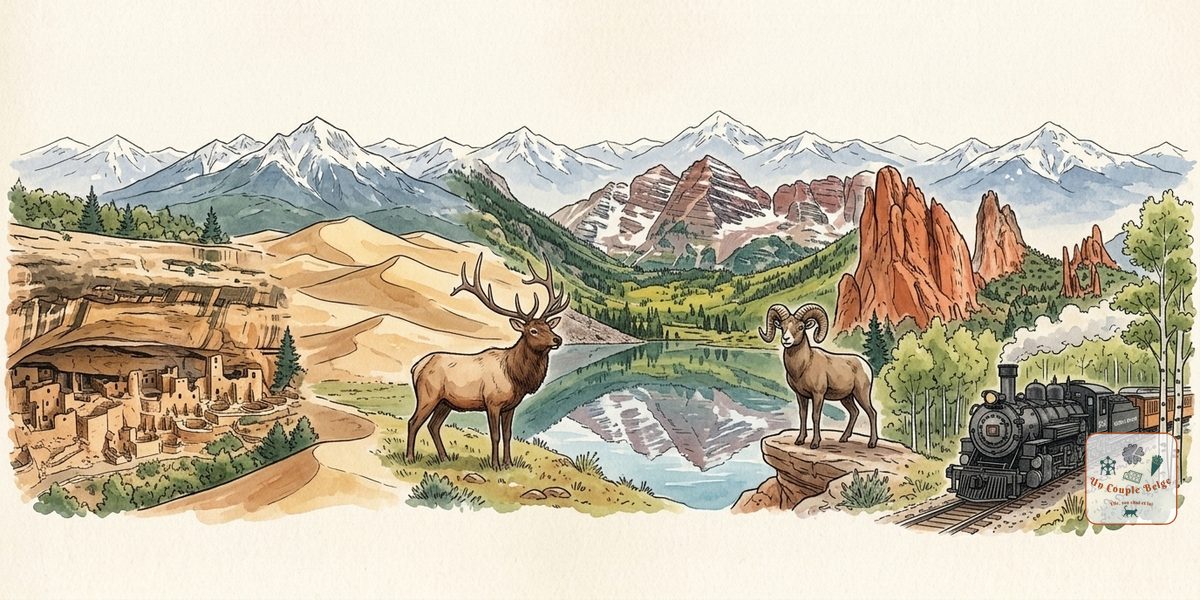
As you leave Denver airport, the first thing you see is a line of jagged mountains blocking the whole horizon to the west. In Colorado, the Rockies aren’t a distant postcard: they’re right there, an hour’s drive away, and they decide almost everything. What the weather will do this afternoon, what the locals do at the weekend, and even the altitude of the capital. Denver is called the “Mile High City” because one step of its State Capitol is engraved at exactly one mile above sea level, or 1,609 metres.
Colorado is a permanent balancing act between extremes. The east is as flat as a table, an extension of the Great Plains. The west lines up dozens of peaks above 4,000 metres, red canyons and world-famous ski resorts. You can spend the morning in an old mining village and end the day in a trendy Denver bar. It’s also a young-at-heart and very sporty state, where many people organise their week around the snow or the trails.
Colorado at a glance
- Capital and largest city: Denver
- Population: about 5.9 million
- Area: about 270,000 km², nearly nine times Belgium
- Joined the Union: 1876, 38th state, a hundred years after independence, hence its nickname
- Time zone: Mountain Time (8 hours behind Brussels)
- Nickname: The Centennial State
- Highest point: Mount Elbert, 4,401 metres
- Good to know: the state has 58 peaks above 14,000 feet (4,267 m), the famous “fourteeners”
Geography: from the plains to the canyons
The Eastern Plains cover nearly 40% of the state: wheat, ranches, wind and endless horizons. Not very touristy, but you cross them when arriving from Kansas or Nebraska.
The Front Range is the long urban strip at the foot of the mountains, from Fort Collins to Pueblo by way of Boulder, Denver and Colorado Springs. This is where the vast majority of the population lives.
The Rockies occupy the centre of the state, crossed by the Continental Divide. Here you’ll find Rocky Mountain National Park, the ski resorts (Vail, Breckenridge, Aspen) and passes above 3,500 metres.
The Western Slope, to the west, descends towards Utah in plateaus, mesas and red-rock canyons, with Grand Junction, the orchards of Palisade and the Black Canyon of the Gunnison.
The south-west, finally, is dominated by the San Juan Mountains and the lands of the Ancestral Puebloans, around Durango and Mesa Verde.
A bit of history
For centuries the Ute, the Cheyenne, the Arapaho and, in the south-west, the Ancestral Puebloans occupied the territory. Part of it passed to the United States with the Louisiana Purchase (1803), the rest after the war with Mexico (1848).
Everything changed in 1858, when gold was discovered near present-day Denver. The Pikes Peak gold rush, with its slogan “Pikes Peak or Bust”, gave rise to mining towns all through the mountains: Central City, Leadville, Silverton, Telluride, Aspen… Silver replaced gold, then collapsed at the end of the 19th century. In 1864, the Sand Creek massacre, in which the army killed more than 200 Cheyenne and Arapaho, most of them women, children and old people, remains one of the darkest pages in the state’s history.
In the 20th century, the ghostly mining towns were reborn thanks to skiing, from the 1940s onwards, and Colorado became a major outdoor destination. In 2012 it was, along with Washington State, the first to legalise recreational cannabis.
The must-sees
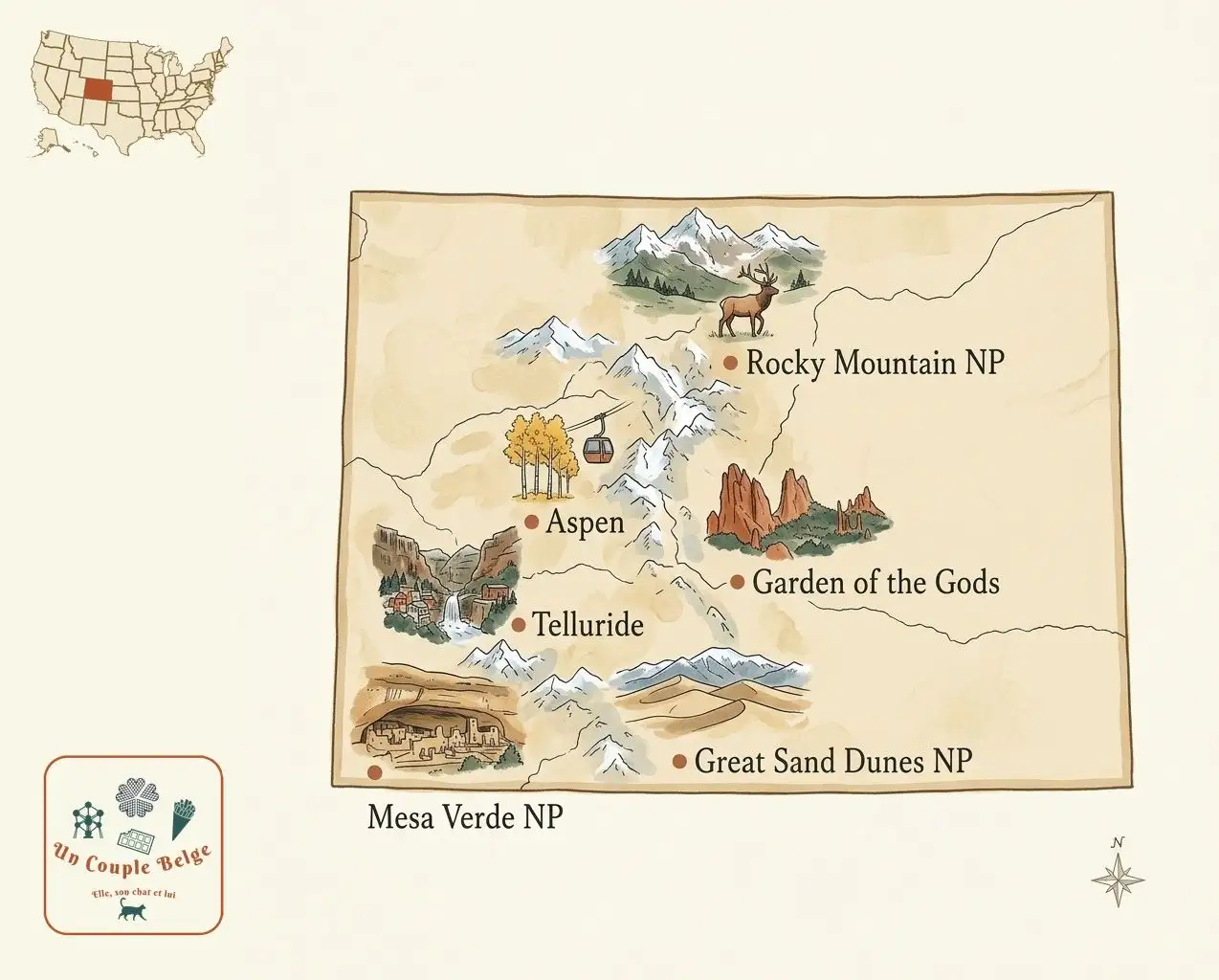
Rocky Mountain National Park
An hour and a half from Denver, Rocky Mountain National Park is the most visited park in Colorado. Trail Ridge Road crosses the park and climbs above 3,700 metres: it’s the highest continuous paved road in the United States. At the top, a wind-swept alpine tundra, even at the height of summer. In the valleys, elk graze at the roadside, especially at dawn and dusk. The lakes around Bear Lake offer lovely easy hikes.
In summer, a timed-entry reservation is generally required: check the dates on the park’s website. Trail Ridge Road is usually only open from late May to October.
Mesa Verde
In the south-west, Mesa Verde protects cliff dwellings built by the Ancestral Puebloans about eight centuries ago, tucked into the sandstone cliffs. Cliff Palace, the largest of these villages, is visited with a ranger by reservation, with ladders to climb. The inhabitants left these cliffs at the end of the 13th century, probably because of prolonged droughts. Allow a whole day: the park is big and the roads are winding.
Great Sand Dunes
This is Colorado’s surprise: the tallest dunes in North America, over 200 metres high, set at the foot of the snow-capped Sangre de Cristo Mountains. People go sand sledding (boards can be rented in the nearby villages) and, from late May to June, paddle in Medano Creek, a seasonal stream that flows at the foot of the dunes. Be careful, the sand can exceed 60 °C in summer: climb early in the morning.
The Black Canyon of the Gunnison
Less well known, the Black Canyon is a chasm so narrow and so deep that some of its walls only see the sun for a few minutes a day. The viewpoints along the South Rim are dizzying. Ideal as a stop between Montrose and Grand Junction.
The San Juan Skyway
It’s probably the finest road trip in Colorado. The San Juan Skyway makes a loop of about 380 kilometres between Durango, Silverton, Ouray, Telluride and Cortez. The stretch between Silverton and Ouray, the Million Dollar Highway, is famous for its hairpins with no guardrail above the drop. Nobody really knows where the nickname comes from: the cost of building it, or the ore said to be in the gravel.
Along the way, Ouray, nicknamed “the Switzerland of America”, has hot springs and ice cliffs for climbing in winter. Telluride is a former mining town turned smart resort, with a free gondola. And in Durango, a historic narrow-gauge steam train climbs to Silverton in 3 hrs 30 through the gorges.
Denver and Boulder
Denver deserves a day or two before you head for the mountains. Larimer Square and its strings of lights, the breweries and murals of the RiNo district, Union Station with its hall turned into a bar and market, and the Denver Art Museum. Half an hour away, Red Rocks Amphitheatre, a natural concert venue between two immense red rocks, can be visited during the day. Going to a concert there in the evening is even better.
Boulder, a university town at the foot of the Flatirons (great tilted slabs of rock), is all about cycling, trail running and café terraces. Golden, right next door, is home to the Coors brewery.
Colorado Springs and Pikes Peak
In Colorado Springs, the Garden of the Gods is a free city park, with immense red rock formations standing vertically in front of Pikes Peak. Pikes Peak itself (4,302 metres) can be climbed by car on a toll road or by cog railway. It was at the summit that Katharine Lee Bates wrote, in 1893, the poem that would become America the Beautiful.
The mountain resorts
Aspen, Vail, Breckenridge, Telluride and Steamboat Springs are among the most famous ski resorts in America. Even if you don’t ski, they’re worth a stop in summer for hiking and music festivals. Near Aspen, the Maroon Bells, two pyramid-shaped peaks reflected in a lake, are one of the most photographed views in the country. In season, access is by shuttle, by reservation.
Leadville, perched above 3,000 metres, is the highest city in the United States, and Glenwood Springs has one of the largest natural hot spring pools in the world.
The Western Slope
Around Grand Junction, Colorado National Monument lines up red canyons and monoliths along a scenic road. The orchards of Palisade produce renowned peaches, and the area has many wineries. Further north, Dinosaur National Monument, straddling the Utah border, displays a wall of dinosaur fossils.
Itinerary ideas
One week, the mountains. Denver (1-2 days) → Rocky Mountain National Park (2 days) → Breckenridge or Vail → Glenwood Springs → Aspen and the Maroon Bells → back over Independence Pass (in summer).
10-14 days, the grand tour. Denver → Colorado Springs → Great Sand Dunes → Durango → Mesa Verde → San Juan Skyway (Silverton, Ouray, Telluride) → Black Canyon → Aspen → back to Denver via Rocky Mountain. About 1,800 kilometres.
With Utah. South-west Colorado combines perfectly with Moab, Arches and Canyonlands, a few hours’ drive away. Mesa Verde is also under three hours from Monument Valley.
On the plate
- Green chile, a stew of green chillies and pork, which smothers burritos, burgers and fries all over the state.
- The Denver omelette, with ham, onions and peppers.
- Colorado-style pizza, with a thick honey crust that you dip in honey at the end (Beau Jo’s, in Idaho Springs).
- Palisade peaches and Rocky Ford melons, in summer.
- Bison and elk meat, and trout from the mountain rivers.
- Rocky Mountain oysters, which are neither oysters nor seafood, but breaded and fried bull testicles. They’re gladly offered to tourists to see the look on their faces.
- And craft beer: Colorado has hundreds of breweries, and every autumn Denver hosts the Great American Beer Festival, the biggest beer festival in the country.
Culture and trivia
- Alferd Packer, a guide who set off to look for gold with five companions in 1874, came back alone in the spring. Accused of killing and eating them, he was convicted of manslaughter. The University of Colorado at Boulder named its cafeteria after him, out of pure black humour.
- South Park 🎬, the series, is set in a fictional Colorado town. The real South Park is a broad high-altitude valley in the centre of the state.
- The “Balloon Boy”, in 2009: parents in Fort Collins made people believe their son had floated away in a balloon. The TV networks followed the balloon live for hours, before the child was found hiding in the attic.
- Cannabis is legal from the age of 21, in licensed shops (“dispensaries”). But it’s forbidden to consume it in public or to take it out of Colorado, and it remains illegal in national parks and on all federal land.
- John Denver chose his stage name in tribute to the city, and his song Rocky Mountain High is one of the state’s two official songs.
When to go
- Summer (June to September): the season for hiking, pass roads and the high-altitude parks. It’s hot in Denver, cool in the mountains. Always set off early: storms break almost every afternoon in the mountains, with lightning above the treeline.
- Autumn (mid-September to mid-October): the aspens turn golden, and it’s one of the most beautiful times of the year. The first snow can fall at altitude.
- Winter (December to March): ski season, with snow that is often dry and plentiful. Prices soar over the holidays. The I-70 motorway to the resorts is often jammed at weekends, and equipment rules (snow tyres or chains) apply.
- Spring (April-May): the shoulder season, with snow in the mountains and mild temperatures on the plains. Many pass roads are still closed.
Practical information
- Recommended length of stay: 10 days minimum to combine Denver, the Rockies and the south-west, two weeks to take your time.
- Getting there: Denver airport is one of the largest in the United States, with direct or one-stop flights from Europe.
- Getting around: a car is essential. In winter, take a 4x4 or all-wheel-drive vehicle with good tyres.
- Budget: medium to high, very high in the ski resorts in winter. The small towns of the south-west are more affordable. Since 2026, the national parks pass has cost foreign visitors 250 dollars, and Rocky Mountain charges a 100-dollar surcharge per person without it: see our guide to the national parks pass.
- Things to watch out for: the altitude makes itself felt quickly. Plan a day of acclimatisation in Denver before going above 3,000 metres, drink plenty of water (the air is very dry) and protect yourself from the sun, which is much stronger at altitude.
- One more tip: book ahead for the Rocky Mountain entry slots, the guided tours at Mesa Verde and the Maroon Bells shuttle.
Our place guides in Colorado
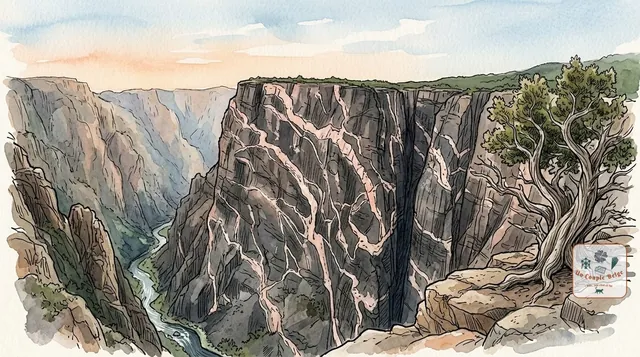
Black Canyon of the Gunnison: a chasm so narrow the sun barely gets in
A narrow, dark and dizzying canyon in western Colorado: sheer walls 600 to 800 metres high, which you look at from a series of overlooks.
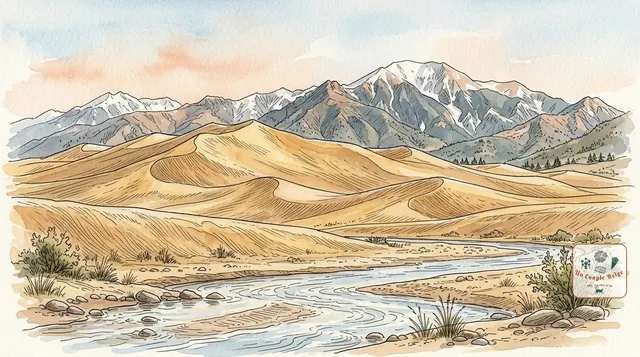
Great Sand Dunes: the tallest dunes in North America, at the foot of the Rockies
The tallest dunes in North America, at the foot of snow-capped mountains in Colorado, with a creek flowing at their feet in spring.
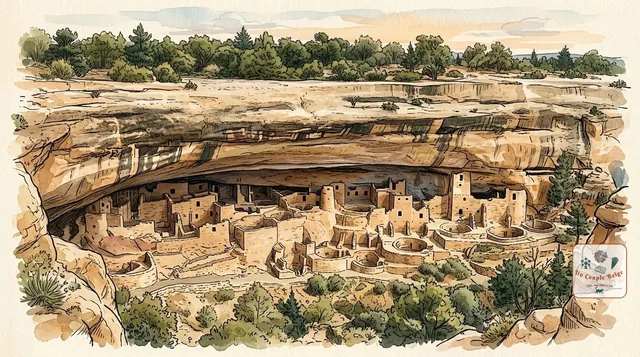
Mesa Verde: the cliff dwellings of the Ancestral Puebloans
Entire villages built beneath the cliffs 800 years ago, in south-west Colorado. The largest group of cliff dwellings in the United States.
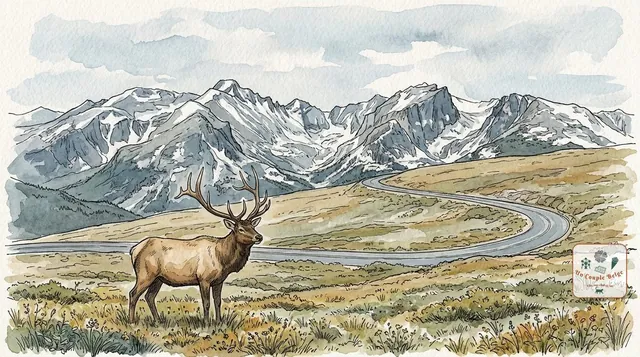
Rocky Mountain: the highest road in America and elk in the valley
The high mountains of Colorado, 1 hr 30 from Denver: a road that climbs to more than 3,700 metres, alpine lakes, elk and 4,000-metre summits.