Hawaii: volcanoes, cliffs and Polynesian culture
Updated on
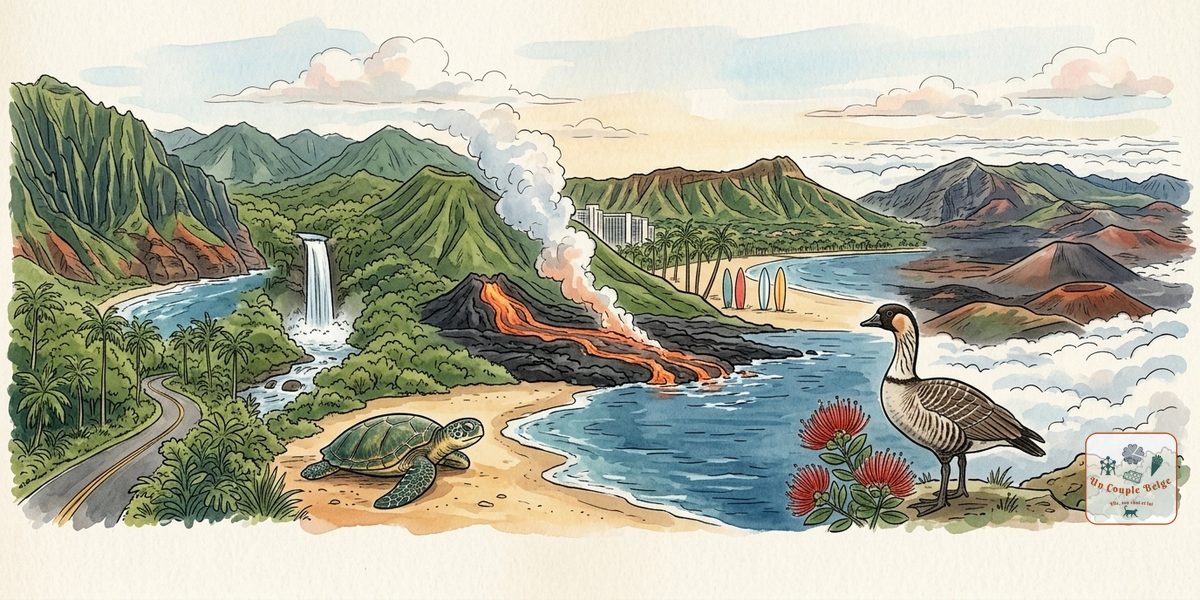
People imagine Hawaii as a succession of golden beaches, cocktails and ukuleles. The reality is rougher and far more interesting. It’s a string of volcanoes born in the middle of the Pacific, nearly 4,000 kilometres from California, where you can see lava and snow on the same day. Hawaiian is still taught at school, and Polynesian culture has never completely given way to tourism.
Hawaii stands apart in every respect: the only state made up entirely of islands, the only one that was an independent kingdom, and the only one where you can’t do a road trip from one end to the other. You travel island by island, flying between each. The first choice to make is therefore which islands.
Hawaii at a glance
- Capital and largest city: Honolulu, on the island of Oahu
- Population: about 1.4 million
- Area: about 28,000 km² including inland waters, barely less than Belgium. The land area is about 16,600 km².
- Joined the Union: 1959, 50th and last state
- Time zone: Hawaii Time, with no daylight saving (11 hours behind Brussels in winter, 12 hours in summer)
- Nickname: The Aloha State
- Highest point: Mauna Kea, 4,207 metres (more than 10,000 metres if measured from its base on the ocean floor)
- Official languages: English and Hawaiian
Geography: the islands, one by one
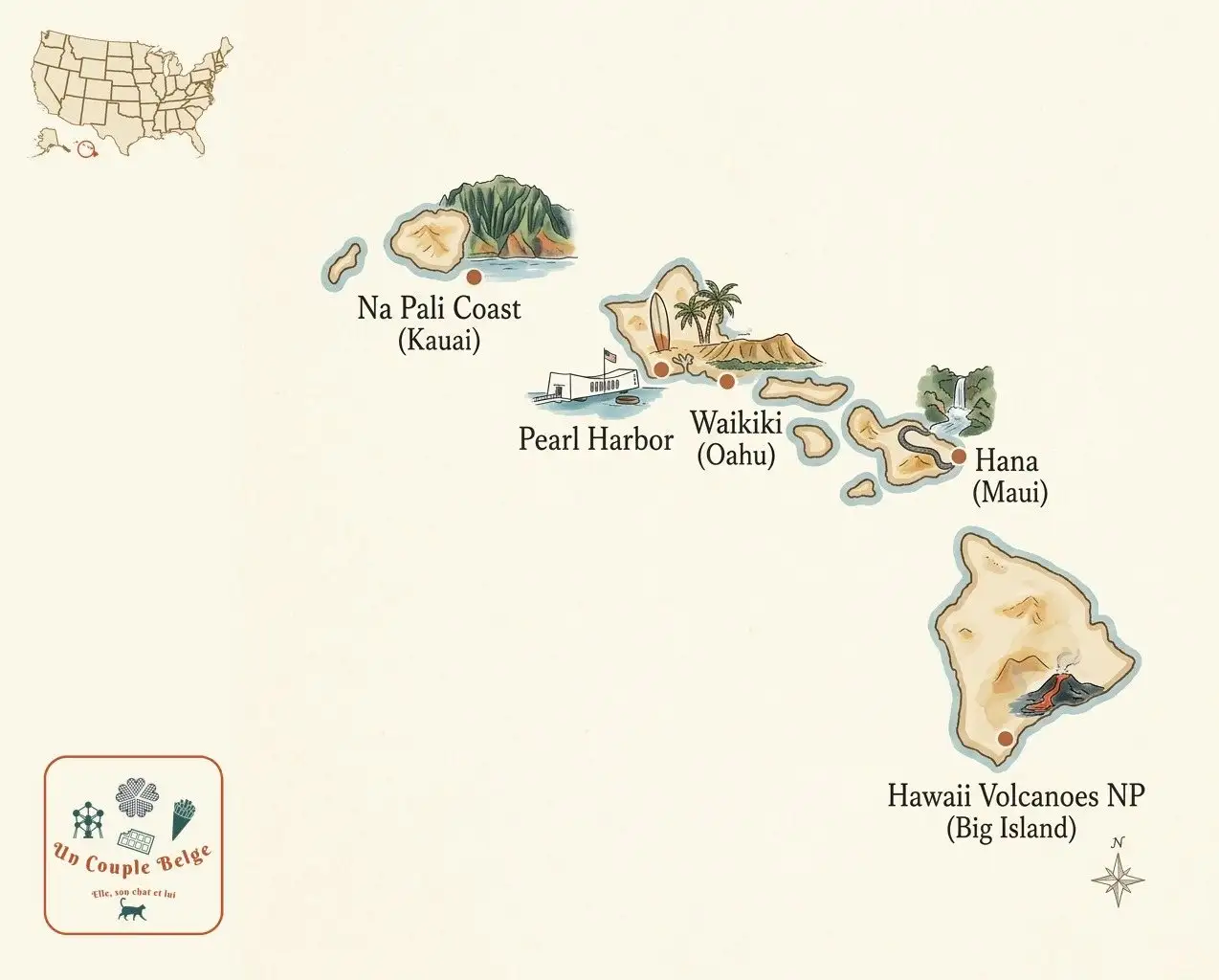
The archipelago has eight main islands, born from a volcanic “hot spot” over which the Pacific plate is moving. The further north-west you go, the older and more eroded the islands are.
Oahu is the urban island, with Honolulu, Waikiki and Pearl Harbor, nearly 70% of the state’s population and the main airport.
Maui is the most versatile: beaches, the Road to Hana, the Haleakalā volcano and whales in winter.
The Big Island, the island of Hawaii proper, is the largest and the youngest. It’s still forming, with two active volcanoes.
Kauai, the oldest of the large islands, is the greenest and wildest, nicknamed the “Garden Isle”.
Molokai and Lanai are more low-key and see very little tourism. Niihau is privately owned and Kahoolawe is uninhabited.
Each island has a windward side (to the east and north-east), wet and lush, and a leeward side, dry and sunny, where most of the resorts are.
A bit of history
Polynesian navigators reached Hawaii about a thousand years ago, in double-hulled canoes, guided by the stars, the waves and the birds. Captain James Cook landed in 1778, then was killed there the following year. In 1810, Kamehameha I unified the islands into a Kingdom of Hawaii, recognised by the foreign powers.
The 19th century brought missionaries, whalers, then the big sugar cane and pineapple plantations, which brought in Chinese, Japanese, Portuguese and Filipino workers. That’s where today’s very mixed population comes from. In 1893, a group of American businessmen, backed by Marines, overthrew Queen Liliʻuokalani. The United States annexed the archipelago in 1898.
On 7 December 1941, the Japanese attack on Pearl Harbor brought the United States into the Second World War. Hawaii became a state in 1959. Since the 1970s, a Hawaiian cultural renaissance has brought the language, hula and traditional navigation back to the fore.
The must-sees
Oahu: Honolulu, Pearl Harbor and the North Shore
Waikiki is the most famous beach in Hawaii, lined with hotel towers, ideal for learning to surf on gentle waves. The climb up Diamond Head crater (reservation required for non-residents) offers a view over the whole coast, best done early in the morning.
At Pearl Harbor, the USS Arizona Memorial, built above the wreck where more than 900 sailors still lie, is free to visit, but tickets must be booked in advance on the park’s website. The battleship USS Missouri, where the Japanese surrender was signed, is moored right alongside.
ʻIolani Palace, in Honolulu, is the only official royal palace in the United States. It tells the story of the end of the Kingdom of Hawaii. For snorkelling, Hanauma Bay is protected and very beautiful, by reservation.
On the north coast, the North Shore changes face completely with the season. In winter, waves of more than 10 metres break on legendary spots such as Pipeline, and the best surfers in the world compete there. In summer, the ocean goes almost flat again. Stop in Haleiwa, for its garlic shrimp trucks and its shave ice. On the east coast, Kualoa Ranch offers tours of the Jurassic Park 🎬 filming locations.
Maui: the Road to Hana and Haleakalā
The Road to Hana is about 80 kilometres long, with more than 600 bends and some fifty one-lane bridges. Non-stop, it takes nearly three hours. In reality it’s a whole day, with waterfalls, bamboo forests, the black-sand beach of Waiʻānapanapa (reservation required) and banana bread stands. Set off very early and, if possible, sleep in Hana.
Haleakalā National Park rises to more than 3,000 metres. Watching the sun rise above the clouds from the summit is a classic, and a reservation is required to enter between 3 and 7 a.m. It can be close to 0 °C up there: take warm clothes.
From December to April, thousands of humpback whales come to calve in the warm waters around Maui: you can watch them from the shore or by boat. Snorkelling at the submerged crater of Molokini is another classic.
Bear in mind that the historic town of Lahaina was destroyed by a fire in August 2023, which killed around a hundred people. Rebuilding is taking years: find out what is open and respect the areas that are still closed.
The Big Island: volcanoes and starry skies
The Big Island is the youngest land in the United States, and it’s still growing. Hawaiʻi Volcanoes National Park, a UNESCO World Heritage Site, is organised around Kīlauea, one of the most active volcanoes in the world, which has erupted regularly in recent years. You walk on old lava flows, go through a lava tube and, with a bit of luck, see the glow of the eruption in the crater at night. The activity changes fast: check the park’s website and the USGS updates before you go.
About an hour from Hilo, Mauna Kea tops 4,200 metres and sometimes gets snow in winter. Its summit hosts some of the largest telescopes in the world. The visitor centre, at 2,800 metres, runs stargazing evenings. To go up to the summit, you need a 4x4 (and many rental companies forbid it) or an organised tour.
On the west coast, around Kona, you can visit coffee farms, swim at night with manta rays and snorkel in Kealakekua Bay. In the south, the black-sand beach of Punaluʻu attracts sea turtles, and Papakōlea has olive-green sand, one of the few such beaches in the world. On the east side, Hilo is a rainy, authentic town surrounded by waterfalls.
Kauai: Nā Pali and Waimea Canyon
The Nā Pali Coast lines up green cliffs plunging into the ocean for more than 25 kilometres, with no road at all. You discover it by boat, by helicopter or on foot along the demanding Kalalau Trail (access to Hāʻena State Park, at the trailhead, must be booked in advance). Inland, Waimea Canyon, nicknamed the “Grand Canyon of the Pacific”, reveals red and green cliffs nearly 900 metres deep.
Kauai is also the rainiest island. Mount Waiʻaleʻale is one of the wettest places in the world, which explains the outsized vegetation. On the north shore, Hanalei and its bay are among the most beautiful spots in the archipelago.
Itinerary ideas
10 days, two islands. Oahu (4 days) + Maui (6 days) or the Big Island (6 days). It’s the simplest combination for a first trip.
Two weeks, three islands. Oahu (3-4 days) → Maui (4-5 days) → Big Island (4-5 days), or Kauai instead of Oahu for more nature.
For nature above all. The Big Island and Kauai, almost skipping Honolulu.
Allow half a day for each change of island, between returning the car, the flight and the new rental.
On the plate
- Poke, raw fish (often tuna) marinated in soy sauce and sesame oil. Everyone makes it, even the supermarkets.
- The plate lunch, a midday meal with two scoops of white rice, a macaroni salad with mayonnaise and a meat (kalua pig, teriyaki chicken…).
- Loco moco: rice, a hamburger patty, a fried egg and lots of brown gravy.
- Spam musubi, a slice of grilled Spam on rice, wrapped in nori seaweed. A legacy of the Second World War, sold in every 7-Eleven.
- Shave ice, very finely shaved ice doused in syrups, and malasadas, Portuguese doughnuts, to be tried at Leonard’s, in Honolulu.
- Kalua pig from the luau, slow-cooked in an oven dug into the ground, and poi, a taro paste with a surprising taste.
- And Kona coffee, among the most expensive in the world.
Culture and trivia
- The Hawaiian alphabet has only 13 letters, hence names like that of the state fish, the humuhumunukunukuāpuaʻa.
- Surfing was born here. Duke Kahanamoku, an Olympic swimming champion from Waikiki, made it known worldwide at the beginning of the 20th century. His statue, on Waikiki beach, is always covered in flower leis.
- “Aloha” doesn’t only mean hello: it’s a notion of love, respect and kindness, written into state law as a guiding principle.
- Don’t take lava rocks home. According to legend, it brings the bad luck of Pele, the volcano goddess. Every year the national park receives parcels of rocks sent back by repentant tourists.
- Only sunscreens without oxybenzone or octinoxate may be sold, to protect the coral.
- The Merrie Monarch Festival, in Hilo during Easter week, is the biggest hula competition in the world.
When to go
- All year round, it’s between 24 and 31 °C by the sea. The differences come more from the rain and the ocean.
- Winter (November to March): the season for whales and big waves on the north shores. More rain, especially on the windward sides. Prices soar over the holidays.
- Spring and autumn (April-May, September-October): the best times, with fewer people, a calm sea and gentler prices.
- Summer (June to August): dry and sunny, with a calm sea on the north shore, but it’s the family high season. Hurricanes are rare but possible from June to November.
Practical information
- Recommended length of stay: 10 days minimum for two islands, two weeks for three.
- Getting there: Honolulu is the main airport, with flights from the West Coast (5 to 6 hours) and a few direct flights to Maui, Kona or Kauai. From Belgium, allow at least one connection.
- Getting around: one rental car per island, and inter-island flights of around thirty minutes (Hawaiian Airlines, Southwest). Honolulu has a good bus network.
- Budget: among the highest in the United States, for accommodation, rental cars and food, which is largely imported. Many hotels add a “resort fee”.
- Things to watch out for: many sites now require a reservation (Diamond Head, Hanauma Bay, Waiʻānapanapa, Hāʻena, Haleakalā at sunrise, Pearl Harbor). Keep your distance from turtles and monk seals, and don’t swim when the ocean is rough: the currents are powerful.
- One more tip: book the entry slots for the sites as soon as reservations open, generally a few weeks or a few days before the date.
Our place guides in Hawaii
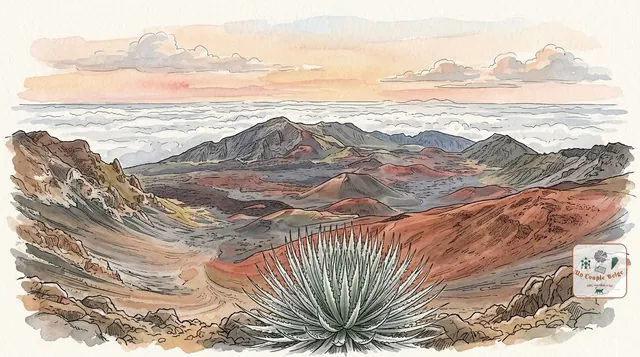
Haleakalā: watching the sun rise from a sleeping volcano
A 3,000-metre volcano on the island of Maui, with a crater of red cinders at the summit and a coast of waterfalls and bamboo at the very bottom.
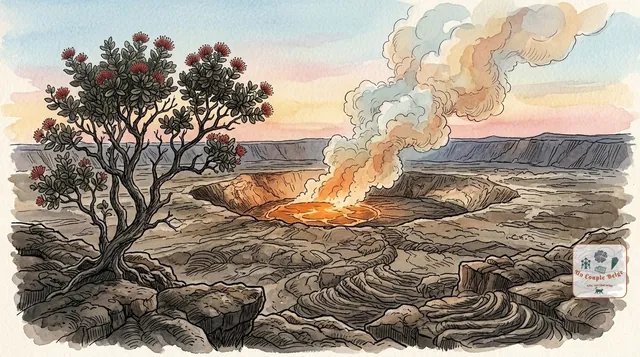
Hawaii Volcanoes: walking on an island that is still being formed
Two of the most active volcanoes in the world on the Big Island of Hawaii: steaming craters, frozen lava flows down to the ocean and, on some days, molten lava.