Idaho: far more than potatoes
Updated on
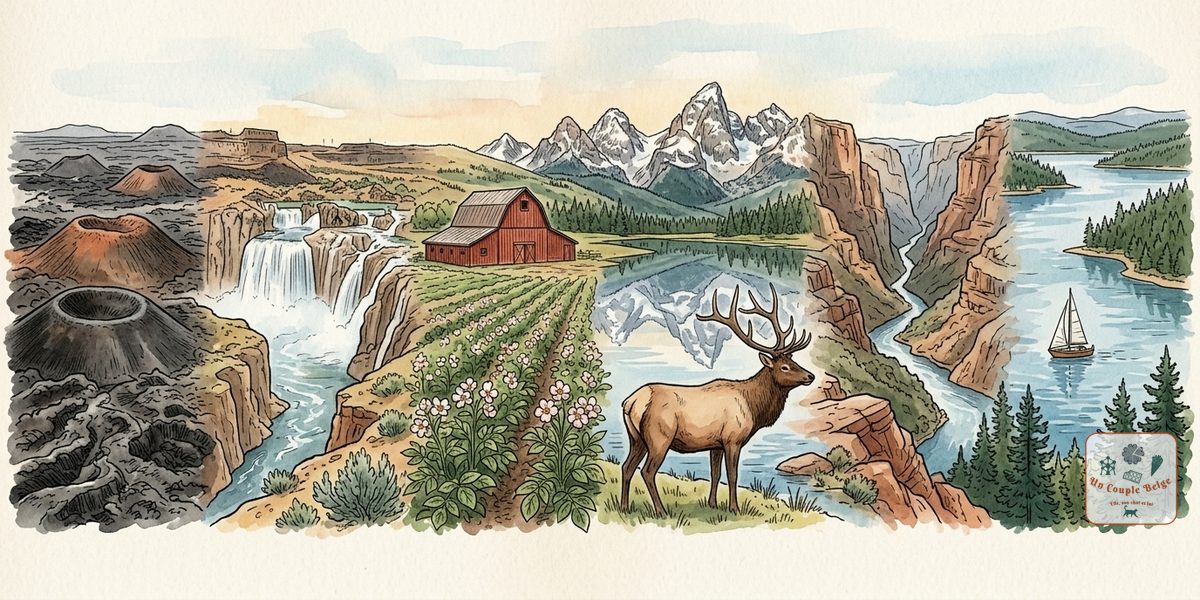
Everyone knows Idaho’s potato, and not much else. This big state set between Oregon, Montana and Wyoming remains one of the least known in the West. Yet Idaho lines up peaks worthy of the Alps, the deepest canyon in North America, a lava field where the Apollo astronauts trained, falls higher than Niagara and more hot springs than you could visit in a lifetime.
It’s a rural, mountainous state, where nature takes up all the room. Larger than Portugal, it has barely 2 million inhabitants, and a large part of its centre isn’t crossed by any road. A trip here means accepting long roads with no petrol station, and that’s precisely its charm.
Idaho at a glance
- Capital and largest city: Boise
- Population: about 2 million
- Area: about 216,000 km², roughly seven times Belgium
- Joined the Union: 1890, 43rd state
- Time zone: Mountain Time in the south (8 hours behind Brussels), Pacific Time in the north (9 hours behind)
- Nickname: The Gem State
- Highest point: Borah Peak, 3,859 metres
Geography: a state in three pieces
The north, nicknamed the “Panhandle”, is a narrow strip of forests and deep lakes (Coeur d’Alene, Pend Oreille), turned more towards Spokane, in Washington State, than towards Boise.
The centre is an immense mountain mass, the Idaho Rockies, with the Sawtooths, the Salmon River and the Frank Church-River of No Return Wilderness, the largest single wilderness area in the 48 contiguous states. No road crosses it.
The south follows the Snake River Plain, a great irrigated agricultural arc where the famous potatoes grow, between fields of volcanic lava. This is where most of the inhabitants live, from Boise to Idaho Falls by way of Twin Falls.
The practical consequence: north and south are so poorly linked by road that it’s often quicker to go through Washington State or Oregon to get from one to the other.
A bit of history
The Shoshone, the Bannock and the Nez Perce have lived in the region for thousands of years. The Lewis and Clark expedition crossed the northern mountains in 1805, guided by Sacagawea, a Shoshone woman born in the region, and saved from starvation by the Nez Perce. In the mid-19th century, the Oregon Trail crossed southern Idaho, then the gold and silver rush of the 1860s gave rise to mining towns.
In 1877, Chief Joseph’s Nez Perce, refusing to be confined to a reservation, fled the army for nearly 2,000 kilometres before surrendering near the Canadian border. Idaho became a state in 1890. In the 20th century, irrigation turned the southern desert into farmland, and Sun Valley invented American-style recreational skiing. For the past ten years or so, Boise has been among the fastest-growing cities in the country.
The must-sees
Boise
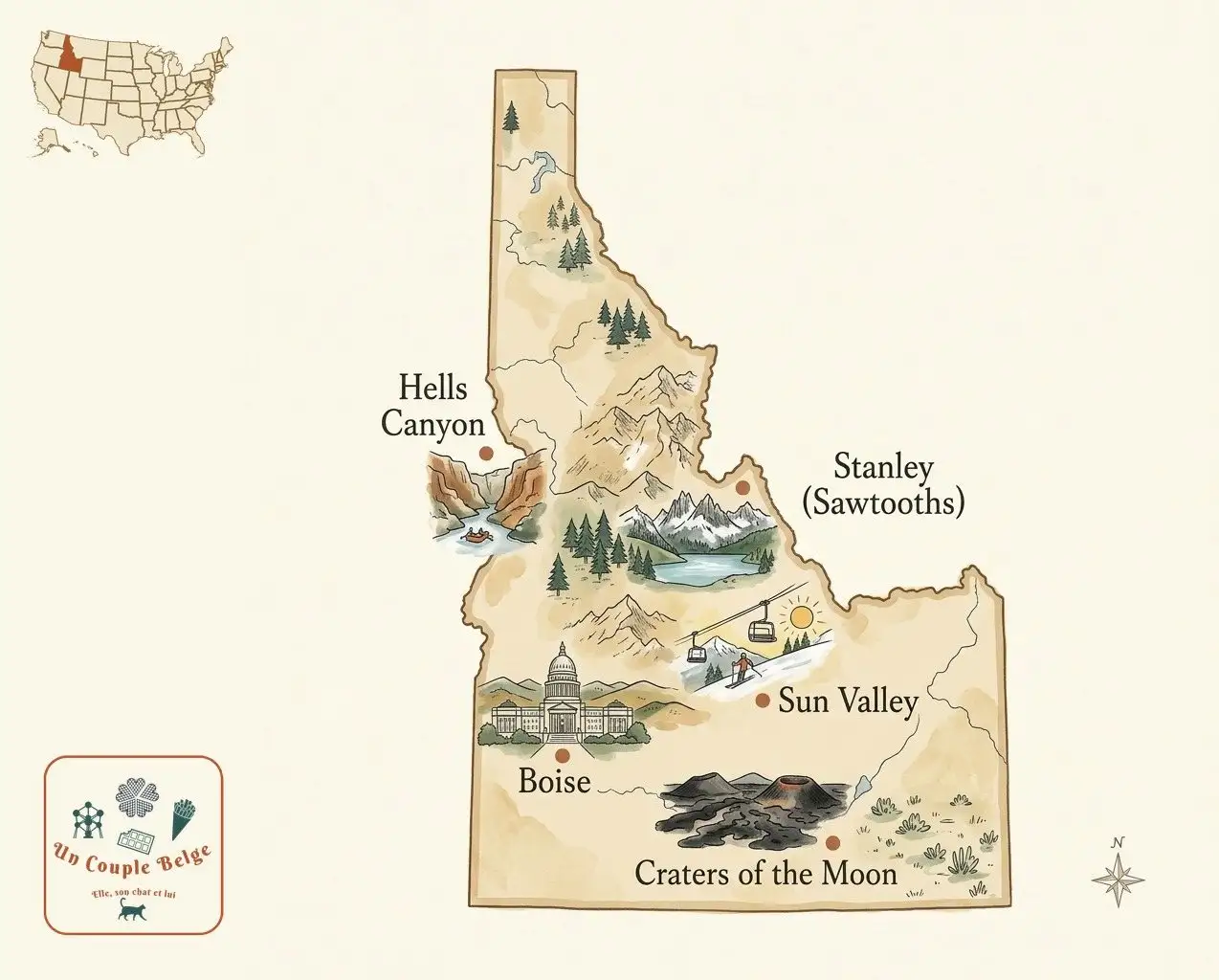
Boise is a surprise. Its city centre is lively and pleasant, the Boise River is lined with a green path nearly 40 kilometres long (the Greenbelt), and in summer the locals float down the river on tubes from Barber Park.
Above all, the city is home to one of the largest Basque communities in the United States, the legacy of shepherds who came from the Pyrenees at the end of the 19th century. On the Basque Block, right in the centre, you’ll find a museum, a pelota court and pintxos bars. Every five years, the Jaialdi festival draws thousands of visitors. North of the city, the Boise Foothills offer kilometres of hiking and mountain-bike trails.
Craters of the Moon
In the south-centre, Craters of the Moon is an immense field of black lava flows, a few thousand years old. The landscape is so strange that the Apollo astronauts came here in 1969 to study volcanic geology before going to the Moon. A loop road leads to cinder cones you can climb in a few minutes and to lava tubes you explore by headlamp (a free permit is required from the visitor centre). There’s almost no shade: carry plenty of water.
The Sawtooths and Stanley
If Idaho has a postcard landscape, this is it: a range of jagged peaks above 3,000 metres, surrounding hundreds of alpine lakes. The village of Stanley, around a hundred inhabitants, is one of the coldest places in the 48 contiguous states in winter, and the ideal base in summer. Redfish Lake, at the foot of the mountains, is perfect for swimming, paddleboarding or setting off on a hike. The Sawtooth Scenic Byway between Ketchum and Stanley, over Galena Summit, is one of the finest in the state. On the road to Boise, several hot springs beside the Payette or Salmon rivers are free to use.
Sun Valley and Ketchum
Sun Valley was the first major recreational ski resort in the United States, created in 1936 by the Union Pacific railroad, which installed the world’s first chairlifts there. Hollywood stars got into the habit of coming to ski. Ernest Hemingway spent his last years in Ketchum, the neighbouring town, and is buried there. In summer, people come for the mountain biking and hiking.
Hells Canyon
On the Oregon border, the Snake River has carved Hells Canyon, the deepest canyon in North America, more than 2,400 metres in places, deeper than the Grand Canyon. Very few roads go down into it: you discover it by jet boat or raft from Lewiston or Riggins, or from the viewpoints of the Hells Canyon Scenic Byway. Riggins, on the Salmon River, is also the state’s rafting capital.
Twin Falls and the Magic Valley
In Twin Falls, Shoshone Falls, nicknamed “the Niagara of the West”, are higher than Niagara Falls (65 metres). They’re spectacular in spring, and sometimes almost dry by late summer, when the water is diverted for irrigation. Right nearby, the Perrine Bridge spans the Snake River Canyon at a height of 150 metres. It’s one of the few places in the world where parachuting from a bridge (BASE jumping) is allowed all year round, without a permit.
Further on, Bruneau Dunes has the tallest single-structured sand dune in North America, nearly 150 metres, and City of Rocks, near the Utah border, is a renowned climbing area, with rocks on which the pioneers of the California Trail carved their names.
The north: lakes and forests
Lake Coeur d’Alene is one of the most beautiful lakes in the West, with a town that’s lively in summer and a famous floating golf green. Further north, Sandpoint, on the shore of immense Lake Pend Oreille, is a very pleasant little mountain town. The lake is so deep that the US Navy tests its submarines there.
To the east, in the Silver Valley, which has produced an enormous quantity of silver, the village of Wallace has every one of its buildings listed on the National Register of Historic Places and proclaims itself, with humour, the “Center of the Universe”. You can visit a former mine there. Right nearby, the Route of the Hiawatha is a cycle trail on an old railway line, with spectacular tunnels and trestles, downhill almost all the way.
Yellowstone on the Idaho side
A very small part of Yellowstone spills over into Idaho, and the east of the state is a convenient gateway to the park and to Grand Teton, from Idaho Falls or Driggs. The Island Park area is renowned for fly fishing.
Itinerary ideas
One week, the south and the mountains. Boise (1-2 days) → Twin Falls and Shoshone Falls → Craters of the Moon → Sun Valley and Ketchum → Stanley and the Sawtooths (2 days) → back to Boise through the Payette valley and its hot springs. About 1,000 kilometres.
With Yellowstone. Many travellers cross southern Idaho between Yellowstone and Oregon or Salt Lake City: Craters of the Moon, Sun Valley and the Sawtooths make perfect stops.
The north. From Spokane: Coeur d’Alene → Wallace and the Route of the Hiawatha → Sandpoint, in 3-4 days.
On the plate
- Potatoes, obviously: Idaho produces about a third of America’s potatoes, and “Idaho potatoes” is a protected name. The Idaho Potato Museum in Blackfoot offers a free potato snack to visitors from out of state.
- Finger steaks, strips of beef battered and fried, invented in Boise in the 1950s.
- Fry sauce, a mix of ketchup and mayonnaise for dipping your fries, common to Idaho and Utah.
- Huckleberries, small wild berries that turn up everywhere in summer: jams, milkshakes, ice cream, beers.
- Trout: Idaho is the country’s leading producer of farmed trout, around Hagerman.
- Boise’s Basque cooking: chorizo, croquetas, lamb.
- And the Idaho Spud, a chocolate bar with marshmallow and coconut shaped like… a potato.
Culture and trivia
- The name “Idaho” was made up. In the 1860s, a lobbyist presented it to Congress as a Shoshone word meaning “gem of the mountains”. It was false. Congress nearly gave the name to Colorado before discovering the hoax, then recycled it for this new territory.
- Napoleon Dynamite 🎬, the 2004 cult film, was shot in Preston, in the south-east.
- Sacagawea, the guide of the Lewis and Clark expedition, was born in Idaho. An interpretive centre is devoted to her in Salmon.
- Idaho is said to have more usable hot springs than any other state: from simple pools beside rivers to developed swimming pools.
- The first nuclear reactor to generate electricity did so in 1951 near Arco, in the Idaho desert. It can be visited in summer.
When to go
- Summer (July-August): the best time for the mountains, the lakes and the Sawtooths, whose trails often stay snow-covered until late June. It’s hot in Boise and at Craters of the Moon.
- Spring (May-June): perfect for Shoshone Falls and rafting, with rivers swollen by snowmelt.
- Autumn (September-October): autumn colours, fewer people and ideal temperatures. The first snow falls at altitude from October.
- Winter (December to March): for skiing at Sun Valley, Schweitzer (near Sandpoint) or Tamarack, and for hot springs in the snow. Many mountain roads are difficult.
Practical information
- Recommended length of stay: one week for the south and the Sawtooths, ten days to add the north or Yellowstone.
- Getting there: Boise airport is served by connecting flights. Salt Lake City (Utah) and Spokane (Washington) are often more convenient or cheaper.
- Getting around: a car is essential. Distances are long and mountain roads slow.
- Budget: fairly affordable for the American West, except in Sun Valley and Coeur d’Alene in high season.
- Things to watch out for: the mobile signal disappears in the valleys, so download your maps for offline use. Fill up as soon as the tank drops below half. In the forests, bear in mind the presence of black bears and, in the north, grizzlies.
- One more tip: at Craters of the Moon, visit the lava tubes early in the morning, take a headlamp and more water than you think you’ll need.
Our place guides in Idaho
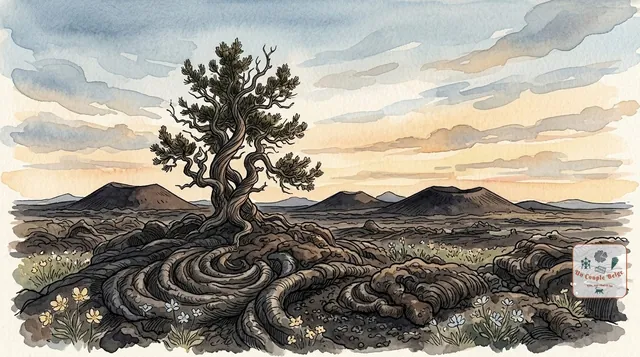
Craters of the Moon: an ocean of black lava in Idaho
Frozen lava flows as far as the eye can see, black cinder cones and tunnels to explore by torchlight. The landscape where the Apollo astronauts came to train.
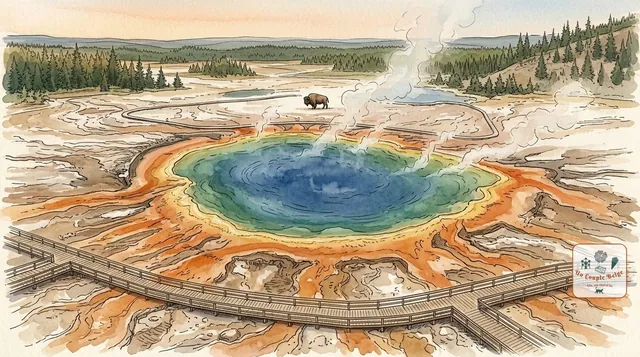
Yellowstone: geysers, bison and springs of every colour
The world's first national park, sitting on a volcano: geysers, multicoloured hot springs, a yellow canyon and bison in the middle of the road.