Wyoming: Yellowstone, Grand Teton and the cowboy West
Updated on
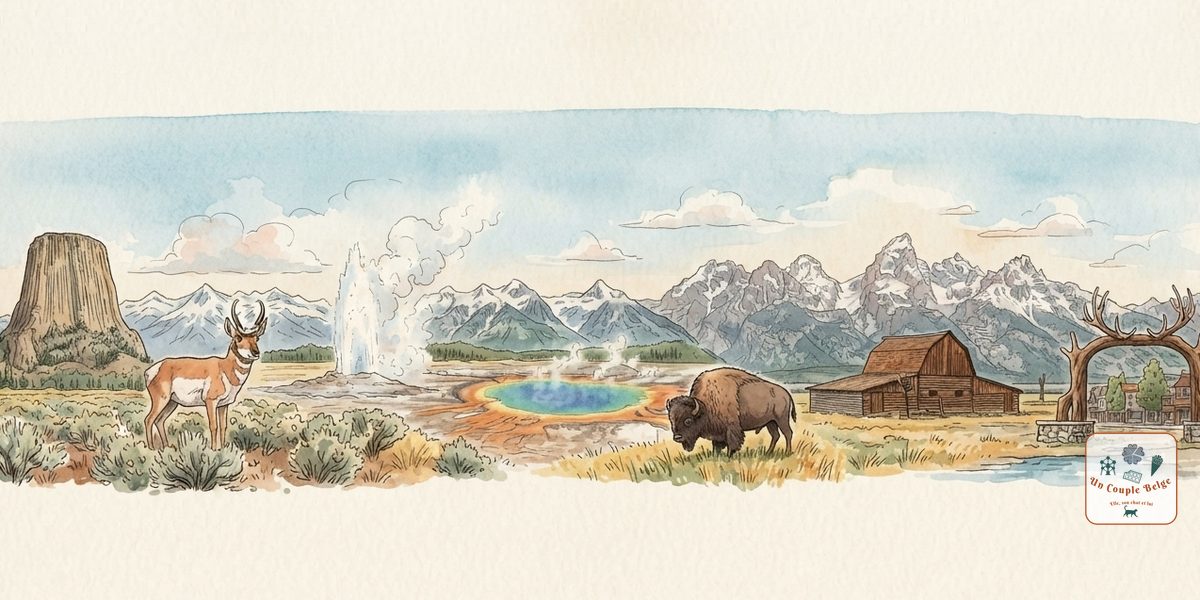
Wyoming is the least populated state in the United States: fewer than 600,000 inhabitants for a territory bigger than the United Kingdom. You sometimes drive for an hour without passing a house, pronghorn outnumber cars, and the most populous city, the capital Cheyenne, has barely 65,000 inhabitants. This is the cowboy West in its most authentic version, with ranches, rodeos and Stetson hats that aren’t fancy dress.
It’s also the state that invented the very idea of a national park. Yellowstone, created in 1872, was the first national park in the world, and it remains one of the most extraordinary places on the planet, with its geysers, its coloured springs and its safari-worthy wildlife. Just to the south, the peaks of Grand Teton form one of the most beautiful mountain ranges in America. Between them they justify the trip, but the rest of the state deserves more than just driving through.
Wyoming at a glance
- Capital and largest city: Cheyenne
- Population: about 590,000, the least populous state in the country
- Area: about 253,300 km², a little over eight times Belgium
- Joined the Union: 1890, 44th state
- Time zone: Mountain Time (8 hours behind Brussels)
- Nicknames: Equality State and Cowboy State
- Highest point: Gannett Peak, 4,209 metres, in the Wind River Range
Geography: from the Rockies to the Great Plains
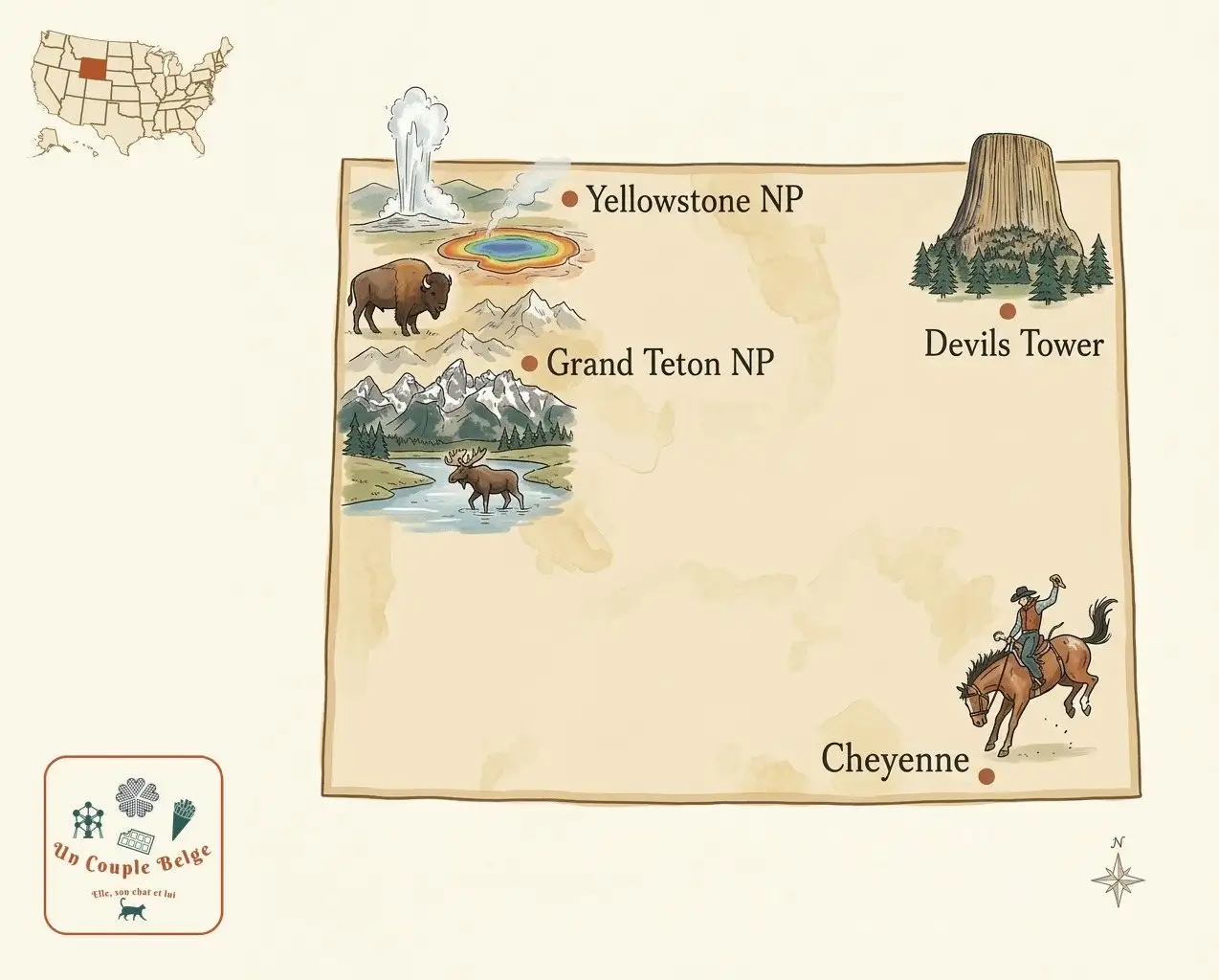
The north-west is postcard Wyoming: the volcanic plateau of Yellowstone, the Teton Range and the valley of Jackson Hole.
The Rockies cross the state in several separate ranges: the Wind River Range, the highest and wildest, the Bighorn Mountains in the north, and the Snowy Range and Laramie Mountains in the south-east.
The basins between the mountains, such as the Great Divide Basin, are high, dry plateaus covered in sagebrush, home to pronghorn and wild horses.
The east belongs to the Great Plains, with prairies, ranches, coal mines and, in the north-east, Devils Tower.
A bit of history
The Shoshone, the Arapaho, the Crow, the Cheyenne and the Lakota lived on these plains and in these mountains. At the beginning of the 19th century, trappers, the “mountain men”, hunted beaver here. Then hundreds of thousands of emigrants crossed the region on the Oregon Trail, whose ruts are still visible in places. In 1867, the Union Pacific railroad brought Cheyenne into being within a few months.
In 1869, Wyoming Territory was the first in the world to give women the right to vote and to hold office, hence its nickname “Equality State”. It became a state in 1890, and in 1925 Nellie Tayloe Ross became the first woman governor in the United States. This was the era of the big cattle ranches, range wars and outlaws like Butch Cassidy. In the 20th century, oil, gas and above all coal became the pillars of the economy: the Powder River Basin supplies a large share of America’s coal. Tourism, centred on Yellowstone, is the other great resource.
The must-sees
Yellowstone
Yellowstone National Park, created in 1872, sits on one of the largest active volcanoes on the planet. It holds more than half the world’s geysers, and thousands of hot springs, mud pots and fumaroles. Old Faithful erupts about every 90 minutes, with a regularity that made it famous. Grand Prismatic Spring, the largest hot spring in the country, is ringed with bands of orange, yellow and green, best seen from above on the Fairy Falls trail.
The Grand Canyon of the Yellowstone, with its yellow walls and its 94-metre waterfall, the Lower Falls, is another highlight, as are Yellowstone Lake and the travertine terraces of Mammoth Hot Springs. And then there’s the wildlife: in the Hayden and Lamar valleys, you can watch bison, elk, bears and, with binoculars and patience, wolves, especially at dawn. The Grand Loop Road, a loop of about 230 kilometres, links the main sites: allow at least two or three days.
Grand Teton and Jackson Hole
Just to the south, Grand Teton National Park offers spectacular relief: a range of jagged peaks, including the Grand Teton at 4,199 metres, bursting out of the plain with no foothills at all. It’s the result of an active fault that lifts the mountains and drops the valley. Jenny Lake, where you can cross by boat to climb to Inspiration Point, the barns of Mormon Row with the Tetons in the background, and the view from Oxbow Bend or Schwabacher Landing at sunrise are classics. Moose and bison are often seen, and sometimes bears.
The valley at the foot of the Tetons is called Jackson Hole. The small town of Jackson has kept a western look, with its wooden boardwalks and the four elk-antler arches on its central square, but it’s also one of the wealthiest places in the country, with galleries, smart restaurants and a big ski resort. In winter, the National Elk Refuge takes in thousands of elk, which you can watch from a horse-drawn sleigh.
Cody and Buffalo Bill
East of Yellowstone, Cody was founded by Buffalo Bill Cody himself, the scout turned showman, whose “Wild West Show” toured the world, as far as Europe. The Buffalo Bill Center of the West is an excellent complex of five museums on the West, Native American cultures, firearms and nature. In summer, the Cody Nite Rodeo takes place every evening. The road between Cody and Yellowstone’s east entrance, through the Wapiti Valley, is magnificent.
Devils Tower
In the north-east, isolated in the middle of the plains, Devils Tower is an enormous column of volcanic rock, grooved with vertical columns, about 265 metres high from its base. In 1906, President Theodore Roosevelt made it the very first national monument in the United States. It was made famous by Steven Spielberg’s film Close Encounters of the Third Kind 🎬. The trail around it is easy. For many Native American peoples, it’s a sacred place, known among other names as “Bear Lodge”: its current name is said to come from a mistranslation in the 19th century. Out of respect, climbers are asked not to climb it in June, a month of ceremonies.
Cheyenne
Cheyenne, the capital, owes its existence to the railway. Every late July, Cheyenne Frontier Days is the largest outdoor rodeo in the world, with concerts and parades. The rest of the year, you can visit the restored State Capitol and the rodeo museum. Close by, the granite rocks of Vedauwoo are a playground for climbers.
And more…
- The Wind River Range, one of the most beautiful mountain ranges in the United States, for experienced hikers, with hundreds of high lakes. Pinedale and Lander are its gateways.
- The Beartooth Highway, which links Yellowstone’s north-east entrance to Montana over a pass at more than 3,300 metres.
- The Bighorn Scenic Byway and the mysterious Medicine Wheel, a sacred Native American stone wheel perched at nearly 3,000 metres.
- Thermopolis and Hot Springs State Park, where you can bathe for free in a hot spring.
- Independence Rock, a big granite rock on which the emigrants of the Oregon Trail carved their names.
- Fossil Butte National Monument, rich in fossil fish, and the red-cliffed Flaming Gorge Reservoir, on the Utah border.
- The Wind River Reservation, shared by the Eastern Shoshone and the Northern Arapaho, where, according to local tradition, Sacagawea, the Shoshone guide of the Lewis and Clark expedition, is buried.
Itinerary ideas
One week, the two parks. Jackson (1 day) → Grand Teton (2 days) → Yellowstone (3-4 days) → out via Cody (1 day).
10-14 days, greater Wyoming. Denver (Colorado) → Cheyenne → Devils Tower → Bighorn Mountains → Cody → Yellowstone (3 days) → Grand Teton (2 days) → Wind River Range → back to Salt Lake City or Denver.
In combination. Wyoming combines with Montana (Glacier and the Beartooth Highway), Idaho, South Dakota (Mount Rushmore is 2 hours from Devils Tower) or Utah.
On the plate
- Bison and elk, as a burger, a steak or a sausage, almost everywhere.
- Rocky Mountain oysters, which aren’t oysters but breaded and fried bull testicles, for the curious.
- Chicken-fried steak, a breaded steak served with a peppery white gravy, a diner classic.
- Huckleberries, wild mountain berries, in jam, ice cream or pie.
- Wyoming Whiskey, distilled in Kirby, and the craft beers of Jackson.
- Beef steak from the local ranches, often excellent.
Culture and trivia
- The cowboy on his bucking horse, the “Bucking Horse and Rider”, has appeared on the licence plates for nearly a century.
- There are more pronghorn than people in Wyoming, according to estimates.
- The coal trains of the Powder River are among the longest in the world, with more than 100 cars.
- Wyoming has no income tax and has two senators, like California, for 67 times fewer inhabitants.
- Butch Cassidy and his gang, the “Wild Bunch”, hid out in a Wyoming canyon, the Hole-in-the-Wall.
When to go
- Summer (June to August): high season, with all the roads open in Yellowstone and Grand Teton. Very busy: set off early in the morning. Frequent afternoon thunderstorms in the mountains.
- Late May-early June: baby bison, green grass and swollen waterfalls, with fewer people. Some roads may still be closed by snow.
- September: one of the best times, with the elk rut, golden aspens and thinning crowds. Nights are cold.
- Winter (December to March): Yellowstone can be reached by snowmobile or snowcoach, and Jackson Hole is a big ski resort. Most of the park’s roads are closed.
Practical information
- Recommended length of stay: one week at least for Yellowstone and Grand Teton, 10 to 14 days for the rest of the state.
- Getting there: Jackson airport is the only one located inside a national park, served by connecting flights. Salt Lake City (5 hours from Jackson), Bozeman (Montana, 1 hr 30 from Yellowstone’s north entrance) and Denver (for the east of the state) are often more convenient.
- Getting around: a car is essential. Fill up whenever you can: petrol stations are sometimes more than 100 kilometres apart.
- Budget: high in Jackson and in the Yellowstone lodges, more reasonable elsewhere. Since 2026, the America the Beautiful pass has cost foreign visitors 250 dollars, but Yellowstone and Grand Teton charge a 100-dollar surcharge per person without it: for two people, it pays for itself at the first park. See our guide to the national parks pass.
- Things to watch out for: never approach bison (at least 25 metres) or bears (at least 100 metres), and carry bear spray when hiking. In Yellowstone, always stay on the boardwalks: the water in the springs is boiling and the ground can give way.
- One more tip: book the lodges and campsites in Yellowstone and Grand Teton as soon as reservations open, often more than a year ahead for summer.
Our place guides in Wyoming
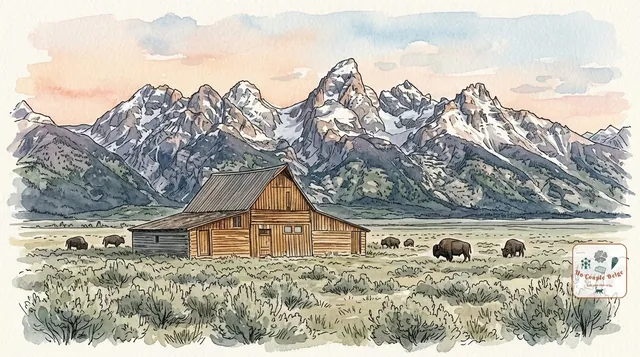
Grand Teton: sheer peaks above the lakes and the plain
A range of jagged peaks rising abruptly above a flat valley, with glacial lakes at its feet. Yellowstone's neighbour, smaller and more alpine.
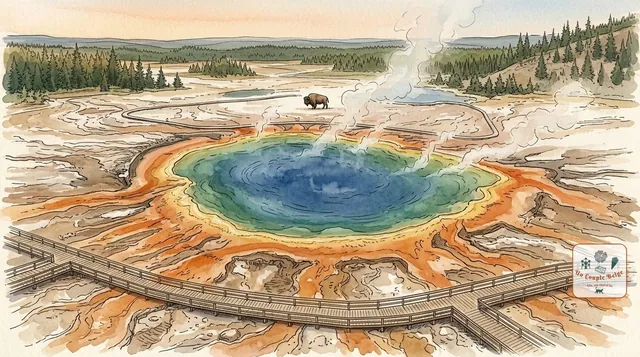
Yellowstone: geysers, bison and springs of every colour
The world's first national park, sitting on a volcano: geysers, multicoloured hot springs, a yellow canyon and bison in the middle of the road.