Survival English for a trip to the United States
Updated on
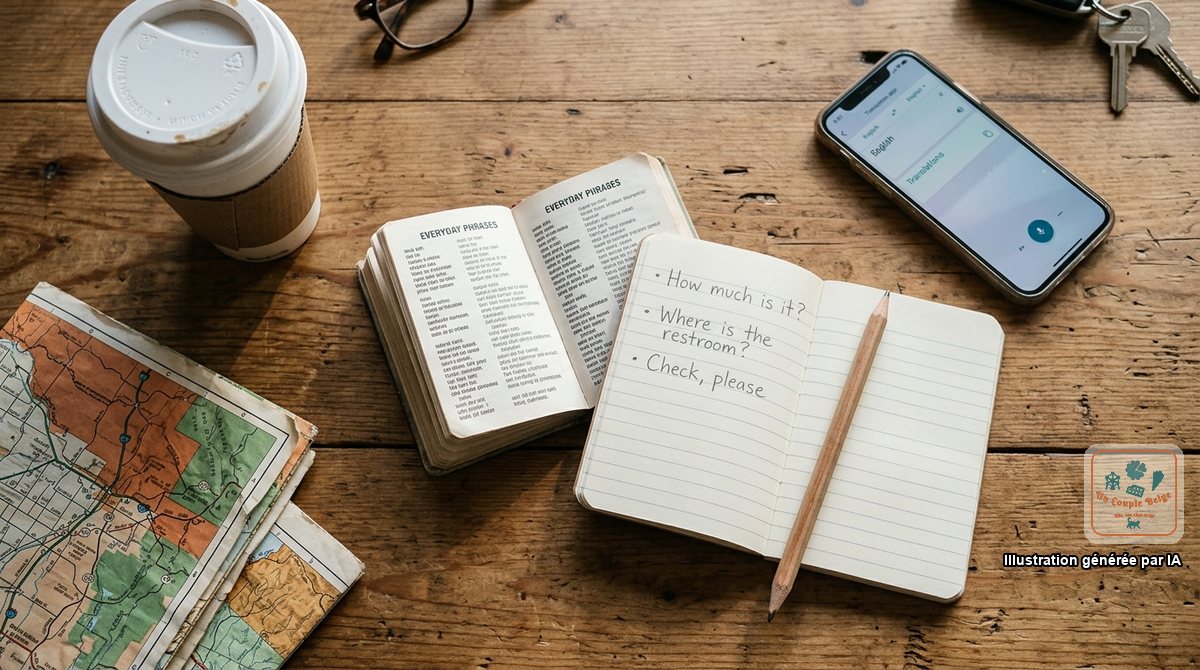
You don’t need to speak fluent English to do a road trip in the United States. Americans are patient, used to accents, and delighted that you’re making the effort.
What throws you is less the phrases you prepare than the questions you’re asked, quickly and with words you didn’t learn at school. Here are the ones that come up all the time.
To practise, we also have a survival English game. And for everyday expressions, abbreviations and notices, see American English decoded.
Everyday expressions
| What you hear | What it means | What you answer |
|---|---|---|
| Hi, how are you? / How’s it going? | Hello (it isn’t a real question) | Good, thanks! And you? |
| What can I get you? | What would you like? | Can I have… please? |
| Is that all? / Anything else? | Will that be everything? | That’s all, thank you. |
| Have a good one! | Have a nice day | You too! |
| You’re all set. | That’s it, everything is sorted | Thank you! |
| My pleasure / You bet / No problem | You’re welcome |
Three phrases that save the day
- Sorry, could you speak more slowly, please?
- Could you repeat that?
- I’m sorry, my English is not very good.
At immigration
The questions are always the same (see our guide).
| The officer’s question | What it’s about | Typical answer (example) |
|---|---|---|
| What’s the purpose of your trip? | The reason for your trip | Vacation. / Tourism. |
| How long are you staying? | The length of your stay | Three weeks. |
| Where are you staying? | Your accommodation | In hotels. We’re doing a road trip. First night in Los Angeles. |
| What do you do for a living? | Your job | I’m a teacher. |
| Are you traveling together? | Whether you’re in the same party | Yes, we are. |
| Do you have anything to declare? | Goods to declare at customs | No, nothing. |
Keep your answers short, and don’t joke.
At the car rental desk
- I have a reservation under the name…
- Is the insurance included?
- I don’t need any extra coverage, thank you.
- Is there unlimited mileage?
- I’d like to add a second driver.
- Should I return it with a full tank?
- There’s a scratch here. Can you note it?
You’ll be offered: an upgrade (a higher category, at a charge), prepaid fuel (a tank paid for in advance), roadside assistance (breakdown cover), a toll pass (a transponder for toll roads). No, thank you is enough. The details are in renting a car.
At the hotel
- We have a reservation for two nights.
- Is breakfast included? What time is it served?
- Could we have a room on a higher floor?
- What time is check-out?
- Can we leave our luggage here?
- The air conditioning doesn’t work.
- Is there a guest laundry?
- Where is the ice machine?
You’ll be asked: Can I see your ID and a credit card? (an identity document and a credit card) and How many keys?
At the restaurant
| What you hear | What it means |
|---|---|
| How many? / Table for two? | How many people are you? |
| Can I get you started with some drinks? | What would you like to drink? |
| Are you ready to order? | Have you chosen? |
| How would you like that cooked? | Rare, medium or well done? |
| What kind of dressing? | Which sauce for the salad? |
| How is everything? | Is everything all right? |
| Did you save room for dessert? | Would you like a dessert? |
| Can I take that out of your way? | May I clear your plate? |
| For here or to go? | Eat in or take away? |
Your turn
- Just water, please.
- I’ll have the…
- Medium rare, please.
- Can I have the dressing on the side? (the sauce served separately)
- I’m allergic to nuts.
- Could we have the check, please? (the bill)
- Can we get a box? (a box to take the leftovers away)
- Separate checks, please. (one bill each)
More vocabulary in eating at restaurants.
At the petrol station and on the road
- Forty dollars on pump six, please.
- Fill it up on pump six.
- Where’s the restroom?
- Is this the right way to…?
- How far is it?
Road signs
| Sign | Meaning |
|---|---|
| Yield | Give way |
| Detour | Diversion |
| Road work ahead | Roadworks |
| Exit only | This lane must leave the road |
| No outlet / Dead end | No through road |
| Ped Xing | Pedestrian crossing |
| Speed limit | Maximum speed |
| Do not pass | No overtaking |
| Merge | Lanes joining |
| Toll | Toll road |
In the parks
- Do you have a park map?
- Which trail would you recommend for two hours?
- Is the road open?
- Where can I refill my water bottle?
- Is there cell service? (is there phone signal?)
The words to know: trailhead (start of a trail), overlook (viewpoint), restroom (toilets), shuttle (shuttle bus), ranger (park warden), campground (campsite), closed, flash flood (a sudden flood).
In shops
- I’m just looking, thanks.
- Do you have this in a medium?
- Where are the fitting rooms?
- Can I pay by card?
- Can I get a store card?
At the till: Debit or credit? (answer credit), Do you need a bag?, Would you like your receipt?
When something goes wrong
- I need help.
- Call 911, please.
- I need a doctor. / Where is the nearest urgent care?
- I lost my passport.
- My car broke down. / I have a flat tire.
- Someone broke into my car.
- I’d like to file a police report.
- It hurts here.
False friends
Words that don’t mean what a French speaker, or a speaker of British English, might expect.
| American word | What it means |
|---|---|
| Entrée | Main course |
| Chips | Crisps (chips are fries) |
| Biscuit | A soft, savoury bread roll |
| First floor | Ground floor |
| Gas | Petrol |
| Restroom | Toilets |
| Check | Bill |
| Pants | Trousers |
| Football | American football (ours is called soccer) |
| Billion | A thousand million |
Spelling and giving a number
You’ll often be asked to spell your name: practise saying it in English letters. The letters that catch French speakers out: E is pronounced “ee”, I “eye”, G “jee”, J “jay”, A “ay”, R “ar”, Y “why”.
Phone numbers are said digit by digit, and zero is often said oh.