American English decoded: phrases, abbreviations and signs
Updated on
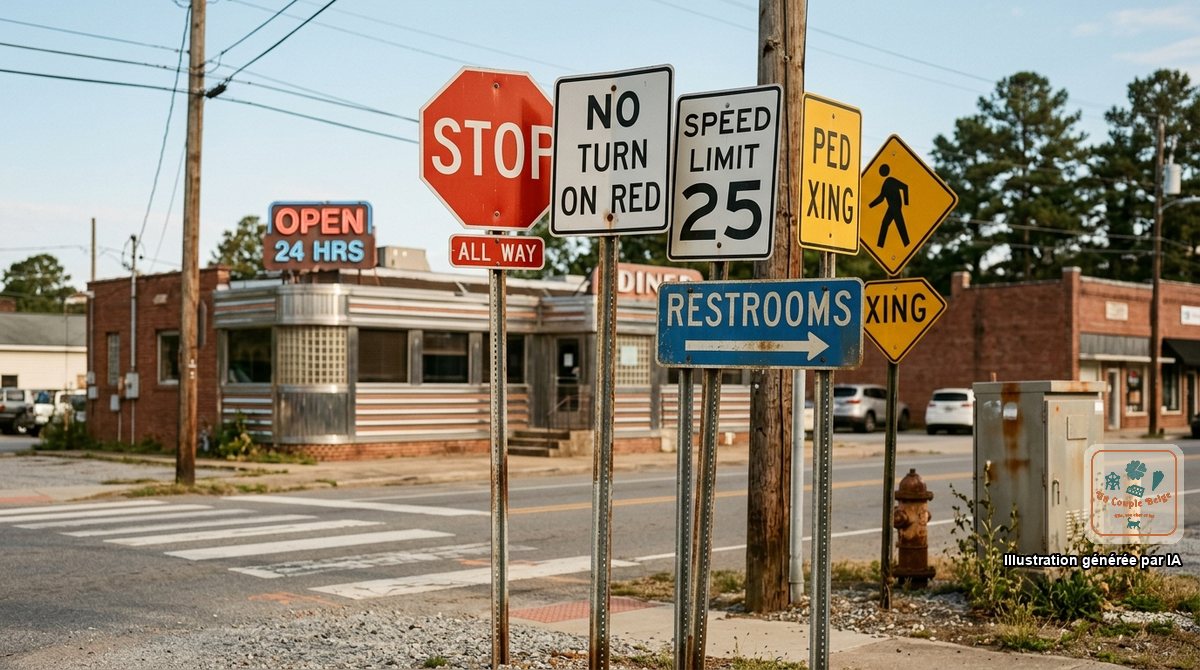
You can speak perfectly good English and still be lost for words when a cashier asks “Did you find everything okay?”.
The English spoken in the United States is fast, full of shortcuts and abbreviations, and often uses a different word from the one you learned. None of it is difficult, as long as you’ve seen it once before leaving.
This guide goes with survival English, which gives the phrases to say in each situation. Here we deal with the other half: what you’re going to hear and read.
The small phrases that don’t mean what you’d think
| What you hear | What it means |
|---|---|
| I’m good. | No, thank you |
| You’re good. | No problem, it’s nothing |
| Go ahead. | After you, please do |
| Here you go. / There you go. | Here it is / There it is |
| Sounds good. | Fine by me |
| Gotcha. | Understood |
| Hang on. / Bear with me. | One moment |
| Take your time. | There’s no rush |
| My bad. | My mistake |
| No worries. | It doesn’t matter |
| What’s up? | Hello (no answer expected) |
| I’ll be right with you. | I’ll be with you in a moment |
| Bless you! | Said after a sneeze |
For the hidden meaning of How are you? and the habits of conversation, see American manners.
At the till and at the counter
The questions come quickly, always in the same order.
| What you hear | What it means | What you answer |
|---|---|---|
| I can help whoever’s next. | Next, please | You step forward |
| Are you in line? | Are you queuing? | Yes. / No, go ahead. |
| Did you find everything okay? | Did you find what you needed? | Yes, thank you. |
| Do you have a rewards card? | Do you have the loyalty card? | No, I don’t. |
| Can I get your phone number? | Your number (for the loyalty account) | I don’t have one, sorry. |
| Would you like to round up for…? | Round up to the next dollar for a charity? | Sure. / Not today, thanks. |
| Cash back? | Would you like to withdraw cash? | No, thanks. |
| Can I get a name for the order? | A first name for the order | A short one will do |
At the restaurant: what the server says
| What you hear | What it means |
|---|---|
| I’ll be your server today. | I’m looking after your table |
| Soup or salad? | Soup or salad (it often sounds like “super salad”) |
| Is Pepsi okay? | We don’t have Coke, will Pepsi do? |
| Can I top that off? | Shall I refill that? |
| Are you still working on that? | Haven’t you finished? |
| How are we doing over here? | Is everything all right? |
| Whenever you’re ready. | No rush (said while putting down the bill) |
| Do you need change? | Shall I bring you your change? |
On a menu, à la mode means “served with a scoop of ice cream”, on the side “served separately”, combo “a meal with a drink and a side”. The rest of the vocabulary is in eating at restaurants.
At the bar
- On tap / draft: draught.
- Neat: no ice, nothing added. On the rocks: with ice.
- Do you want to open a tab?: they keep your card and you pay at the end.
- Close it out?: shall we settle up?
- It’s on the house.: it’s free, courtesy of the place.
- Last call!: last orders.
The words that change across the Atlantic
If you learned British English, you’ll be understood, but you’ll be answered with the other word.
| British English | In the United States |
|---|---|
| toilet | restroom, bathroom |
| lift | elevator |
| petrol | gas |
| motorway | highway, freeway, interstate |
| car park | parking lot |
| boot (of a car) | trunk |
| queue | line |
| holiday | vacation |
| bill (at a restaurant) | check |
| takeaway | to go, takeout |
| crisps | chips |
| chips | fries |
| sweets | candy |
| biscuit | cookie |
| autumn | fall |
| rubbish | trash, garbage |
| mobile phone | cell phone |
| chemist | pharmacy, drugstore |
| torch | flashlight |
| return ticket | round trip |
| postcode | zip code |
| ground floor | first floor |
| pavement | sidewalk |
Watch the last one: on an American road sign, pavement means the road surface. Pavement ends announces the end of the tarmac, not of the footpath.
Money
- A buck: a dollar. Ten bucks: ten dollars.
- A grand: a thousand dollars.
- A bill: a banknote. A twenty: a twenty-dollar note.
- Penny (1 cent), nickel (5 cents), dime (10 cents), quarter (25 cents). The 10-cent coin is smaller than the 5-cent one, which catches everybody out.
- Can you break a twenty?: Can you change a twenty for me?
- Keep the change.
- Plus tax: the price shown excludes sales tax, which is added at the till.
Quarters are still needed for launderettes and some parking meters: keep a few.
Abbreviations
On labels, menus and receipts
| Abbreviation | Meaning |
|---|---|
| w/ and w/o | with and without |
| ea | each |
| lb, oz | pound (454 g), ounce (28 g) |
| doz | dozen |
| BOGO | buy one, get one (free) |
| AYCE | all you can eat |
| BYOB | bring your own bottle |
| ID | proof of identity |
| ATM | cash machine |
| A/C | air conditioning |
| N/A | not applicable, not available |
| RV | motorhome |
| EV | electric vehicle |
Conversions are set out in miles, Fahrenheit, gallons and sizes.
Dates and times
The date is written month, day, year: 10/03/2026 is 3 October, not 10 March. Times use the twelve-hour clock: 12 a.m. is midnight and 12 p.m. is midday. To avoid any doubt, Americans often write noon and midnight.
Addresses and roads
St (street), Ave (avenue), Blvd (boulevard), Rd (road), Dr (drive), Ln (lane), Pkwy (parkway), Hwy (highway), Fwy (freeway), Jct (junction), Apt (apartment, a flat), Ste (suite, an office). I-15 is an interstate motorway, US-89 a federal highway.
The road signs you can’t guess
American road signs are written out in words, often abbreviated. The most common ones (Yield, Detour, Merge…) are already in survival English. Here are the others.
| Sign | Meaning |
|---|---|
| crossing: Deer Xing (deer), RR Xing (level crossing) | |
| Thru traffic | Through traffic |
| No turn on red | No turning right at a red light |
| Left turn yield on green | On green, give way to oncoming traffic before turning left |
| Right lane must turn right | The right-hand lane has to turn |
| HOV / Carpool | Lane reserved for vehicles with passengers |
| Slower traffic keep right | Slow vehicles keep to the right |
| Turnout / Pullout | Lay-by to stop or to let others pass |
| Scenic overlook / Vista point | Viewpoint with parking |
| Rest area | Rest stop with toilets |
| Gas – Food – Lodging | Fuel, food and accommodation at the next exit |
| Next services 80 miles | Nothing for the next 130 km |
| Soft shoulder | Soft verge |
| Dip / Bump | Dip / Hump in the road |
| Loose gravel | Loose chippings |
| Open range | Livestock roaming free on the road |
| Cattle guard | Cattle grid |
| Runaway truck ramp | Escape lane for lorries |
| Flagger ahead | Traffic controlled by a person with a flag or sign |
| Bridge ices before road | The bridge freezes before the road does |
| Weigh station | Lorry weighbridge (not for you) |
The rules that go with them are in driving in the United States, and the parking signs (No standing, Tow-away zone…) in parking in the United States.
Notices on doors and in the parks
In town
- Please wait to be seated: wait to be shown to a table. Please seat yourself: sit where you like.
- Restrooms for customers only: toilets for customers only.
- No shirt, no shoes, no service: you must be properly dressed to be served.
- Cash only.
- We card / We ID: proof of age is asked for alcohol, whatever your age.
- Out of order.
- Employees only: staff only.
- No vacancy: full. Vacancy: rooms available.
- No trespassing / Private property: keep out.
- No loitering: no hanging around.
- Curbside pickup: collect your order from the car park.
In the parks
- Fee area / Self-pay station: there’s a charge, and you put the money in an envelope.
- Day use only: no staying overnight.
- No overnight parking.
- Stay on trail: keep to the path.
- Pack it in, pack it out: take all your rubbish away with you.
- Closed for the season: shut until next season.
- Bear country: bears about, store your food away.
What you actually hear
Americans swallow syllables: gonna, wanna, gotta, lemme, kinda. You know these from films, but two things still cause trouble in real life.
- A t between two vowels turns into a soft d: water sounds like “wadder”, twenty like “twenny”, thirty like “thirdy”. If a server doesn’t understand your water, say it their way and it works first time.
- Can is barely pronounced (“k’n”), while can’t is stressed. When in doubt, ask them to repeat.
Place names that aren’t said the way they’re written
Handy when asking for directions or talking about your route.
| Place | Rough pronunciation |
|---|---|
| Yosemite | yoh-SEM-it-ee |
| Zion | ZY-un |
| Moab | MOH-ab |
| Mojave | moh-HAH-vee |
| Sequoia | sih-KWOY-uh |
| Saguaro | suh-WAH-roh |
| Tetons | TEE-tonz |
| Canyon de Chelly | duh-SHAY |
| Tucson | TOO-sonn |
| Phoenix | FEE-nix |
| Albuquerque | AL-buh-kur-kee |
| La Jolla | luh-HOY-uh |
| San Jose | san-hoh-ZAY |
| Houston | HYOO-stun |
| Illinois | ill-uh-NOY |
| Arkansas | AR-kun-saw |
| Oregon | OR-ih-gun |
From one region to another
- Y’all: “all of you”, throughout the South. Elsewhere, people say you guys.
- Howdy: hello, in Texas and the rural West.
- Sir and Ma’am: used in every sentence in the South.
- Hon, sweetie: what the waitress in a diner calls all her customers, with no undue familiarity.
- Soda, pop or Coke: a fizzy drink, depending on whether you’re on the coasts, in the Midwest or in the South.
- Freeway in the West, highway, expressway or turnpike (tolled) in the East. In Southern California, the number takes the article: the 101, the 405.
- Aloha and mahalo: hello and thank you in Hawaii, used by everyone.