American manners: small phrases, queues and subjects to avoid
Updated on
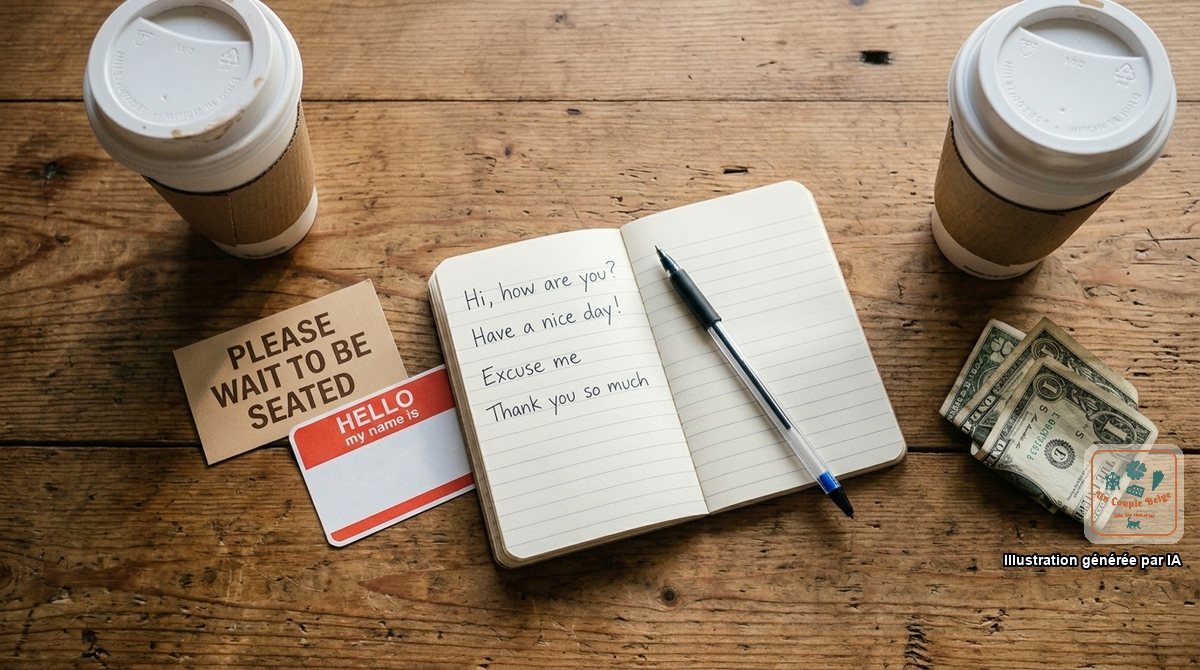
The first thing that strikes you in the United States is that everyone talks to you. The cashier asks how your day is going, the person at the next table comments on your plate, a stranger compliments you on your shoes. For a Belgian, it’s disconcerting at first, then very pleasant.
You still need to understand what these exchanges mean, and what they don’t mean.
“How are you?” isn’t a question
How are you?, How’s it going?, How are you doing today?: these are greetings, the equivalent of our “hello”. Nobody expects you to describe your day.
Talking to strangers
Small talk, light conversation with people you’ll never see again, is a real form of politeness. In a queue, in a lift, on a trail or at a bar, someone will strike up a conversation.
The subjects that work
- The weather, the scenery, the park you’re in.
- Where you come from. “Belgium” often brings up waffles, beer, chocolate or a memory of Bruges.
- Your itinerary. Americans love giving advice, and it’s often good.
- Sport, food, dogs.
What it doesn’t mean
This warmth is sincere, but it commits nobody to anything. “We should get together sometime!” or “You should come visit!” are friendly phrases, not invitations. If someone really wants to see you again, they’ll suggest a date.
The magic words
- Excuse me: to get past, to attract someone’s attention, to apologise for brushing against someone.
- Sorry: as soon as you’re in someone’s way, even from a distance.
- Thank you and please: in every exchange, without exception.
- You’re welcome, No problem, Sure, You bet: all ways of replying to thanks.
- Have a good one!: have a nice day.
- Sir and Ma’am: very widely used in the South, including by children.
People smile a lot, including at strangers passed on a pavement or a trail. On hiking paths, you greet each other with a “Hi!”.
First names and compliments
- People use first names almost straight away, servers and guides included.
- A handshake is the rule when introducing yourself. People don’t kiss on the cheek, and they keep their distance.
- Compliments between strangers are common: “I love your jacket!” Simply reply “Thank you!”, without playing it down.
- Enthusiasm is the norm. Awesome, amazing, perfect describe a decent sandwich. Conversely, our “not bad” comes across as coldness.
Personal space
Americans keep an arm’s length apart in conversation. You don’t crowd people in a queue, you don’t touch the arm of the person you’re talking to, and you apologise if you brush against someone in a supermarket aisle.
Queues
People queue for everything, in order and without cheating: it’s almost sacred.
- A single queue for several tills: you wait behind the line until the cashier calls, “Next!” or “I can help the next guest!”.
- Saving a place for someone who arrives later is frowned upon.
- At a four-way stop, the first to arrive goes first: the same logic as the queue (see driving).
- On escalators in big cities, you stand on the right and walk on the left.
Service
The customer is treated very well, and is expected to return the favour.
- Be pleasant to staff. Losing your temper with a server or an employee is very badly received, including by the other customers.
- The tip is part of the deal: not leaving one at a restaurant is an insult, not a saving (see the amounts).
- If there’s a problem, you explain it calmly and ask for a solution. You almost always get one: a dish remade, a drink on the house, a change of room.
- You don’t snap your fingers or call across the room. A glance or a wave of the hand is enough.
Subjects to avoid
With people you barely know, you don’t start a conversation about:
- politics and the president of the day;
- religion;
- guns;
- money: salaries, the price of a house;
- abortion, immigration, racial issues.
The country is deeply divided on these subjects, and you don’t know who you’re dealing with. If the other person brings them up, listen, ask questions, and keep your European judgements for the car.
Avoid lectures too on the size of the cars, the portions or the bins. Americans have heard them before.
The flag, the anthem and the military
Patriotism is displayed without inhibition: flags outside houses, the anthem before every game, thanks to veterans.
- During the anthem, you stand up, stay quiet and take off your cap. Nobody will ask you to sing or to put your hand on your heart.
- You don’t joke about the flag or the armed forces.
At the table
- People often eat with the fork alone, held in the right hand, after cutting.
- Burgers, fries, pizza, ribs and chicken wings are eaten with the fingers.
- You don’t linger for hours at the table after the meal in a full restaurant: others are waiting, and the server lives off the turnover.
- Sharing the bill is called to split the check. Among American friends, everyone often pays their own share.
In company
- Punctuality matters: for a guided tour, a booked restaurant or an appointment, you arrive five minutes early.
- You don’t smoke near people without asking, and almost never indoors.
- People talk loudly, but they don’t make calls on speakerphone.
- On the beach, going topless is banned almost everywhere, and children wear a swimsuit.
- You get changed in the changing rooms, not under a towel by the pool.
- You hold the door for the person behind you, even if they’re five metres away.
In people’s homes
If you’re invited:
- Bring something: a bottle, a dessert, Belgian chocolates.
- Ask whether you should take your shoes off.
- A word of thanks the next day is much appreciated.
A few classic misunderstandings
| What you hear | What it means |
|---|---|
| How are you? | Hello |
| That’s interesting. | I don’t agree, or it doesn’t interest me |
| We should do this again! | That was nice |
| I’ll think about it. | Probably not |
| It’s not bad. | It’s bad |
| Let me know if you need anything! | A sales assistant’s polite phrase, not pressure |
| Bless your heart (in the South) | Depending on the tone, compassion or a dig |
For useful everyday phrases, see survival English.