Parking in the United States: signs, kerb colours and city car parks
Updated on
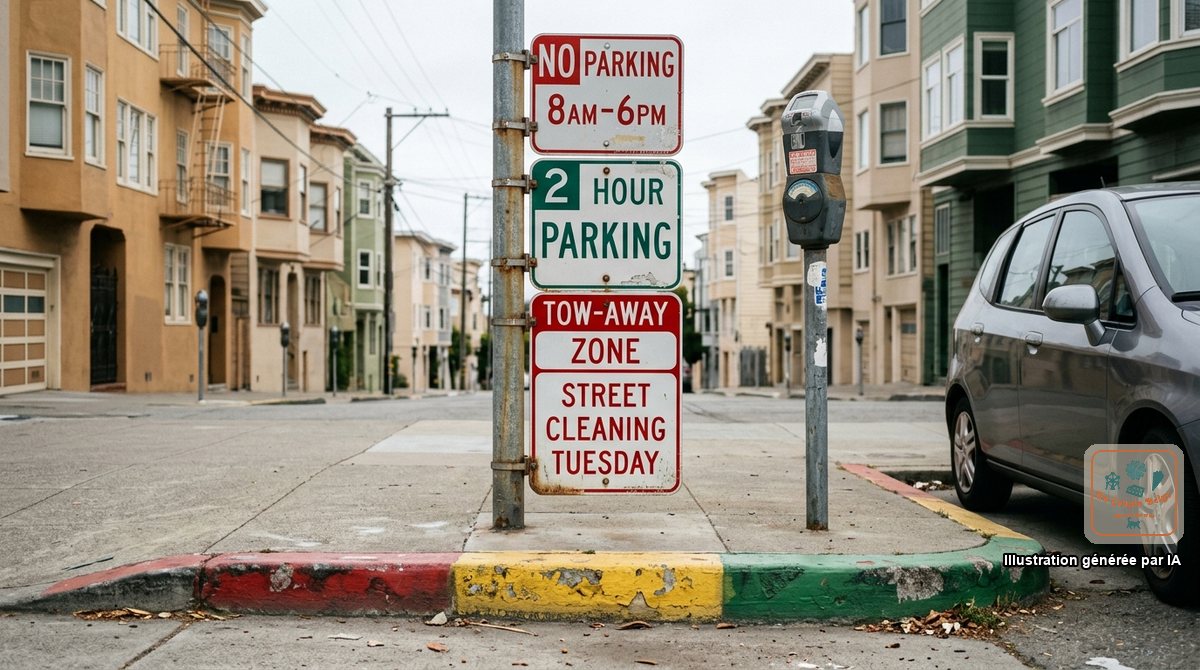
On the road and in the parks, parking is no problem at all: car parks are huge and free. In cities, it’s another story.
Signs are stacked up on the same pole, the rules change from one side of the street to the other, and the tow truck comes round quickly.
Do you need a car in the city?
In several big cities, the answer is no.
- New York: we spent four days in Manhattan on foot and by subway, and only picked up the car on the morning we left. A car park there costs 40 to 70 dollars a day.
- San Francisco, Boston, Chicago, Washington: the centre is visited on foot and by public transport.
- Los Angeles, Miami, Las Vegas, Orlando: a car is still useful, but hotel parking is charged for.
The smart move is to rent the car when leaving the city, or to return it on arrival. Over 18 days of road trip between New York and Florida, we spent 61 euros on parking in all.
Reading the signs
Signs are read from top to bottom, and each line adds a restriction. The vocabulary:
| Sign | Meaning |
|---|---|
| No Parking | You may stop to drop someone off or to load, without leaving the car for long |
| No Standing | Stopping only to let passengers in or out |
| No Stopping | No stopping at all, not even for a minute |
| Tow-Away Zone | The car will be towed away |
| 2 Hour Parking 8am-6pm | Parking limited to two hours during those times, unrestricted outside them |
| Permit Parking Only | Reserved for residents with a permit |
| Street Cleaning | No parking while the street sweeper passes, for example Tuesday from 8am to 10am |
| Loading Zone | Deliveries only |
Kerb colours
In many cities, especially in California, the kerb is painted:
- Red: no stopping.
- Yellow: deliveries and loading, at the times shown.
- White: dropping off passengers, for a few minutes.
- Green: very short-term parking, 10 to 30 minutes.
- Blue: reserved for disabled drivers, with a permit.
With no paint and no sign, parking is in principle unrestricted.
The rules we don’t have in Europe
- You park in the direction of traffic. Parking facing the wrong way earns a fine.
- Not within 4.5 metres of a fire hydrant (15 feet), even with no markings on the ground. The distance varies a little from state to state.
- Not in front of a driveway, even partially.
- Not on the pavement, ever.
- In San Francisco, you turn your wheels on a slope: towards the kerb when facing downhill, towards the street when facing uphill, with the parking brake on. It’s compulsory, and you can be fined.
Paying
Parking meters take coins, cards and often an app. The zone number is written on the post. The most common apps are ParkMobile and PayByPhone, with local variants. They let you extend your time remotely, but some require an American phone number: in that case, pay at the machine.
Private car parks (parking lots and garages) display an hourly rate and a daily maximum. “Early bird” prices reward arriving before 9 or 10am. The SpotHero and ParkWhiz apps let you book a space in advance, often 30 to 50% cheaper than on the spot.
Valet parking: you leave the key with an attendant outside the hotel or restaurant. It’s charged for, and you leave a tip of 2 to 5 dollars when the car comes back.
Fines and the tow pound
A fine comes in the form of an envelope slipped under the windscreen wiper. Allow 40 to 100 dollars depending on the city, more for a fire hydrant or a disabled space.
Pay it online before returning the car. Otherwise the rental company will receive it and charge it on to you with an administrative fee of 30 to 50 dollars.
If the car has disappeared, it’s probably at the tow pound. Call the local police’s non-emergency number, or 311 in the big cities. Allow 300 to 600 dollars and half a day lost.
Car break-ins
This is the real risk in cities, particularly in San Francisco, around the Bay Area, in Los Angeles and in the car parks at tourist viewpoints. A smashed window, fifteen seconds, and the suitcases are gone.
- Leave nothing visible, not even a jacket or a charging cable.
- Put the luggage in the boot before you arrive, not in the car park: thieves are watching.
- Call at the hotel to drop off the suitcases before visiting a city, on the day you arrive as on the day you leave.
- Keep on you passports, camera and laptop.
More advice in our article on safety.
Parking in the national parks
The problem there is the opposite: it’s free, but it’s full. At Zion, Yosemite, Arches or the Grand Canyon, the car parks for the well-known trails are full by 8 or 9am in season.
- Arrive early, before 8am, or in the late afternoon.
- Use the free shuttles where they exist: at Zion, the canyon road is closed to cars for much of the year.
- Don’t park on the verge outside the marked spaces: rangers issue fines, and desert vegetation takes years to grow back.
And with a van?
- Check the height before entering a covered car park: many are limited to 2 metres or 2.10 metres.
- Vehicles longer than 6 or 7 metres are banned from parking in certain streets.
- Sleeping in a vehicle in town is forbidden in many municipalities (see where to sleep in a van).