Electricity in the United States: sockets, adapters and charging on the road
Updated on
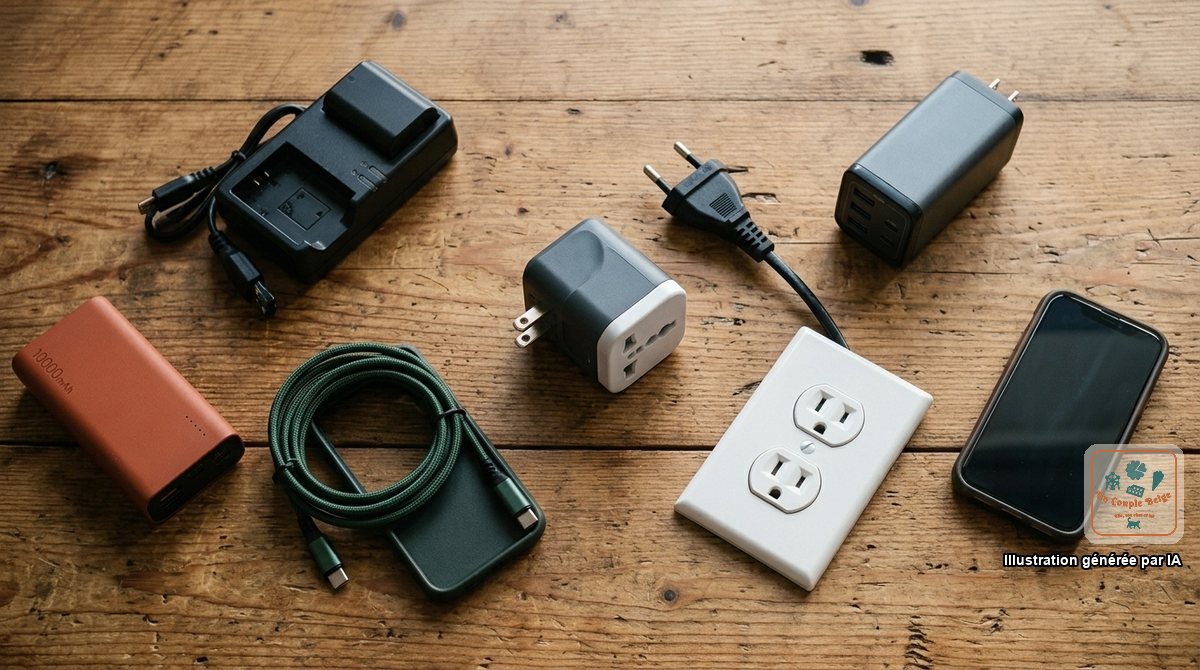
Phone, camera, power bank, watch, earphones, laptop: we travel with around ten devices to recharge every evening. In the United States, neither the sockets nor the voltage are the same as in Europe.
Most of your chargers cope with that very well, but not everything that heats up.
Sockets and current
| Belgium | United States | |
|---|---|---|
| Socket | Type E, two round pins | Type A (two flat pins) and type B (two flat pins and a round earth pin) |
| Voltage | 230 volts | 120 volts |
| Frequency | 50 hertz | 60 hertz |
Your plugs won’t fit American sockets: you need an adapter. And the voltage is half as high: you have to check that your devices accept it.
Adapter or transformer?
An adapter only changes the shape of the plug. It costs a few euros and is enough for all devices that accept 120 volts.
A transformer (or converter) changes the voltage. It’s heavy, expensive, and almost never needed when travelling.
To find out, read the label on the charger or the device:
- “Input: 100-240 V, 50/60 Hz”: it works everywhere. A simple adapter is enough.
- “220-240 V” only: it won’t work properly in the United States.
What works, and what doesn’t
No problem, with an adapter
- Phone, tablet, watch and earphone chargers
- Laptop chargers
- Camera and drone chargers
- Power banks
- E-readers, handheld consoles
- Electric toothbrushes and recent shavers (check the label)
To leave at home
- European hairdryers: they blow lukewarm and slowly, or not at all. Almost every hotel room has one.
- Hair straighteners and curling irons, except travel models marked “100-240 V”.
- Kettles, irons, bottle warmers: the same problem for anything that heats up.
What we put in the suitcase
- Two or three adapters to type A/B. Buy them before you leave: they’re expensive at the airport. Once there, you’ll find them at Walmart, Target or in electronics shops.
- A Belgian power strip, a simple one, with no surge protection. A single adapter in the wall, and all your chargers plugged into it: it’s the most useful accessory of the trip.
- A multi-port USB charger, which replaces four separate plugs.
- Duplicate cables for the phone: one for the room, one for the car.
- A power bank, in hand luggage only.
“Universal” adapters work, but they’re heavy and often fall out of American sockets, which don’t grip well. A simple adapter is more stable.
In hotels
- Sockets are plentiful, often with built-in USB ports on the bedside table or the lamp. Some are slow: keep your own charger.
- In the bathroom, sockets have two little buttons, Test and Reset. It’s a built-in circuit breaker. If the socket stops working, press Reset.
- A socket that doesn’t work is sometimes controlled by the switch at the door.
- Light switches are the other way round: up is on.
- Plugs don’t hold well in old sockets. If the charger falls out, try another socket or wedge it in place.
Charging in the car
On a road trip, the car is the main source of power during the day.
- USB ports: recent rental cars have several, USB-A or USB-C. They charge slowly, sometimes just enough to keep a phone running GPS going.
- The 12-volt socket (the old cigarette lighter): with a multi-port fast charger, it’s the best solution. Bring one from Belgium or buy it at the first supermarket.
- A 12 V to 120 V converter (power inverter, 20 to 40 dollars) lets you plug in a laptop or camera charger while driving. Stay under 150 watts on the 12-volt socket.
- Some cars have a real 120-volt socket in the back or in the console.
The car only charges with the engine running, or the ignition on. Don’t leave anything plugged in for hours with the engine off.
In a van and at the campground
- The van’s auxiliary battery powers the USB sockets, the lighting and the fridge. It recharges as you drive, sometimes with a solar panel.
- Plugging in at a campground (shore power or hookup) is done at a 30- or 50-amp pedestal, with the cable supplied by the rental company. It gives 120 volts throughout the vehicle.
- Sites without electricity mean recharging everything while driving: think about that before spending two nights in the same place.
- Visitor centers, cafés and laundromats will help out for a top-up.
More details in travelling by van.
Batteries and flying
- Power banks and spare lithium batteries: in the cabin only, never in the hold.
- Up to 100 Wh (about 27,000 mAh), no authorisation is needed.
- Protect the terminals of camera and drone batteries in a case.
Medical devices
Sleep apnoea machines and most recent medical equipment accept 100-240 volts: check the label, and bring a spare adapter and an extension lead. Ask for a medical certificate for carrying them in the cabin.
In extreme weather
- Heat: a phone on the dashboard shuts down as a safety measure, and batteries get damaged. Keep them in the shade.
- Cold: batteries drain very quickly. Keep one in an inside pocket.
For network coverage and mobile data, see phone and internet.