On the road
Travelling by van in the United States: models, rental companies and the real cost
Updated on
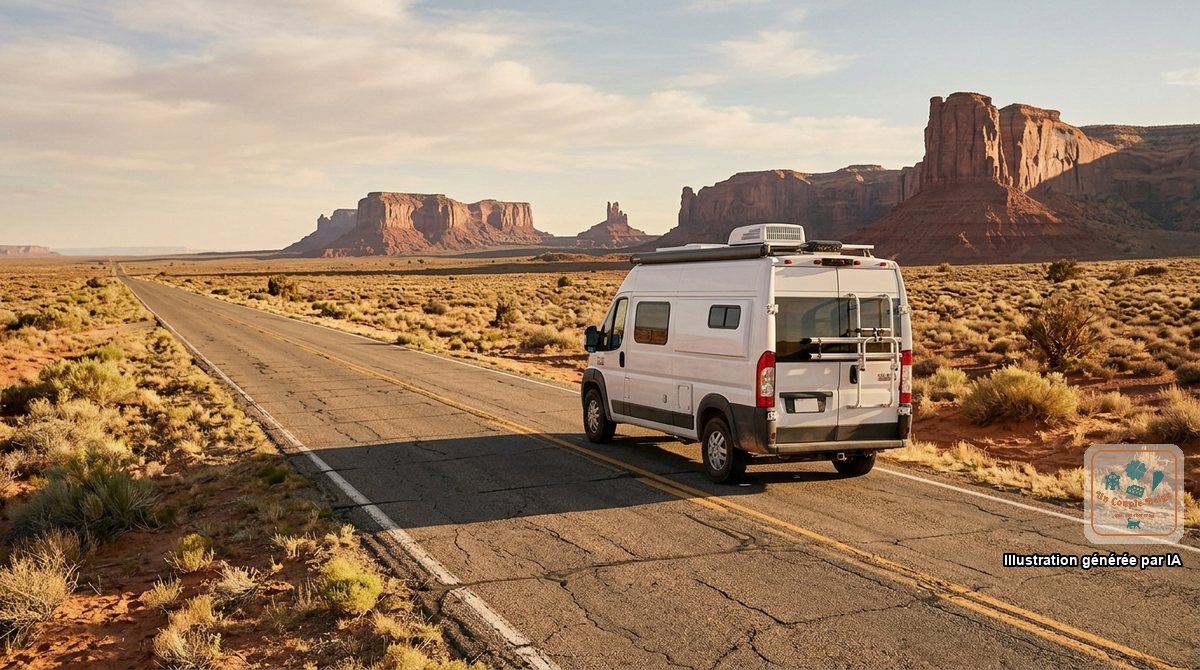
A van is the stuff of dreams: waking up facing a canyon, cooking beside a lake, never unpacking your suitcase again. It’s a wonderful way to travel in the United States, provided you know what you’re renting, what it really costs and what it changes day to day.
Van, motorhome: what are we talking about?
| Type | What it is | For whom |
|---|---|---|
| Converted minivan | A people carrier with a bed in the back and a kitchen in the boot | Two people, small budget, parks anywhere |
| Campervan (class B) | A panel van you can stand up in, with a fixed bed, an indoor kitchen, sometimes a toilet | Two people who want comfort |
| Motorhome (class C) | A living unit on a truck chassis, with a bathroom and a proper kitchen, 6 to 9 metres long | Families, long stays |
| Large motorhome (class A) | A converted coach | Best avoided for a first trip |
In the United States, the word RV (recreational vehicle) covers anything on wheels that you sleep in.
The rental companies
Among the names that come up most often:
- Escape Campervans: hand-painted vans, unlimited mileage on most packages, a dozen depots in the West and a few in the East.
- Travellers Autobarn: simple vans, unlimited mileage, often among the cheapest.
- Indie Campers and Roadsurfer: two European rental companies established in the United States, with recent vehicles.
- Cruise America: the big motorhome specialist, with branches all over the country.
- Outdoorsy and RVshare: peer-to-peer rental, with an enormous choice and conditions that vary from one owner to another.
We haven’t tried them ourselves. Compare on the same dates, looking at what is included.
What to check in the quote
- Mileage. Unlimited with some, charged per mile with others (often 35 to 50 cents a mile). Over 4,000 km, the difference exceeds 1,000 dollars.
- The kits. Bedding, crockery, chairs, table: sometimes included, sometimes extra.
- Insurance. Bank cards and travel insurance rarely cover motorhomes. Read the excesses, and the usual exclusions: roof, underbody, windscreen.
- Forbidden roads. Many contracts exclude unpaved tracks, Death Valley in summer or Mexico.
- The generator and gas, charged by use on motorhomes.
- One-way fees if you return the vehicle somewhere else, and preparation fees.
- The minimum age of the driver, 21 or 25 depending on the company.
- The first night. Some motorhome rental companies ask you to sleep at a hotel on the evening you arrive, so that you don’t take the wheel after a long-haul flight.
Your Belgian category B licence is enough for all these vehicles.
The real cost: van, or car and motels?
An example for two people, over 21 days in shoulder season in the West. These are orders of magnitude.
| Campervan | Car + motels | |
|---|---|---|
| Rental | $100 to $180 a day | $50 to $80 a day |
| Nights | $20 to $50 (campground) | $110 to $180 |
| Fuel | $35 to $50 a day | $20 to $30 a day |
| Meals | $40 to $60 (you cook) | $70 to $110 |
| Total per day | $195 to $340 | $250 to $400 |
What a van changes day to day
The pluses
- You sleep as close as possible to the scenery, sometimes inside the parks.
- You no longer unpack your suitcase or look for a restaurant in the evening.
- The sunrise is ten metres from the bed.
The minuses
- Park campgrounds are booked months ahead: total freedom is a myth in high season. See where to sleep in a van or at a campground.
- Cities are a pain: car parks that are too low, overnight parking banned, risk of theft. For San Francisco or Los Angeles, it’s better to return the van beforehand.
- You have to manage the logistics: water, emptying the tanks, ice, showers, laundry (see our article).
- You drive more slowly and use more fuel. Allow 12 to 15 litres per 100 km for a panel van, 20 to 30 for a motorhome.
- It’s cold at night at altitude in spring and autumn, and very hot in the desert in summer.
Driving a large vehicle
- Write down the height of the vehicle on a piece of paper stuck to the dashboard. Drive-throughs, covered car parks and certain low bridges are unforgiving.
- Some roads are restricted. The Zion-Mount Carmel tunnel is subject to size restrictions that have recently been tightened (check on nps.gov/zion before going that way), and the Going-to-the-Sun Road at Glacier bans vehicles more than 6.4 metres long.
- Beware of crosswinds on the plains and on bridges.
- On descents, change down instead of braking continuously.
- Have someone guide you when reversing: it’s the leading cause of damage.
Getting off to a good start
- Book the van six months ahead for summer.
- Lock in the national park campgrounds first, then build the itinerary around them.
- Plan one or two motel nights in the middle of the trip: a proper shower and a big bed set everyone right again.
- On pick-up day, film the vehicle from every angle, inside included, and have each piece of equipment shown to you.
We’ve also written an article on cooking in a van.