Stargazing and the northern lights in the United States
Updated on
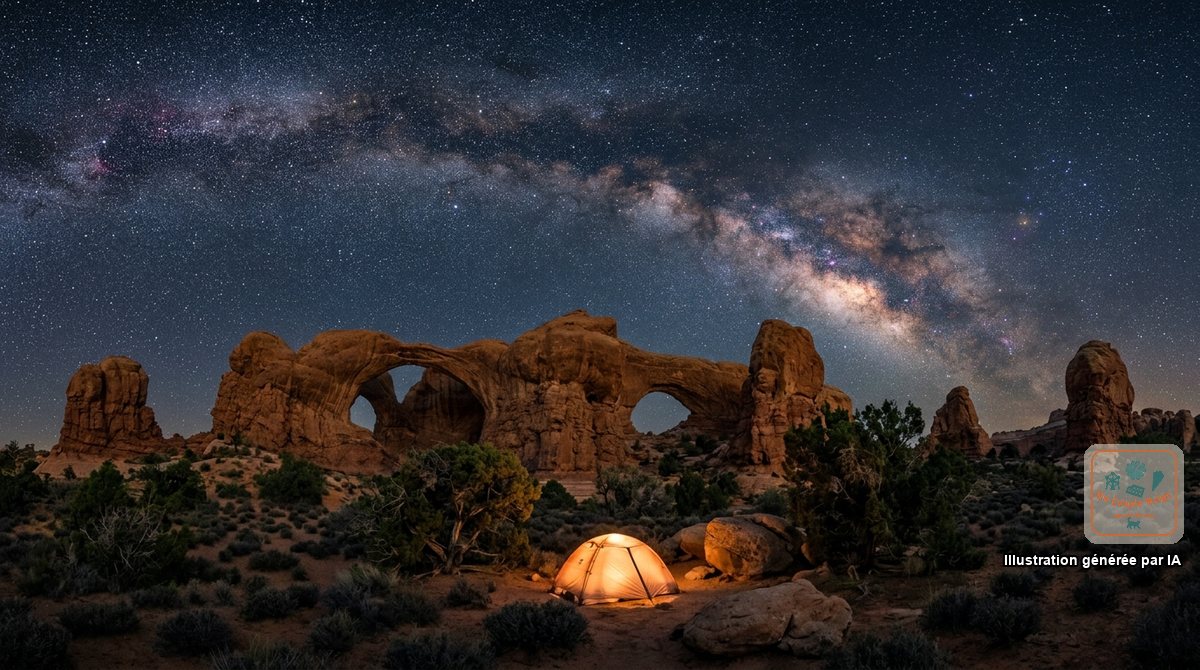
In Belgium, we’ve forgotten what a real night sky looks like. In the deserts of the West, hours’ drive from the nearest town, you only have to get out of the car and switch off the headlights: after twenty minutes, the Milky Way crosses the sky from one horizon to the other.
It’s free, it can’t be booked, and it’s one of the most powerful sights of a road trip.
The dark sky parks
An international association, DarkSky, awards a designation to places that protect their night from light pollution. The United States has more than a hundred, including many national parks.
| Place | State | Good to know |
|---|---|---|
| Natural Bridges | Utah | The first park in the world to receive the designation, in 2007 |
| Bryce Canyon | Utah | Renowned astronomy evenings, a festival in June |
| Capitol Reef, Canyonlands, Arches | Utah | Very little light for dozens of kilometres |
| Death Valley | California | One of the darkest skies in the country, mild in winter |
| Great Basin | Nevada | Remote, at 2,000 metres and more |
| Grand Canyon | Arizona | Star party in June, on both rims |
| Joshua Tree | California | The most accessible from Los Angeles |
| Big Bend | Texas | Among the least light-polluted in the contiguous United States |
| Cherry Springs (state park) | Pennsylvania | The best site in the East |
Utah has the largest number of designated sites: any night between Monument Valley, Capitol Reef and Bryce Canyon will do.
Choosing the right night
The moon first. It’s the criterion that matters most. Around the full moon, the sky is too bright to see the Milky Way. Aim for the five days before and after the new moon, or the hours before moonrise.
Then the season.
- From March to October, the core of the Milky Way, its brightest part, is visible. Early in the season it rises late in the night; from June to August, it’s high in the sky from nightfall.
- In winter, the sky is very clear and the nights long, but the core of the Milky Way is hidden. You do, however, see Orion and the winter constellations.
The time. The sky is only truly dark an hour and a half after sunset.
The weather. A clear, dry sky. In July and August, the monsoon of the Southwest often clouds the sky in the evening.
Meteor showers
| Shower | Peak | Note |
|---|---|---|
| Quadrantids | 3-4 January | Brief and cold |
| Lyrids | 21-22 April | Modest |
| Perseids | 11-13 August | The most popular, mild nights |
| Orionids | 20-22 October | Modest |
| Geminids | 13-14 December | The richest, but it’s cold |
The show depends on the moon: check its phase for the year of your trip. The best time is between midnight and dawn.
How to observe
- Get away from all light: lit car parks, lodges, the headlights of passing cars.
- Let your eyes adjust for twenty to thirty minutes. A single glance at your phone, and you have to start again.
- Use a red light: it doesn’t dazzle. Many head torches have this mode.
- Lie down: a blanket, a camping mat or the still-warm bonnet of the car.
- Wrap up. In the desert, the temperature drops by 15 to 20 degrees after sunset, even in summer.
- Bring binoculars: they show the moons of Jupiter, the craters of the Moon and thousands of stars invisible to the naked eye.
- An app such as Stellarium or SkyView identifies what you’re looking at. Turn down the screen brightness and switch to night mode.
Safety
- Get to know the place in daylight: cliffs, ravines, cacti.
- Stay near the car or on a trail you know.
- Watch out for animals on the road when you leave (see remote roads).
Evenings with the rangers
In season, many parks hold free astronomy evenings: a ranger presents the sky with a laser pointer, then volunteers lend their telescopes. Bryce Canyon, the Grand Canyon, Great Basin, Death Valley and Joshua Tree are known for it.
The programme appears in the park newspaper and on its website, under Ranger programs or Night sky. Some parks also offer full-moon hikes.
Sleeping under the stars
- Camping in the park is the simplest solution: you step out of the tent, and there it is (see where to camp).
- Remote accommodation also does the job. At Monument Valley, we slept facing the buttes, far from any town.
- From a motel, drive ten minutes out of town to a viewpoint car park.
The parks are open at night, and the entrance fee you’ve already paid remains valid.
The northern lights
In Alaska, the season runs from late August to April, when the nights are dark. Fairbanks is the most reliable base: staying three nights, your chances of seeing them are high. You need a clear sky, patience and very good clothing: it’s routinely −25°C in winter.
In the rest of the United States, the northern lights are rare and unpredictable. They appear during strong solar storms, mainly near the Canadian border:
- northern Minnesota (Voyageurs National Park, the lakes region);
- the Upper Peninsula of Michigan;
- the north of Montana (Glacier), North Dakota, Idaho and Washington State;
- northern Maine.
The Sun went through a peak of activity between 2024 and 2026, with auroras seen exceptionally far south. Activity then declines for several years.
Following the forecasts
- The US Space Weather Prediction Center (swpc.noaa.gov) publishes a map of the area where the aurora is visible, updated continuously.
- The Kp index, from 0 to 9, measures activity: from 5, the aurora comes down towards the north of the contiguous United States; at 7 and above, it can reach the centre of the country.
- Apps send an alert when the index climbs.
You don’t build a trip to Montana around seeing the aurora. But if an alert comes through during your stay, get out of town, look north, and take a photo with an exposure of a few seconds: the camera sees the colours before the eye does.
Eclipses
Total solar eclipses visible from the United States are rare: after the one in April 2024, the next to cross the country will be in 2044 and 2045. Lunar eclipses, on the other hand, can be seen from anywhere it’s night, several times a decade.
Photographing the sky
A camera on a tripod, a wide-angle lens at its widest aperture, a 15 to 20 second exposure at ISO 3200: that’s the basis. Recent phones have a night mode that gives surprising results, propped on a rock. The settings and advice are in taking photos and filming.