Long distances and remote roads: driving safely in the American West
Updated on
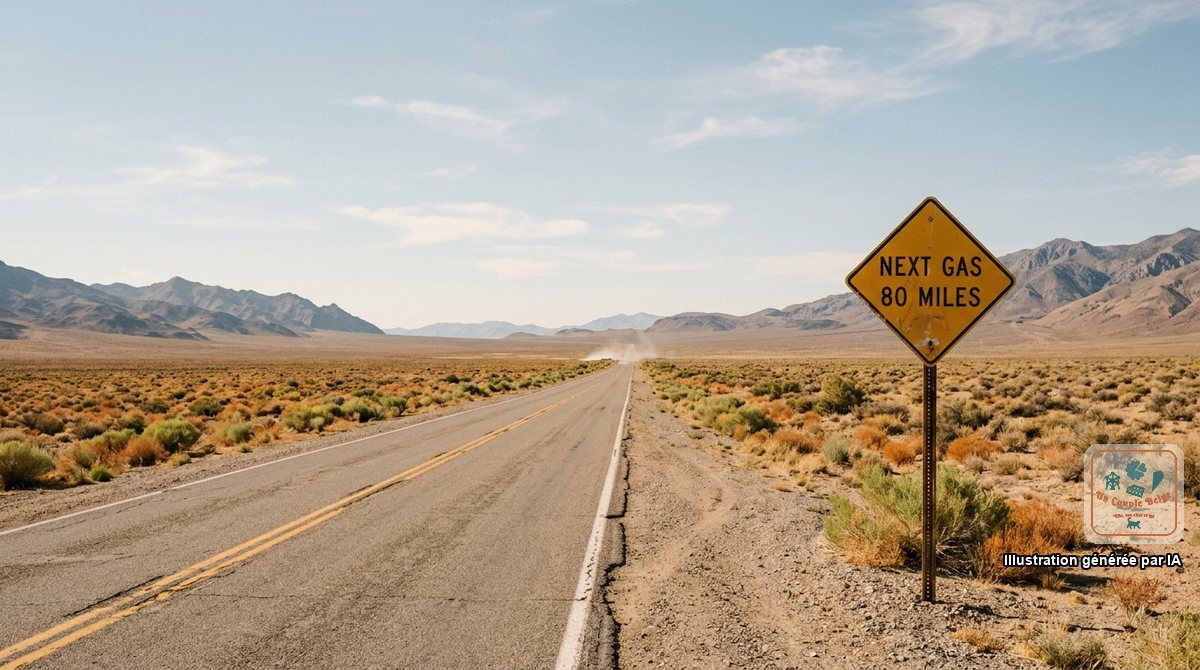
In the West, you can drive for an hour without passing a house, a petrol station or a bar of signal. That’s what makes these roads beautiful, and it’s what calls for a little preparation. Nothing to worry about: a few habits are enough.
Before setting off in the morning
- A full tank, as soon as the gauge drops below half (see fuel).
- Water: at least four litres per person in the car, on top of what you drink. A one-gallon jug in the boot costs a dollar or two.
- Enough food for one meal.
- Offline maps downloaded, and the day’s route checked.
- Road conditions: each state has its own site (the “511”), and the parks publish their closures on nps.gov.
- Someone who knows where you’re going, if you’re heading off on a track or a long hike.
Fatigue at the wheel
Straight roads, cruise control and heat send you to sleep more surely than a mountain road.
- A break every two hours, even a short one.
- Change drivers regularly. Declare the second driver to the rental company: otherwise the insurance doesn’t apply (see car rental).
- Be wary of the early afternoon and of the first few days, with the jet lag.
- Drive with the window slightly open or turn the air conditioning down from time to time.
Animals on the road
Between sunset and dawn, deer, elk, pronghorn and free-roaming cattle cross without warning. An Open Range sign means the livestock isn’t fenced in. In the Navajo Nation you also come across horses and sheep.
- Avoid driving at night outside towns. Plan to arrive an hour before sunset.
- Slow down at dawn and dusk.
- Where there’s one animal there’s often another: deer move in groups.
- Brake in a straight line rather than swerving. Leaving the road is more dangerous than the collision.
Unpaved tracks
Many famous sites lie at the end of a track: Valley of the Gods, the Monument Valley loop, certain roads in Death Valley or Grand Staircase.
What the rental contract says. Most rental companies forbid driving off paved roads or, more precisely, exclude all insurance cover for damage on a track. A puncture, a damaged underbody or a tow is then entirely at your expense, and a tow from a remote track can cost more than 1,000 dollars.
Before you commit:
- Ask about the state of the track at the visitor center or from the rangers on the day itself.
- Give up after rain. The clay of Utah and Arizona turns into a sticky skating rink, even for a 4x4. At Valley of the Gods, the track is no problem in an ordinary car in dry weather, but not at all after a shower.
- Don’t trust the sat nav, which suggests tracks as shortcuts.
- Check that the car has a spare wheel and not just a puncture repair kit.
- Drive slowly: washboard surfaces are hard on the tyres and the nerves.
The words High Clearance and 4WD Only (four-wheel drive) are to be taken literally. Otherwise, guided jeep tours exist for most of these sites.
Heat and the car
- On climbs, watch the engine temperature. If the needle rises, turn off the air conditioning. In Death Valley, signs ask you to do so on certain hills.
- Never leave anyone, or an animal, in a closed car, even for five minutes.
- The phone overheats on the dashboard and shuts down. Put it in front of an air vent.
- Protect the cooler from the sun, and don’t leave aerosol cans or batteries in direct sunlight.
If you break down
- Park as far from the roadway as possible, with your hazard lights on.
- Stay near the car. It can be seen from a long way off and gives shade. Setting off on foot in the desert is what turns a breakdown into a serious accident.
- Call the rental company’s assistance line: the number is on the contract and often on a sticker in the glove compartment. If you’re in danger, dial 911.
- With no signal, try 911 anyway: the call goes through any available operator. Recent phones can also send an emergency message by satellite. Check before you leave whether yours can.
- Wait. On a paved road, even a remote one, someone eventually comes by, and Americans readily stop.
Punctures
This is the most common breakdown. Before leaving the rental company’s car park, find out where the spare wheel and the jack are. The spare is often a space-saver: it limits your speed to 80 km/h and your distance to around a hundred kilometres, just enough to reach a garage.
Most recent cars display the tyre pressure on the dashboard, in PSI (1 bar is 14.5 PSI). A warning light that comes on in the morning, when it’s cold, often goes out after a few kilometres. If it stays on, top up the pressure at the first station.
Hills and weather
- On long descents, change down instead of keeping your foot on the brake. Automatic cars have an L position or a manual mode.
- In the mountains it can snow in May and October. In California, chain controls apply even to rental cars.
- Never drive through a flooded road: thirty centimetres of water are enough to carry a car away.
- In a dust storm in Arizona, pull off the road, switch off your lights and wait.
More in our article on extreme weather.
The kit to keep in the boot
- Water and snacks
- Head torch
- Power bank and cable
- Paper road map of the state (a few dollars at a petrol station)
- Blanket or fleece
- First-aid kit
- Sun cream and a hat