Extreme weather in the United States: heatwaves, flash floods, storms, wildfires and hurricanes
Updated on
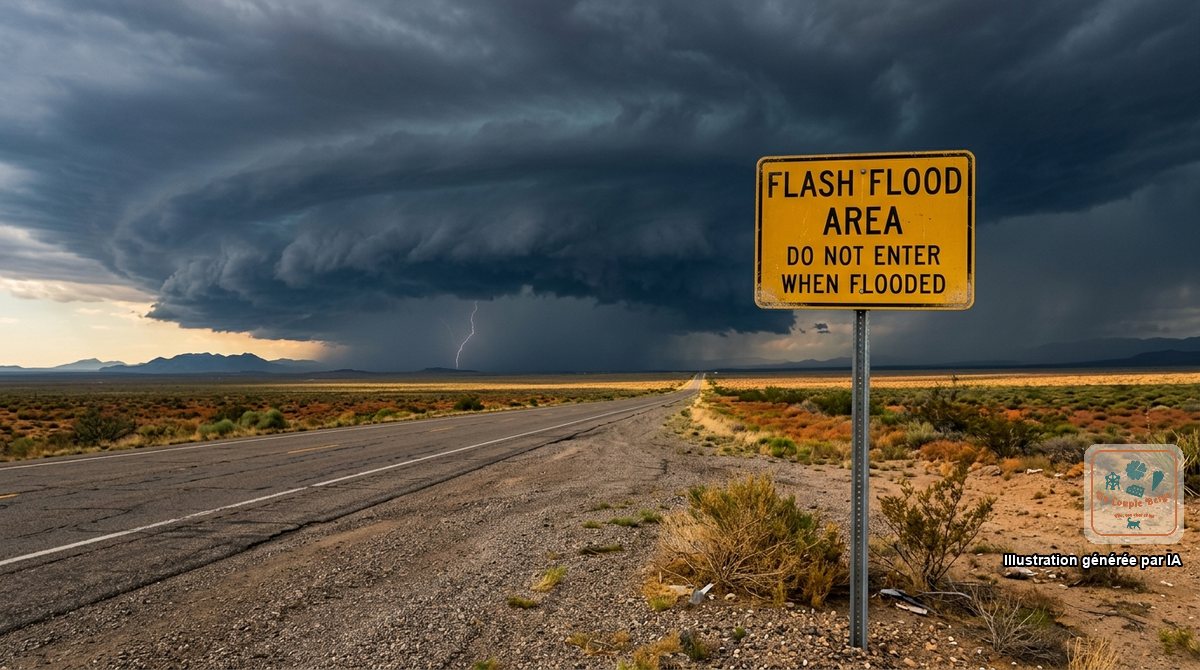
The American climate doesn’t do things by halves: 50°C in Death Valley, canyons that fill with water in ten minutes, tornadoes on the plains, hurricanes over Florida.
The likelihood of being affected during two or three weeks’ holiday is low. But since you spend your days outdoors and on the road, it’s better to know how to read an alert and what to do.
Where to get information
- weather.gov, the website of the National Weather Service (NWS). Type the name of a town or click on the map to get the forecast for a precise point, which is useful in the mountains. Current alerts are shown in red at the top of the page.
- Park visitor centers, which post the weather and the day’s risks every morning.
- Alerts on your phone: the authorities send emergency messages to every phone in an area, with a piercing alarm. Depending on your plan, you won’t always receive them with a foreign number.
- The car radio and the electronic signs on the motorways.
Watch or Warning?
All American alerts use the same words:
| Term | Meaning | What to do |
|---|---|---|
| Advisory | Troublesome conditions | Take care |
| Watch | The event is possible | Be ready, review your plans |
| Warning | The event is under way or imminent | Act straight away |
A Flash Flood Watch is a call to avoid canyons. A Flash Flood Warning means the water is coming.
Extreme heat
From June to September, the Southwest routinely exceeds 40°C. Death Valley holds the world record, with 56.7°C measured in 1913, and exceeds 50°C on several days every summer.
- Visit early in the morning, and spend the hot hours in the car, in a museum or at the pool.
- Drink a litre per hour of activity, and eat salty food.
- Don’t set off on a hike in the desert after 10am in summer. At the Grand Canyon, rangers advise against any descent during the day.
- Keep water in the car: four litres per person at least.
- Don’t leave anyone in a stationary vehicle.
We went through in May, before the worst of the heat. Our advice is in the park guide.
Flash floods
This is the most insidious danger in the Southwest. A storm breaks over a plateau thirty kilometres away, under a sky that stays blue where you are, and a wave of mud tears down the canyon a few minutes later.
Where: the narrow canyons of Utah and Arizona (the Narrows at Zion, Antelope Canyon, the canyons around Escalante and Page), dry riverbeds (washes), and the roads that cross them.
When: mainly from July to mid-September, during the monsoon, but also in spring.
What to do
- Check the day’s risk at the visitor center. At Zion, it’s posted on four levels.
- Give up if storms are forecast for the region, even a long way off.
- In a canyon, keep an eye out at all times for where you could climb. Water turning cloudy, floating debris or a rumble upstream mean climbing straight away, without trying to walk back down the canyon.
- On the road, never drive through a flooded section. Americans have a slogan: “Turn around, don’t drown”. Thirty centimetres of moving water will carry a car away.
Guided tours of Antelope Canyon are cancelled as soon as there’s a risk. It’s frustrating, and it’s a good thing.
Thunderstorms and lightning
Summer storms are violent in the mountains, in the desert and in Florida, where there’s one almost every afternoon from June to September.
- If you can hear thunder, you’re within range of lightning. Go inside a building or get in the car, windows closed.
- Leave summits, ridges, exposed viewpoints, beaches, pools and lakes.
- On open ground, move away from isolated trees and metal objects, and crouch down, feet together.
- Wait thirty minutes after the last clap of thunder before going back out.
At the Grand Canyon and Bryce Canyon, the overlooks on the cliff edge are the places struck most often.
Tornadoes
They mainly affect the Great Plains, from Texas to South Dakota, and the Southeast, peaking from April to June.
- In a building: go down to the basement or shelter in an interior room with no windows, on the ground floor (bathroom, corridor).
- At a hotel, follow the staff’s instructions: they’re used to it.
- On the road: don’t shelter under a bridge. If the tornado is far off, drive away at right angles to its path. If it’s close, leave the vehicle and lie down in a ditch, hands over your head.
Wildfires
From July to October, wildfires are part of life in the West. They can close a park, cut a road for weeks or smother a region in smoke.
- Watch Duty (a free app) and InciWeb (the official site) track active fires.
- AirNow.gov gives the air quality. Above 150, limit exertion outdoors.
- Park websites announce road and trail closures.
- If an evacuation order is given, leave without arguing, by the route indicated.
- Respect fire bans, including for barbecues and cigarettes.
Keep a little flexibility in the itinerary for an August or September trip in the West, with cancellable bookings.
Hurricanes
The season runs from 1 June to 30 November, peaking from mid-August to mid-October. It affects Florida, the Gulf of Mexico coast, and the Atlantic coast up to North Carolina, sometimes further.
Unlike the other phenomena, a hurricane can be seen coming several days ahead.
- Follow the forecasts of the National Hurricane Center (nhc.noaa.gov) if you’re travelling at that time of year.
- The Keys are evacuated first, by a single road.
- If an evacuation is ordered, leave early: the motorways clog up and petrol stations run out of fuel.
- Check your travel insurance before you leave: not all policies cover cancellation because of a hurricane (see insurance).
- Airlines and hotels generally make changes free of charge when an alert is issued.
Snow and cold
- In the Sierra Nevada and the Rockies, it can snow from October to May. Some passes close all winter (see when to go).
- In California, checkpoints sometimes require chains on mountain roads.
- In New York and Chicago, a snowstorm can ground planes for a day or two. In winter, avoid tight connections.
Dust storms
In Arizona, during the monsoon, a wall of dust (a haboob) can cut visibility to zero in a few seconds. The official advice: pull completely off the road, switch off all your lights, take your foot off the brake and wait. A lit-up car on the verge attracts drivers who take it for a vehicle to follow.