Getting medical care in the United States: pharmacy, urgent care, emergency room and medicines
Updated on
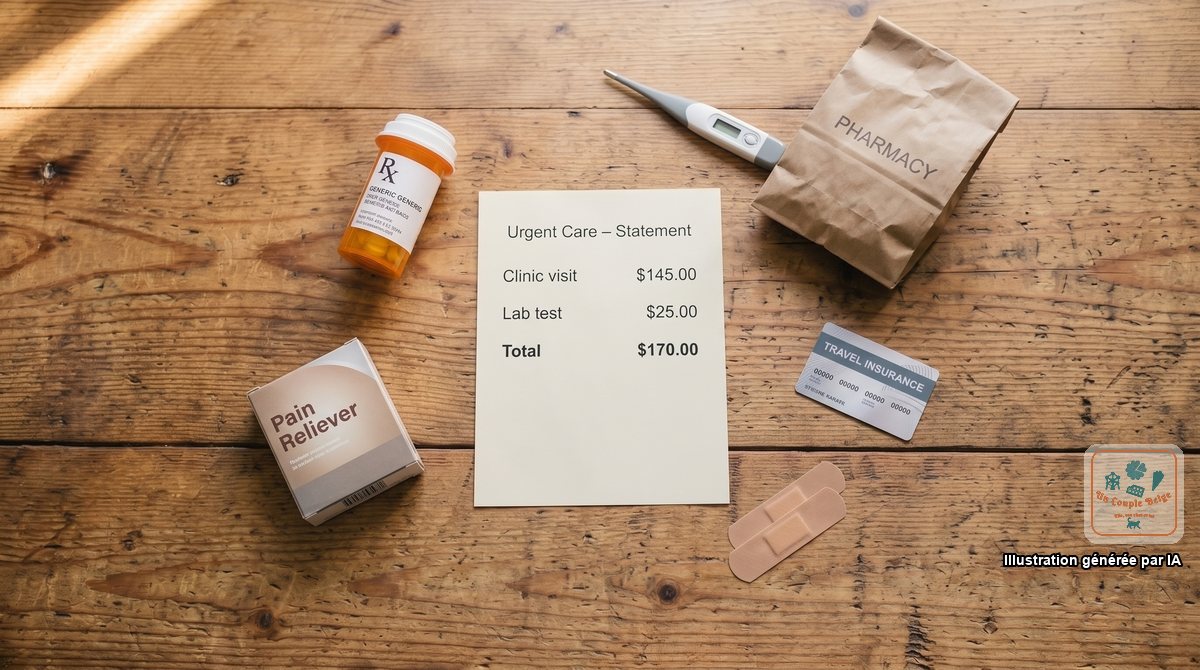
The American healthcare system is excellent and very expensive. There are no regulated fees, no European Health Insurance Card, and a simple consultation costs what you’d pay in Belgium for ten.
Knowing where to go for which problem avoids turning a sore throat into a 2,000-dollar bill.
Where to go? Four levels
| Situation | Where | Cost without insurance (order of magnitude) |
|---|---|---|
| Cold, blisters, sunburn, stomach ache | Pharmacy, over-the-counter medicines | $5 to $30 |
| Need for advice or a simple prescription | Telehealth consultation or an in-store clinic | $50 to $150 |
| Sore throat, ear infection, sprain, wound needing stitches, urinary infection | Urgent care | $150 to $400 |
| Chest pain, difficulty breathing, fracture, accident, loss of consciousness | Emergency Room (ER) or 911 | $1,500 and much more |
The pharmacy
The big chains are CVS and Walgreens, found at almost every crossroads, often open late, sometimes all night. Supermarkets (Walmart, Target, Kroger, Safeway, Publix) also have a pharmacy section.
Two separate areas:
- The self-service shelves (over the counter, OTC): painkillers, syrups, antihistamines, plasters. You help yourself and pay at the till.
- The pharmacist’s counter (pharmacy), at the back of the store, for prescription medicines. The pharmacist readily answers questions.
Telehealth and in-store clinics
For a simple problem, a video consultation gets you advice and a prescription sent to the nearest pharmacy. Your travel insurance often offers one for free: it’s the first number to call.
Some pharmacies (CVS’s MinuteClinic, for example) have a small clinic run by a nurse practitioner, with no appointment needed, for minor infections and vaccinations.
Urgent care
This is the level we lack at home: a walk-in medical centre, open in the evening and at weekends, with a doctor, X-rays and minor stitching. You find them in every town, including near the parks (Moab, Page, St. George, Flagstaff, Jackson).
- Search for urgent care near me in Google Maps.
- Show your passport and your insurance certificate.
- You generally pay on the spot, then claim it back.
- Ask for an itemized bill and the medical report.
The emergency room
The emergency room treats everyone, insured or not, but the bill arrives afterwards, and it’s heavy. An ambulance alone costs 1,000 to 2,500 dollars, a helicopter tens of thousands.
As soon as possible, call your insurer’s assistance line or have someone call it: it can settle the costs directly with the hospital and save you from paying out enormous sums up front.
In the national parks
The big parks have a clinic or a first-aid station (Yosemite, Grand Canyon, Yellowstone). Elsewhere, the rangers are trained in first aid, and the hospital may be two hours’ drive away.
A rescue in the mountains or in a canyon is usually free in the national parks, but the medical transport that follows isn’t. Check that your insurance covers search and rescue costs.
Medicines: the equivalents
The brands differ, the molecules are the same. Look for the name of the substance, written in small print under the brand.
| Need | In Belgium | In the United States |
|---|---|---|
| Pain, fever | Paracetamol (Dafalgan) | Acetaminophen: Tylenol |
| Pain, inflammation | Ibuprofen (Nurofen) | Ibuprofen: Advil, Motrin |
| Allergy | Cetirizine, loratadine | Zyrtec, Claritin; diphenhydramine: Benadryl (makes you drowsy) |
| Diarrhoea | Loperamide (Imodium) | Imodium |
| Stomach ache, nausea | Pepto-Bismol, Tums | |
| Motion sickness | Dramamine | |
| Cold, blocked nose | Sudafed, DayQuil / NyQuil | |
| Cough | Robitussin, Mucinex | |
| Itching, bites and stings | 1% hydrocortisone cream, Cortizone-10 | |
| Burns, sunburn | Aloe vera gel | |
| Disinfecting wounds | Neosporin (antibiotic ointment) | |
| Rehydration | Pedialyte, Liquid I.V. |
Bringing your own medication
- Bring your treatment for the whole length of the trip, plus a week’s margin.
- Keep it in the cabin, in the original boxes with your name on them.
- Bring the prescription, and for a heavy treatment, a certificate from your doctor in English, with the names of the molecules.
- Some medicines authorised in Belgium are tightly controlled in the United States: opioids, certain sleeping pills and anti-anxiety drugs, treatments for attention deficit disorder. Bring only the quantity you need, with the prescription, and find out beforehand.
- Insulin and medicines to be kept cool: bring an insulated pouch, and ask the hotel for a fridge.
The minor ailments of travel
- Sunburn and dehydration: the most common in the West. Factor 50 sun cream, hat, water.
- Blisters: special plasters at the first sign of rubbing, not afterwards.
- Air-conditioning colds: a fleece for restaurants and cinemas.
- Altitude sickness above 2,500 metres: headaches, nausea. Drink, rest, and go back down if it persists.
- Traveller’s diarrhoea: rare, as tap water is drinkable everywhere.
- Bites and ticks: repellent, and a check in the evening (see wildlife).
Dentist and glasses
- A dental emergency is treated by an emergency dentist: 200 to 500 dollars for a consultation and simple treatment. Most travel insurance only covers pain relief, with a low ceiling.
- Broken glasses: the big chains (LensCrafters, Walmart Vision) repair them or make simple lenses quickly. Bring a spare pair and your prescription.
- Contact lenses: they’re sold on prescription in the United States. Bring enough.
After treatment
- Keep all the bills and all the reports.
- Notify your insurer within the time limits set out in the policy.
- A hospital bill may arrive by post weeks after you get home. Pass it on to the insurer without paying it yourself, unless instructed otherwise.
For our part, we’ve never needed a doctor or a pharmacy over there, but we always leave with a well-stocked supply of medicines.