Visiting Navajo lands: Monument Valley, Antelope Canyon and the rules to know
Updated on
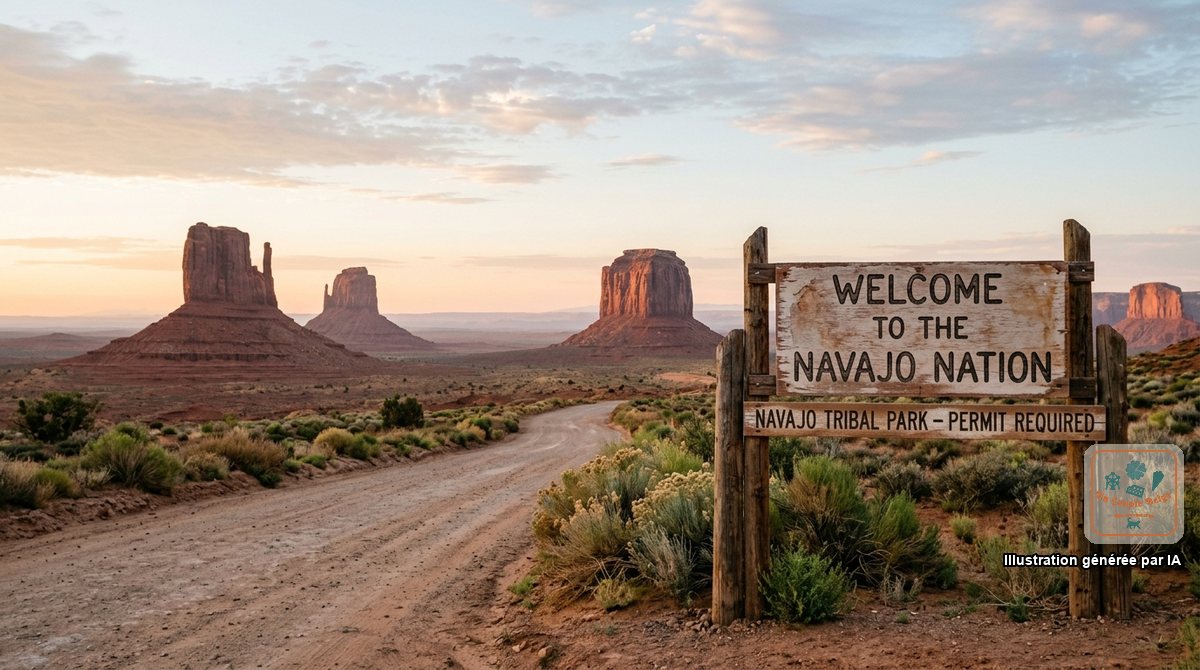
Monument Valley, Antelope Canyon, Canyon de Chelly: several of the best-known landscapes of the West aren’t in national parks, but on the territory of the Navajo Nation.
It’s the largest Native American reservation in the United States, more than twice the size of Belgium, straddling Arizona, Utah and New Mexico. It has its own government, police, laws and visiting rules.
We spent several days there on our first road trip, including two nights facing the buttes of Monument Valley. It’s one of the highlights of the trip.
What changes compared with the national parks
- The America the Beautiful pass isn’t accepted. Each site has its own fee.
- Many sites can only be visited with a Navajo guide.
- The time isn’t always the same as Arizona’s.
- Alcohol is in principle banned throughout the territory.
- You’re in people’s home, not on a film set: families live, farm and raise their animals in the midst of these landscapes.
The time: watch the difference
Arizona doesn’t observe daylight saving time, but the Navajo Nation does. From March to November:
- Monument Valley, Kayenta, Chinle (Canyon de Chelly) are an hour ahead of Page, Flagstaff and the Grand Canyon.
- Page and the Antelope Canyon tours generally follow Arizona time. Check your confirmation: the reference time is stated on it.
In winter, everyone is on the same time. We explain it all in our article on time zones.
Monument Valley
Monument Valley Navajo Tribal Park lies on the border between Arizona and Utah.
- Entry is paid per person, around ten dollars, with a per-vehicle supplement for the dirt road since 2026. The fees changed recently: check on navajonationparks.org.
- The 27 km dirt road (Valley Drive) is driven in your own car. It’s unpaved and bumpy, and not advised for low cars, especially after rain. Motorhomes and motorcycles aren’t allowed on it. Also look at what your rental contract says about unpaved roads (see remote roads).
- Guided tours in open vehicles go further than the public road, into areas closed to unaccompanied visitors: arches, petroglyphs, hogans. They are booked at the visitor center or in advance.
- The only self-guided trail is the Wildcat Trail, a 6 km loop around the West Mitten butte.
- Sleeping on site: The View Hotel and its cabins are the only accommodation inside the park. We watched the sun rise over the Mittens from our cabin.
Everything is in our guide to Monument Valley.
Antelope Canyon
This narrow canyon sculpted by water, near Page, is probably the most photographed in the world. It’s divided into several sections, all on Navajo land.
- A guided tour is compulsory, with a licensed Navajo operator.
- Upper Antelope Canyon: on the flat, wider at ground level, known for its light beams in the middle of the day, from late March to early October. Allow 90 to 120 dollars.
- Lower Antelope Canyon: longer and narrower, with metal ladders to go down and up. Allow 60 to 85 dollars. It’s the one we visited.
- Canyon X and other neighbouring canyons: less busy.
- The Navajo entrance fee (15 dollars per person) is generally included in the price.
- Book several months ahead for summer and the midday slots.
- Bags are banned, as are tripods and selfie sticks. You take only your phone or camera, and a bottle of water.
- Tours are cancelled when there’s a risk of flash flooding (see extreme weather).
- A tip for the guide is expected, in cash: 5 to 10 dollars per person.
See our guide to Page and Antelope Canyon.
Canyon de Chelly
This national monument is managed jointly by the National Park Service and the Navajo Nation, and families still live there.
- The roads along both rims and their overlooks are free and open to all.
- The canyon floor can only be visited with a Navajo guide, on foot, on horseback or by off-road vehicle.
- Spider Rock, a 230-metre spire, is the best-known viewpoint.
See our guide to Canyon de Chelly.
The other sites
- Four Corners Monument: the only point in the United States where four states meet (Arizona, Utah, Colorado, New Mexico). There’s an entrance fee per person.
- Horseshoe Bend: the viewpoint is in a federal area, with a paying car park run by the city of Page. It isn’t a Navajo site.
- Navajo National Monument: ancient cliff dwellings, free.
- Window Rock, the capital, with its arch and the memorial to the Code Talkers, the Navajo soldiers whose language served as a code during the Second World War.
The rules of respect
Taking photos
- Don’t photograph residents, their houses, their herds or their ceremonies without asking permission. A tip is often expected, as for the rider who poses at John Ford’s Point.
- Drones are banned throughout Navajo territory.
- Commercial photography requires a permit.
Getting around
- Stay on the authorised roads and trails. Any hike outside the developed sites requires a permit or a guide.
- Don’t go onto private land, even for a photo.
- Don’t climb the rock formations, and don’t pick anything up: no stones, no pottery, no plants.
- Watch out for animals on the road: horses, sheep, goats and dogs roam freely, especially at nightfall.
Day-to-day life there
- Alcohol is in principle banned: no sales, no drinking, no carrying it. Restaurants don’t serve it.
- Services are few. Kayenta, Tuba City, Chinle and Window Rock have petrol stations, supermarkets and a few hotels. In between, there’s nothing. Fill up beforehand.
- The mobile network is weak or absent.
- Hogans, the traditional eight-sided dwellings, have their door facing east. You only go in by invitation.
Buying crafts
Silver and turquoise jewellery, woven rugs and pottery are sold at stalls beside the roads and at the viewpoints.
- Buy directly from the artisans: the money goes to them, and they readily talk about their work.
- Bring cash, even though many now take cards.
- There’s little haggling. A handmade piece represents days of work.
- Beware of imitations sold in the souvenir shops of the neighbouring towns. The historic trading posts, such as Cameron Trading Post or Hubbell Trading Post, are reliable places.
Trying Navajo food
- Fry bread: a round of fried dough, served plain with honey or sugar.
- The Navajo taco: the same fry bread, topped with beans, minced meat, salad and cheese. One is enough for two.
- Mutton stew.
The restaurant at The View Hotel and the stands in Kayenta serve them.
The other Native American nations
Each nation has its own rules. The Hopi, whose territory is enclosed within that of the Navajo, forbid all photography, recording and drawing in their villages. The Havasupai, at the bottom of the Grand Canyon, require a reservation made months ahead to reach their turquoise waterfalls. Always check the official website of the nation concerned.