Packing for a road trip in the United States
Updated on
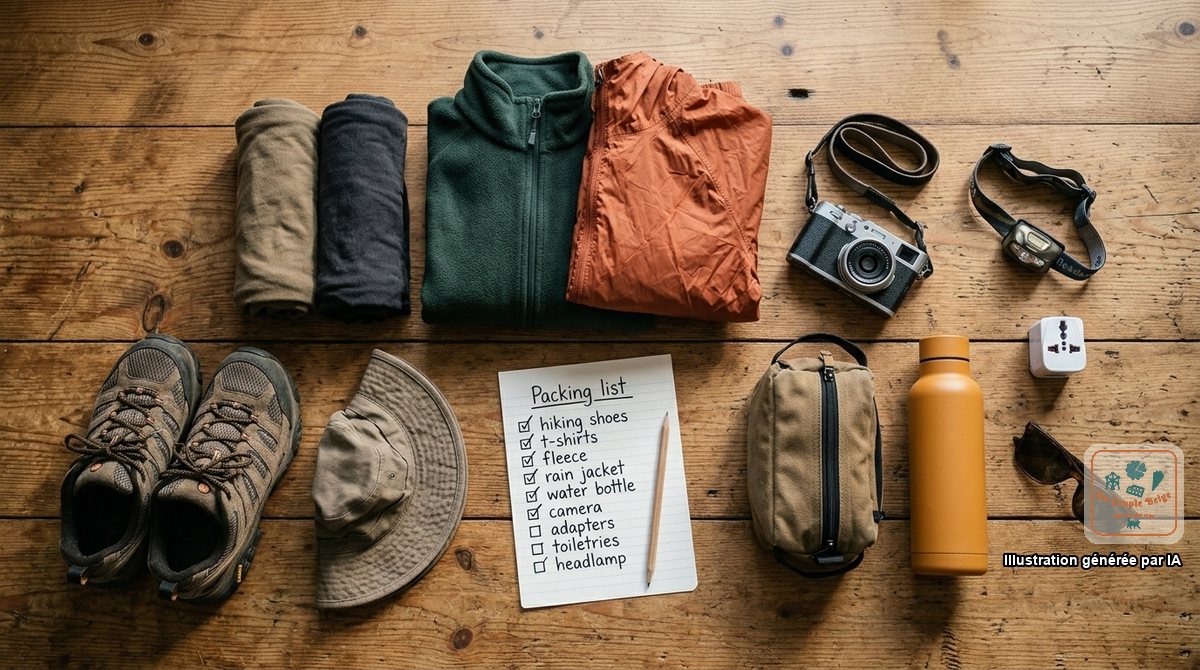
On a road trip, the climate changes as you drive. On our first trip to the West, we were cold in the morning at Bryce Canyon and very hot in Las Vegas two days later. And for our Christmas road trip, the down jacket for New York and the swimsuit for Florida had to fit in the same suitcase.
The solution comes down to two ideas: layers, and a wash along the way.
The principle: a week’s worth of clothes, no more
Whether we’re away for two weeks or five, we take enough for seven to eight days. Nearly all motels have a laundry room, and you’ll find laundromats in every town (see laundry, showers and toilets). A half-empty suitcase on the way out also leaves room for shopping.
Clothes, in three layers
- A breathable layer: technical or light cotton T-shirts, which dry quickly.
- A warm layer: a fleece or a small packable down jacket. It’s useful in the morning at altitude, in the evening in the desert, and anywhere the air conditioning is set to freezing, which is to say almost everywhere.
- A windproof and waterproof layer: a light jacket is enough, except in winter in the North.
For a spring or summer trip in the West, to be adapted to the season:
- 6 or 7 T-shirts, 1 or 2 long-sleeved tops
- 2 pairs of shorts, 2 pairs of trousers including one for hiking
- 1 fleece, 1 thin down jacket, 1 waterproof jacket
- Underwear and socks for 8 days, including 2 or 3 pairs of walking socks
- 1 swimsuit (motel pools, lakes, hot springs)
- 1 slightly smarter outfit for a restaurant or a show
- Cap or hat, sunglasses
- Woolly hat and thin gloves if you’re going to Bryce Canyon, Yosemite or Yellowstone outside high summer
On your feet: hiking shoes that are already broken in (never new), a pair of trainers, and sandals or flip-flops. For walking in water, as in the Narrows at Zion, you rent the equipment on the spot.
Documents
- Passport, and a copy kept somewhere else
- Approved ESTA (the application step by step)
- Belgian driving licence, and the international permit if you’ve applied for one (see driving)
- Bank card in the driver’s name, plus a backup card
- Travel insurance certificate with the assistance number (see insurance)
- Confirmations for the car, the first hotel and any booked visits, saved offline
Electronics
- American plug adapter (type A/B), at least two. Sockets are 110 V: chargers marked “100-240 V” work, European hairdryers rarely do.
- Belgian power strip: a single adapter in the wall, and all your chargers plugged into it.
- Car charger with several USB ports, and the cables to go with it.
- Power bank, to be kept in the cabin: it’s banned from the hold.
- Phone holder for the car, with a suction cup or a clip.
- Camera, memory cards and something to back up onto.
First-aid kit
- Your usual medication, in its box, with the prescription (see getting medical care there)
- Paracetamol, anti-diarrhoea tablets, antihistamine
- Plasters, blister plasters, disinfectant
- Factor 50 sun cream, lip balm
- Mosquito repellent for Florida and the South in summer
- Hand sanitiser, tissues
For the road and for hiking
- Water bottles: one per person, at least a litre. There are fountains for refilling them in all the park visitor centers.
- Small backpack of 20 to 25 litres.
- Head torch, for sunrises and getting back after dark.
- Cloth bags for shopping, and a few freezer bags.
- Binoculars, if you like watching wildlife.
What we buy once we’re there
To pick up at the very first supermarket:
- a cooler (a simple polystyrene one costs a few dollars) and a bag of ice;
- a pack of water or one-gallon jugs;
- extra sun cream and repellent, if needed;
- picnic supplies: cutlery, salt, kitchen roll.
The classic mistakes
- Too many clothes. You always wear the same ones, and you buy more there.
- Light-coloured clothes for hiking. The red dust of Utah doesn’t wash out.
- Nothing warm for a trip to the sun. Restaurants, supermarkets and cinemas are real fridges.