Arizona: the Grand Canyon, and everything else
Updated on
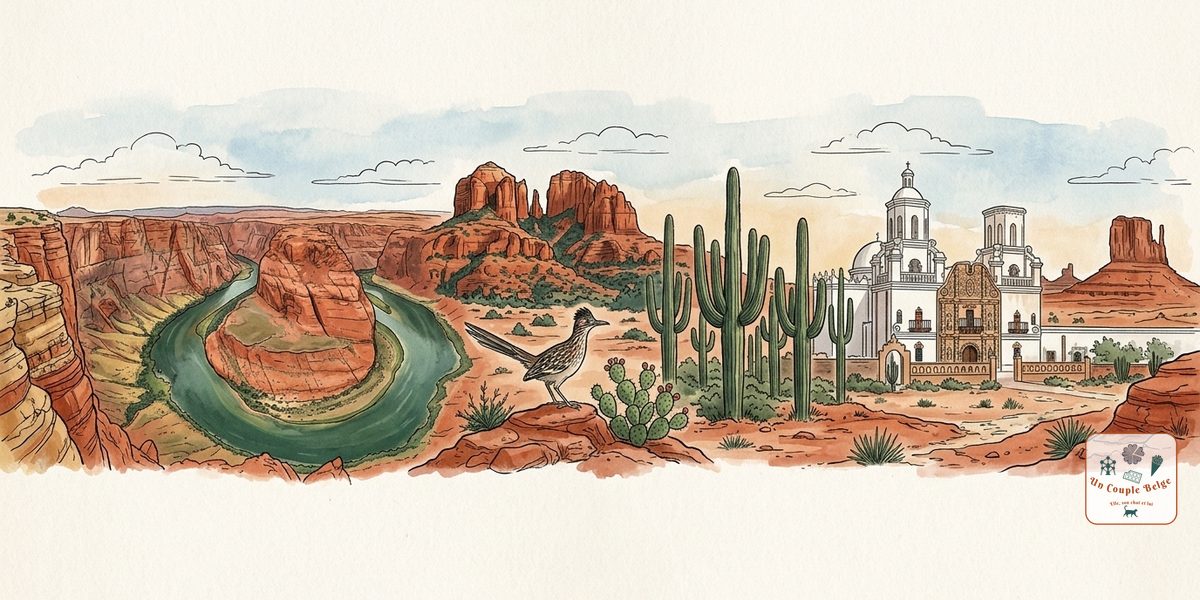
People picture Arizona as one big red desert studded with cacti, and that’s only a small part of the truth. In a few hours on the road, you go from a desert at over 45 °C to pine forests where it snows in winter, with the most famous geological gash in the world in between. It can be snowing in Flagstaff while people are swimming in Phoenix, two hours away.
It’s also a deeply Native American land. More than twenty nations are recognised here, including the Navajo Nation, the largest reservation in the United States, which covers the whole north-east of the state. Monument Valley, Antelope Canyon and Canyon de Chelly are visited on their lands, often with a guide from the community. Travelling in Arizona therefore means going a little beyond the western clichés.
Arizona at a glance
- Capital and largest city: Phoenix
- Population: about 7.5 million
- Area: about 295,000 km², nearly ten times Belgium
- Joined the Union: 1912, 48th state (the last of the contiguous states, before Alaska and Hawaii)
- Time zone: Mountain Time with no daylight saving (8 hours behind Brussels in winter, 9 hours in summer). The Navajo Nation, however, does observe daylight saving time.
- Nicknames: Grand Canyon State, and unofficially Copper State for its copper mines
- Highest point: Humphreys Peak, 3,851 metres, near Flagstaff
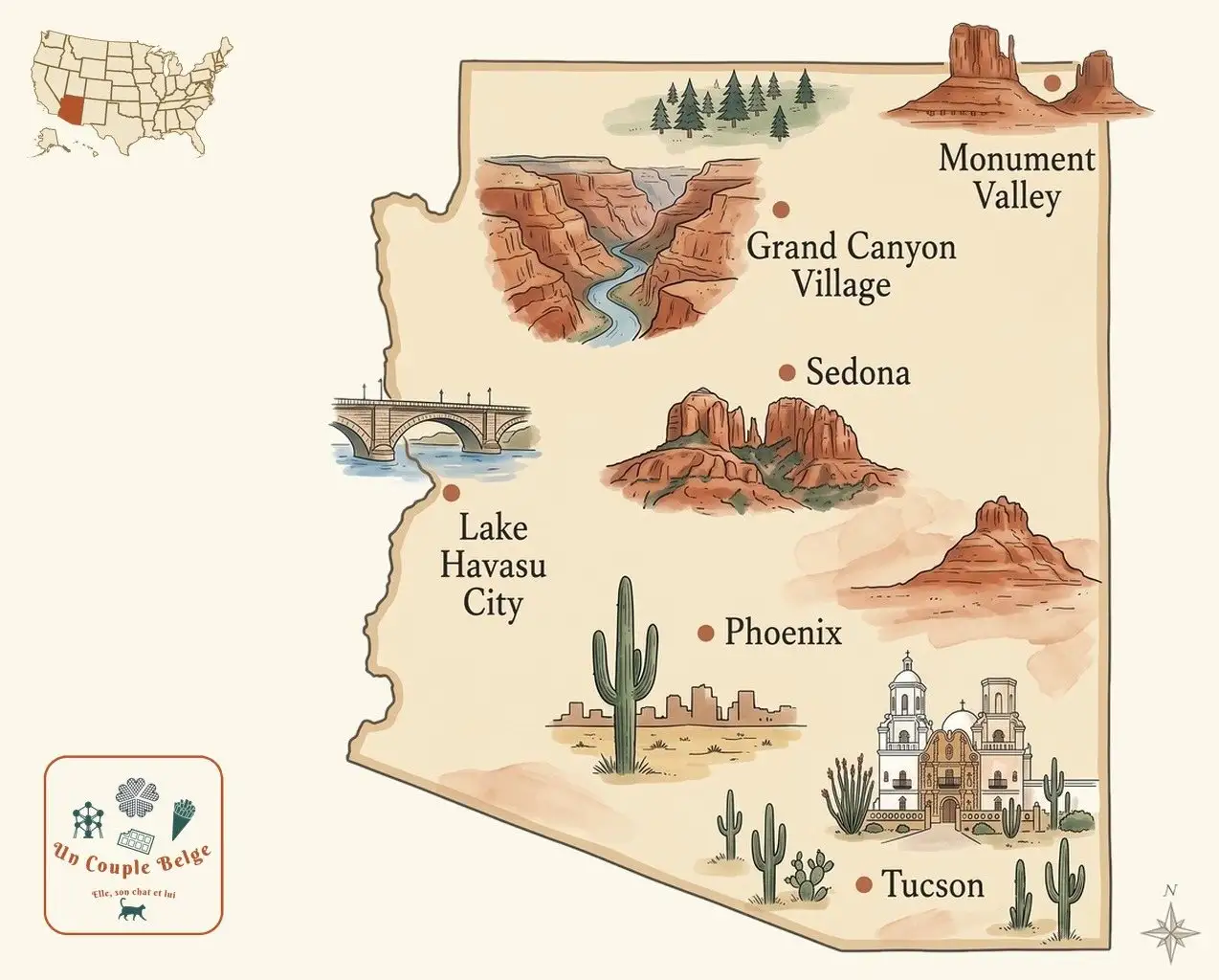
Geography: from the Colorado Plateau to the Sonoran Desert
Arizona reads as three main zones.
The north belongs to the Colorado Plateau, a high plateau between 1,500 and 2,500 metres above sea level, carved by canyons. This is where you’ll find the Grand Canyon, Page, Monument Valley and most of the Navajo and Hopi lands.
The centre is a transition zone, along a great escarpment called the Mogollon Rim. Here are Flagstaff, Sedona, Jerome and the largest ponderosa pine forest in the world.
The south is the Sonoran Desert, the only place in the world where the saguaro, the cactus with arms, grows naturally. Phoenix, Scottsdale and Tucson hold most of the population. Further south-east, small isolated mountain ranges, the “sky islands”, rise above the desert as far as the Mexican border.
A bit of history
Long before the Europeans, the Hohokam farmed the Phoenix valley thanks to hundreds of kilometres of irrigation canals, some of which still form the basis of today’s network. The Ancestral Puebloans left spectacular cliff dwellings in the north, and the Navajo, the Hopi, the Apache and the Tohono O’odham are still here.
The Spanish arrived in the 16th century and founded missions, such as San Xavier del Bac near Tucson. The territory became Mexican in 1821, then American after the war of 1846-1848 and the Gadsden Purchase in 1853. Then came the Wild West years: silver and copper mines, the Apache Wars (Geronimo surrendered in 1886) and the gunfight at the O.K. Corral in Tombstone. Arizona only became a state in 1912.
In the 20th century, dams, irrigation and above all air conditioning turned the desert south into one of the most dynamic regions in the country. Phoenix is now the fifth-largest city in the United States.
The must-sees
The Grand Canyon
No photo really does justice to the Grand Canyon. The Colorado took millions of years to carve this gorge, 446 kilometres long, up to 29 kilometres wide and nearly 1,800 metres deep in places. The rock layers tell nearly two billion years of geological history. Our two days there: day 6 and day 7 of road trip 1.
The South Rim is open all year and draws most of the visitors: Grand Canyon Village, Desert View Drive and its viewpoints, Hermit Road (closed to cars for much of the year, accessible by free shuttle). The Bright Angel and South Kaibab trails go down into the canyon. Descending a few kilometres is enough to change your perspective, but don’t try to go down to the river and back in a day: the climb back up, in full sun, exhausts even fit walkers.
The North Rim is higher, wilder and closed in winter. The historic lodge that stood there was destroyed by a fire in 2025: check which services are available on the park’s website before planning the detour.
Outside the national park, Grand Canyon West, on Hualapai land, offers the Skywalk, a glass walkway over the void. It’s closer to Las Vegas, but expensive, and the view is less impressive than from the South Rim.
Page: Antelope Canyon, Horseshoe Bend and Lake Powell
The small town of Page brings together three classics. Antelope Canyon, a slot canyon sculpted by flash floods, with undulating walls where the light draws beams in the middle of the day. It’s on Navajo land and can only be visited with a guide: book several weeks ahead, especially for the midday slots. Horseshoe Bend, the famous horseshoe-shaped meander of the Colorado, a 1.2-kilometre walk from the car park (paid). And Lake Powell, an immense reservoir with turquoise water among the cliffs, to be explored by boat or kayak. Our day there: day 8 of road trip 1.
Monument Valley
Straddling the Utah border, Monument Valley is the very image of the American West, made famous by John Ford’s westerns. It’s a Navajo tribal park, with its own entrance fee (the national parks pass doesn’t apply). A dirt track of about 27 kilometres loops around the buttes, passable in an ordinary car in dry weather. To reach the areas closed to the public, you need a Navajo guide. Sleeping on site to see the sun rise behind the “Mittens” is well worth it. Our travel diaries: day 9 and day 10 of road trip 1.
Canyon de Chelly
Less well known, Canyon de Chelly is nevertheless one of the most beautiful sites in the state. Navajo families still live and farm on the canyon floor, at the foot of cliff dwellings nearly a thousand years old. The scenic roads along the rims are freely accessible. To go down, only one trail is allowed without a guide, the White House Ruin trail, reopened in 2024 after four years of closure and open seasonally (check locally).
Sedona and Jerome
Sedona is first of all a colour: orange-red sandstone buttes that blaze at sunset, surrounded by pines. The town has an unapologetic New Age feel, with its energy “vortexes” and its crystal shops, but above all it’s a hiking hotspot (Devil’s Bridge, Cathedral Rock, West Fork of Oak Creek) and mountain biking. In high season the trailhead car parks fill up fast: set off early or take the shuttle.
Forty-five minutes away, Jerome is a former mining town clinging to the mountainside, which very nearly became a ghost town before being reborn as an artists’ village. Ideal for a lunch break with a view.
Flagstaff and the north
Flagstaff, at more than 2,100 metres, is a friendly university town and the ideal base for the Grand Canyon (1 hr 30). It was at Lowell Observatory that Pluto was discovered in 1930, and the town was the first in the world to be named an “International Dark Sky City”. The stargazing evenings are worth it.
Nearby: Meteor Crater, a meteorite crater more than a kilometre wide near Winslow, the Petrified Forest and its Painted Desert, with fossilised tree trunks more than 200 million years old, and the small national monuments of Wupatki and Sunset Crater.
Phoenix and Scottsdale
Phoenix isn’t the most charming city in the United States, but it has some good addresses. The Desert Botanical Garden is a fine introduction to desert plants. The Heard Museum is one of the best museums of Native American art in the country. In Scottsdale, Taliesin West was the winter home and studio of the architect Frank Lloyd Wright. And the area has countless urban hiking trails, such as Camelback Mountain, to be done very early in the morning.
Tucson and the south
Tucson has a more relaxed and more Mexican feel than Phoenix. Around the city, Saguaro National Park protects forests of giant cacti, which take decades to grow their first arm and can live for more than 150 years. The Arizona-Sonora Desert Museum, half zoo, half botanical garden, is excellent. Mission San Xavier del Bac, nicknamed “the white dove of the desert”, dates from the end of the 18th century. And the Mount Lemmon road climbs 2,000 metres in an hour, from desert to pine forest.
Further south-east, head for the old Wild West: Tombstone and its O.K. Corral, with re-enactments every day, Bisbee, a former mining town turned artists’ haunt, and Chiricahua National Monument, a forest of rock columns.
Route 66
Arizona has kept one of the finest stretches of Route 66: Seligman and its retro shops, Hackberry and its old petrol station, Oatman, where wild burros wander down the main street, and Winslow, where a street corner pays tribute to the Eagles’ song Take It Easy. Allow a good day from Oatman to Williams with the stops; Winslow lies further east, beyond Flagstaff. We drove part of it on day 5 (Oatman) and day 6 (Seligman) of our road trip 1.
And more…
In 1968, Lake Havasu City bought the old London Bridge, dismantled stone by stone and rebuilt in the middle of the desert, where it now spans a canal. Havasu Falls, turquoise waterfalls at the bottom of a canyon on the Havasupai reservation, require a permit that is very hard to get and several hours’ walking. And the Hoover Dam, on the Nevada border, is an easy visit from Las Vegas.
Itinerary ideas
One week, the north. Phoenix → Sedona (2 days) → Grand Canyon South Rim (1-2 days) → Page (1-2 days) → Monument Valley (1 night), returning via Flagstaff or carrying on into Utah.
10-14 days, the grand tour. Add Tucson and the saguaros at the start, then the Petrified Forest and Canyon de Chelly to the east. About 2,000 kilometres.
The Grand Circle. Many travellers combine Arizona with Utah and Nevada: Las Vegas → Zion → Bryce → Capitol Reef → Moab → Monument Valley → Page → Grand Canyon → Las Vegas. Allow two to three weeks.
On the plate
Arizona’s cooking mixes Mexican, Native American and cowboy traditions.
- The Sonoran hot dog, born on the streets of Tucson: a sausage wrapped in bacon, in a soft bun, with beans, onions, tomatoes, mayonnaise and salsa. A real meal.
- The chimichanga, a deep-fried burrito, which Phoenix and Tucson both claim to have invented.
- The Navajo taco, built on fry bread, a traditional Navajo fried bread.
- Everything made with prickly pear: lemonades, margaritas, sweets, syrups.
- Dates from Yuma, especially in a milkshake.
Tucson was in fact the first city in the United States to be named a UNESCO “Creative City of Gastronomy”, in 2015, for its 4,000 years of farming tradition and its mixed cuisine.
Culture and trivia
- The gunfight at the O.K. Corral, on 26 October 1881, pitted Wyatt Earp, his brothers and Doc Holliday against a band of outlaws. It lasted about thirty seconds and has fed a century of films.
- Dust storms (haboobs) can swallow a motorway in a few minutes during the summer monsoon. The official advice: “Pull aside, stay alive”, meaning park well off the road and turn off your lights.
- The London Bridge in Lake Havasu City really is the original, not a copy. It was bought for about 2.5 million dollars.
- Winslow has put up a statue and a mural at the street corner mentioned in Take It Easy: “Standin’ on a corner in Winslow, Arizona”.
- Arizona ignores daylight saving time, but the Navajo Nation observes it, while the Hopi reservation, enclosed within it, does not. Be careful with tour times in the north-east.
When to go
- Spring (March to May): the best time, especially in the south. The desert is in bloom and temperatures are pleasant everywhere.
- Summer (June to September): extreme in the south, often above 43 °C in Phoenix. The north (Grand Canyon, Flagstaff, Sedona) stays bearable. From July to September it’s the monsoon: violent afternoon thunderstorms, flash floods in the canyons and dust storms.
- Autumn (September to November): excellent everywhere, with fewer people than in spring.
- Winter (December to February): mild and sunny in the south, ideal for Phoenix and Tucson. Cold and sometimes snowy in the north: the South Rim of the Grand Canyon under snow is superb, but some roads close.
Practical information
- Recommended length of stay: 7 to 10 days for the essentials, two weeks to add the south.
- Getting there: Phoenix is the main airport. Las Vegas (Nevada) is often more convenient if you’re starting with the Grand Canyon and Page.
- Getting around: a car is essential. Distances between the major sites are counted in hours.
- Budget: medium. Hotels near the Grand Canyon, in Sedona and in Page climb quickly in high season. The Navajo guided tours (Antelope Canyon, Monument Valley) add to the budget. Since 2026, the national parks pass has cost foreign visitors 250 dollars, and the Grand Canyon is one of the eleven parks that charge a 100-dollar surcharge per person without it: see our guide to the national parks pass.
- Things to watch out for: carry plenty of water, even for a short walk. Never hike in a slot canyon when a storm is threatening. Bear in mind that the “America the Beautiful” pass doesn’t work on tribal lands.
- One more tip: book your Antelope Canyon tour and your accommodation at the Grand Canyon months ahead if you’re travelling between April and October.
Our place guides in Arizona
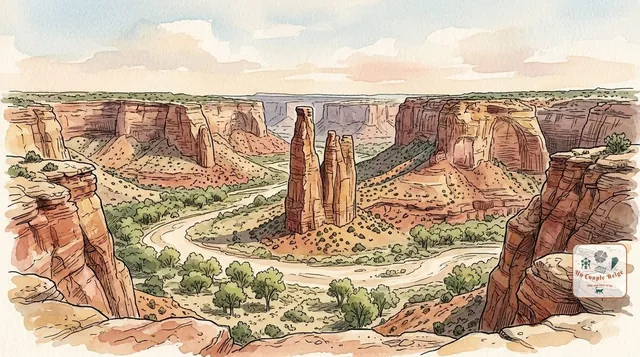
Canyon de Chelly: a Navajo canyon that is still lived in
A red sandstone canyon on Navajo land, inhabited for 5,000 years and still farmed today. You look at it from above for free, and go down into it with a guide.
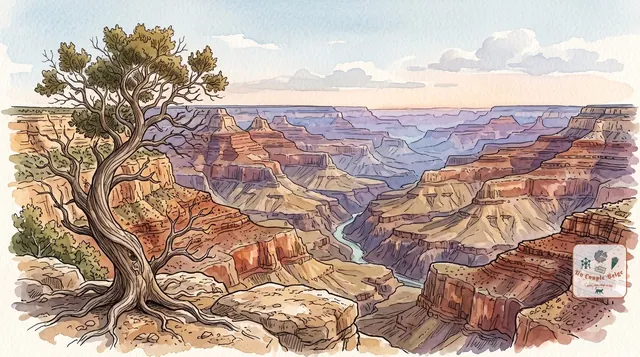
Grand Canyon: the South Rim, from viewpoint to viewpoint
A canyon 446 km long and more than 1,600 metres deep, which you discover from the South Rim, one viewpoint after another. Even half a day is enough to remember it for a long time.
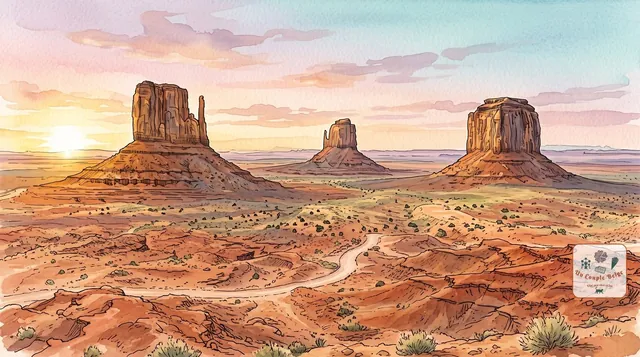
Monument Valley: the red buttes of Navajo country
Red sandstone buttes on a vast plain, on Navajo land: the Western backdrop everyone has in mind, best seen at sunrise.
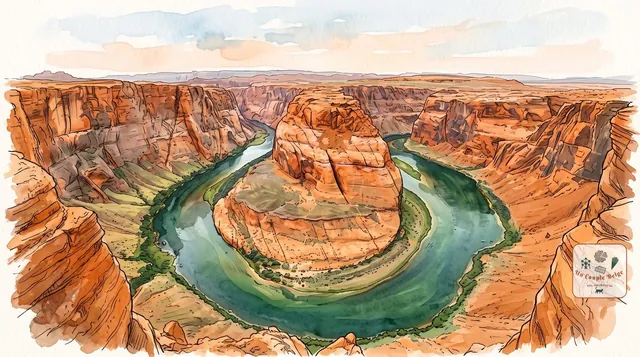
Page: Antelope Canyon, Horseshoe Bend and Lake Powell
A small Arizona town surrounded by sights we have all seen in photos: the orange walls of Antelope Canyon, the bend of Horseshoe Bend and Lake Powell.
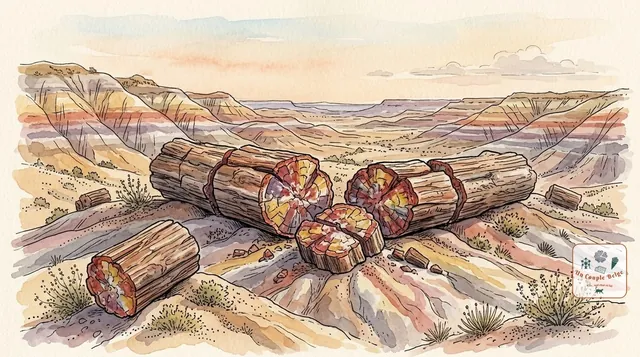
Petrified Forest: a 200-million-year-old forest turned to stone
Tree trunks turned to multicoloured stone more than 200 million years ago, scattered across a desert of striped hills, in Arizona.
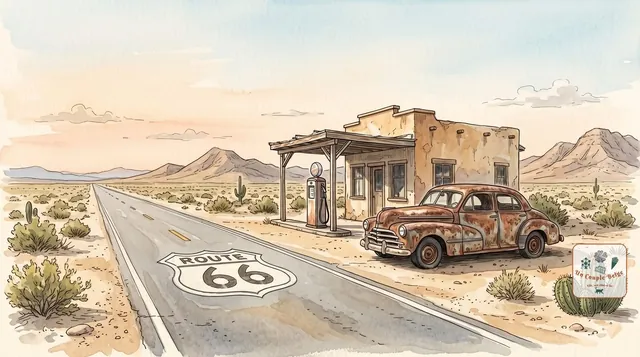
Route 66: from Chicago to Santa Monica, America's legendary road
The most famous road in the United States, from Chicago to Santa Monica: 3,940 km, eight states, neon-lit motels and villages that have stayed in the 1950s.
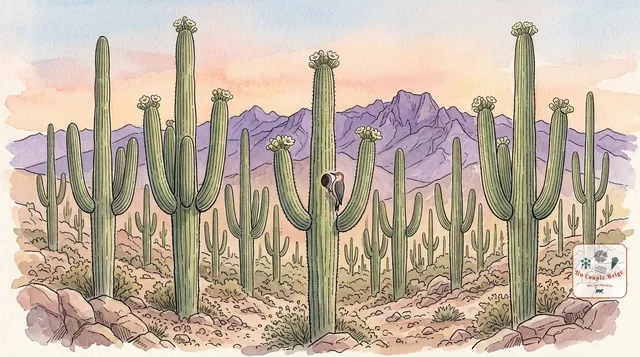
Saguaro: the forest of giant cacti that frames Tucson
Thousands of giant cacti with raised arms, on either side of the city of Tucson. The backdrop to every western, a few minutes from downtown.
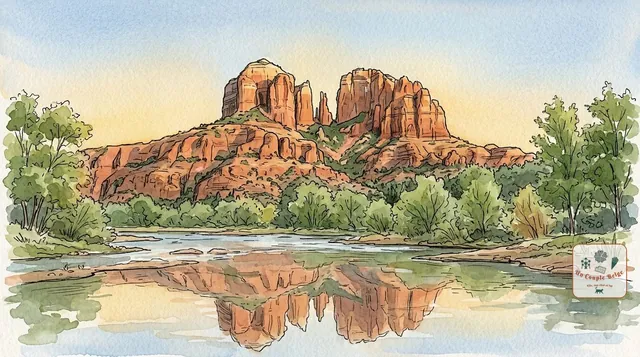
Sedona: red rocks, trails and vortexes
A small Arizona town set among red sandstone buttes, with short, spectacular hikes, art galleries and spiritual tourism.