Las Vegas, a user's guide: hotels, hidden fees, casinos and day trips
Updated on
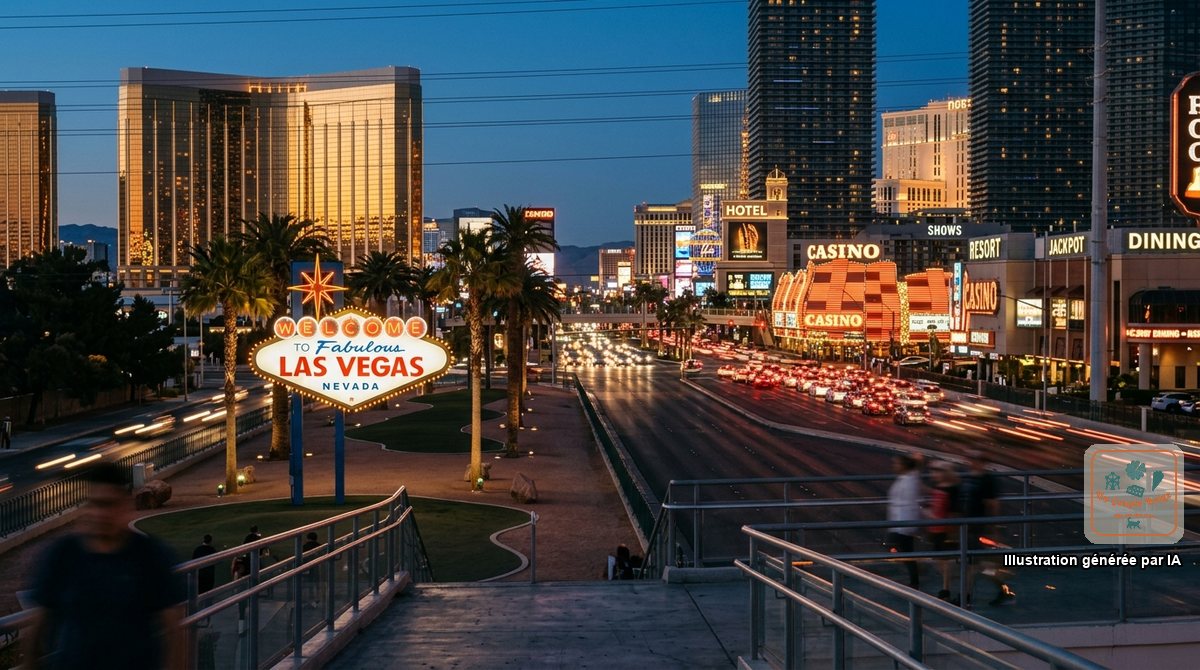
Las Vegas is an almost compulsory stop on a road trip in the West: it’s a well-served airport, a city to sleep in between Zion and Death Valley, and a show in itself.
We spent two nights there on our first road trip, between the red rocks of Valley of Fire and the heat of Death Valley. The contrast is total.
Understanding the city
- The Strip: a seven-kilometre boulevard lined with giant hotel-casinos, each with its own theme. This is where you sleep and stroll.
- Downtown and Fremont Street: old Las Vegas, ten kilometres to the north, with its historic casinos beneath a canopy of screens 420 metres long. The atmosphere there is more down-to-earth and wilder.
- The rest: a big American suburban city, of no interest to the visitor.
Choosing your hotel
Rooms are surprisingly cheap on weekdays, because the hotels are counting on the casino. But the price displayed isn’t the price you pay.
The fees that get added
- Resort fee: 45 to 55 dollars a night on the Strip in 2026, plus the 13.38% room tax. A 60-dollar room therefore costs 120.
- Parking: 20 to 25 dollars a day at the hotels of the two big Strip groups, 40 dollars and more with valet. A few hotels still offer free parking.
- Deposit: 50 to 150 dollars a night blocked on your card.
Always look at the total, fees included, before booking (see motels, hotels and lodges).
When to come
- From Sunday to Thursday, prices are two to three times lower than at the weekend.
- Avoid the big trade shows, such as CES in early January, and the evenings of big games or concerts.
- In summer, it’s 40 to 45°C: you live indoors and by the pool.
Where to stay
- In the centre of the Strip (around the Bellagio, Caesars Palace, the Flamingo, Paris): you can do everything on foot.
- At the south end (Luxor, Excalibur, Mandalay Bay): cheaper, further away.
- Downtown: inexpensive, a different atmosphere.
From our room we could see the High Roller observation wheel and the Sphere, the ball-shaped venue covered in screens.
What you can see without paying
This is the nice surprise: visiting the hotels is free, and it’s the city’s main attraction.
- The Bellagio fountains, every 15 to 30 minutes in the afternoon and evening.
- The Bellagio botanical garden, whose display changes five times a year. On our first visit, we arrived right in the middle of a change of season, among cranes and scaffolding: bad luck.
- The ceiling of glass flowers by Dale Chihuly, in the Bellagio lobby.
- The Wildlife Habitat at the Flamingo, a tropical garden with real flamingos.
- Caesars Palace, its statues and painted domes.
- The Venetian and its canals, the Luxor and its pyramid, New York-New York and its Statue of Liberty.
- Fremont Street and its light shows in the evening.
- The “Welcome to Fabulous Las Vegas” sign, at the south end of the Strip, with a small car park.
- Brand stores, such as the Coca-Cola Store and M&M’s World.
The casino, without ruining yourself
- You must be 21 to gamble and to linger in the gaming areas. Children can walk through them, not hang about.
- Set a budget in cash, and stop when it’s spent. Casino cash machines charge high fees.
- Slot machines take a few dollars. Blackjack and roulette tables have minimum bets of 10 to 25 dollars on the Strip, less Downtown.
- Drinks are free for gamblers. You leave the waitress a tip of a dollar or two.
- People still smoke in the casinos, which comes as a surprise.
You can drink in the street on the Strip, from a plastic cup. Cannabis, legal in Nevada, remains banned in hotels and casinos (see our article).
Eating
- Celebrity chef restaurants: Gordon Ramsay, for example, has several places on the Strip. We tried one for dinner.
- All-you-can-eat buffets, fewer than there used to be, are still an experience: allow 50 to 90 dollars in the evening at the best-known ones.
- The hotels’ food courts and the fast-food outlets on the Strip for a simple meal.
- Off the Strip, everything is half the price.
The shows
Cirque du Soleil, magicians, residency concerts, the Sphere: there are around twenty major productions every evening. The discount ticket booths on the Strip sell seats for the same day. Details in seeing a game or a show.
Getting around
- On foot on the Strip, with good shoes and water.
- The Deuce bus, which runs along the Strip day and night as far as Downtown.
- The monorail, behind the hotels on the east side.
- Uber and Lyft, with specific pick-up points at each hotel.
- A car is only useful for day trips. The airport is ten minutes from the Strip.
Day trips
| Destination | Drive from the Strip |
|---|---|
| Red Rock Canyon | 30 minutes |
| Seven Magic Mountains | 30 minutes |
| Hoover Dam | 45 minutes |
| Valley of Fire | 1 hour |
| Death Valley (Furnace Creek) | 2 hours |
| Grand Canyon West (Skywalk) | 2 hrs 15 |
| Zion | 2 hrs 30 |
| Grand Canyon, South Rim | 4 hrs 30 |
We did Red Rock Canyon in the morning (a timed slot has to be booked from October to May), then Seven Magic Mountains, seven towers of fluorescent boulders standing in the middle of the desert, free. And Valley of Fire on the way in from Zion.
How long?
Two nights are enough for most travellers: an evening on the Strip, a day between the desert and Fremont Street, a second evening. It’s also a good place to do some laundry, some shopping and fill up before heading back to the parks.
See also our guide to Las Vegas and the day 16 travel diary.