Florida: far more than Disney and Miami Beach
Updated on
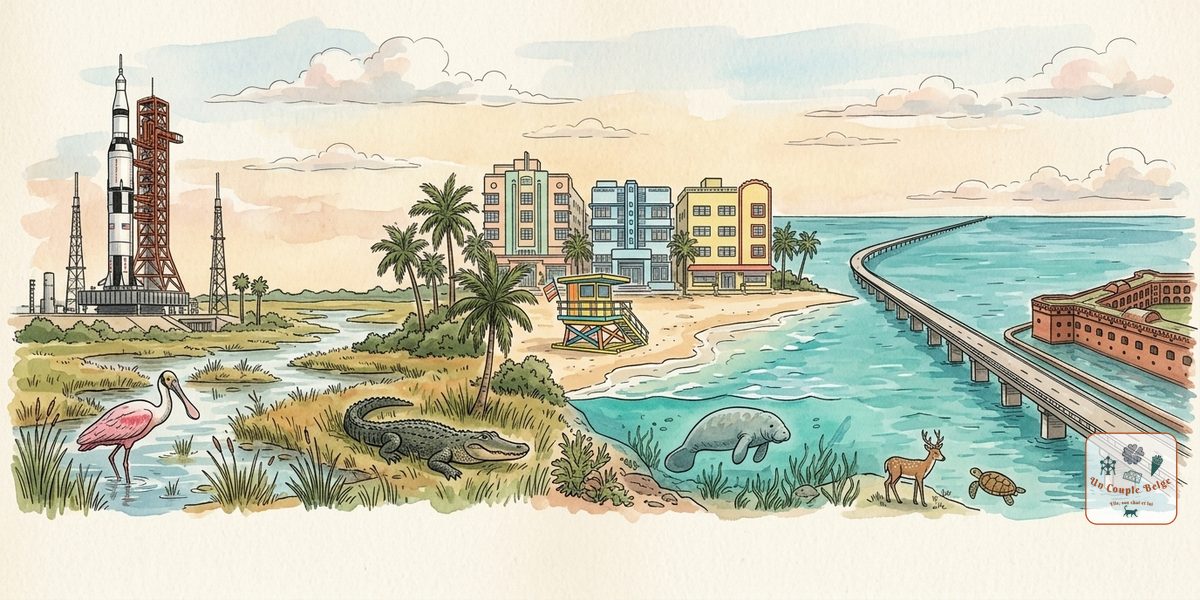
Florida points towards the Caribbean like an outstretched finger, and it’s the only state on the American mainland that truly touches the tropics. People often arrive with ready-made images: the Disney parks, Miami Beach, retirees in the sun. Then they discover a territory far wilder and stranger than the postcard. Alligators cross golf courses, manatees come to warm up in springs of crystal-clear water, and rockets lift off a few kilometres from family beaches.
Florida is also a mosaic. The north, rural and conservative, resembles the Deep South. Miami, Spanish-speaking and cosmopolitan, owes as much to Havana as to New York. The Gulf Coast is quiet, the centre is saturated with theme parks, and the Keys live in a world of their own. Better to choose one or two regions than to try to see everything at once.
Florida at a glance
- Capital: Tallahassee
- Largest city: Jacksonville (but the Miami metropolitan area is by far the most populous)
- Population: about 23 million, the third most populous state
- Area: about 170,000 km², a little over five and a half times Belgium
- Joined the Union: 1845, 27th state
- Time zone: Eastern Time (6 hours behind Brussels). The western Panhandle is on Central Time.
- Nickname: The Sunshine State
- Highest point: Britton Hill, 105 metres, the lowest high point of any state
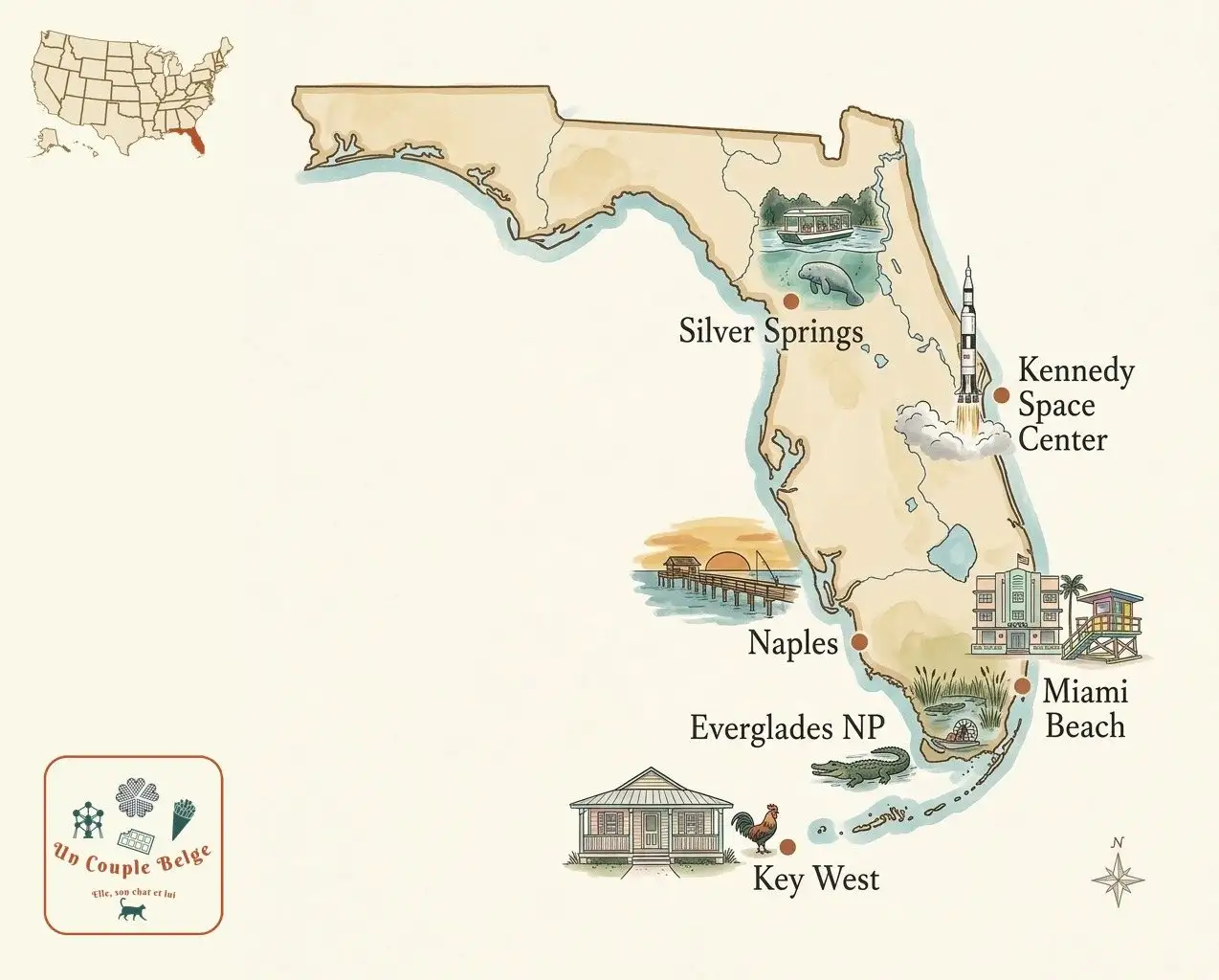
Geography: five Floridas
The Panhandle, in the north-west, borders the Gulf of Mexico with beaches of white quartz sand (Pensacola, Destin, Panama City Beach) and a hinterland of pine forests. Culturally, it’s already Alabama.
The north-east, with Jacksonville and St. Augustine, the oldest city in the United States.
The centre: Orlando and its parks, hundreds of lakes, clear-water springs and, on the east coast, the Space Coast and Cape Canaveral.
The south: the Miami metropolitan area (Miami, Fort Lauderdale, Palm Beach) on the Atlantic coast, the Everglades in the middle, Naples and Fort Myers on the Gulf.
The Keys, finally, a string of coral islands stretching more than 200 kilometres to Key West.
Florida’s bedrock is an immense block of porous, water-filled limestone, which feeds more than 700 springs, one of the largest concentrations in the world.
A bit of history
The Timucua, the Calusa, the Apalachee and other peoples had lived on the peninsula for thousands of years when Juan Ponce de León landed in 1513 and named it “Florida”, the flowery one. The Spanish founded St. Augustine in 1565, the oldest continuously occupied city of European origin in the United States. Florida passed to the British, returned to the Spanish, then was ceded to the United States in 1821.
In the 19th century, the Seminole Wars pitted the US Army against the Seminole, who took refuge in the Everglades and never officially surrendered. Florida became a state in 1845. At the end of the century, the railways of Henry Flagler and Henry Plant opened the peninsula to tourists from the North.
The 20th century sent the population soaring: the property boom of the 1920s, air conditioning, the space programme at Cape Canaveral in the 1950s and 60s, the opening of Walt Disney World in 1971 and the arrival of hundreds of thousands of Cuban exiles after 1959, who transformed Miami.
The must-sees
The Everglades
Everglades National Park protects the southern end of an immense river of grass, tens of kilometres wide and a few centimetres deep, flowing slowly towards Florida Bay. It’s one of the only places in the world where alligators and crocodiles live side by side.
The easiest option from Miami is the Royal Palm Visitor Center and its boardwalk trail, the Anhinga Trail, where you’re almost certain to see alligators, turtles and birds. To the north, Shark Valley is explored by bike or tram on a 24-kilometre loop, with an observation tower in the middle. Airboat tours, on those boats with a big propeller, take place outside the national park, along the Tamiami Trail. It’s noisy but spectacular. And at Flamingo, right in the south, you can rent kayaks to explore the mangroves. Our day there: day 12 of road trip 2.
Miami
Miami is several cities in one. South Beach, on Miami Beach, with its Art Deco district of pastel 1930s façades, its beaches and its nightlife. Little Havana, where you drink a very sweet Cuban coffee at the counter and where the old-timers play dominoes in Máximo Gómez Park. Wynwood, a former warehouse district covered in street-art murals. And Coconut Grove or Coral Gables, greener and calmer, with the Venetian Pool, a public swimming pool dug out of an old coral rock quarry. Our travel diaries: day 10 and day 11 of road trip 2.
Just to the south, Biscayne National Park is 95% underwater, ideal for snorkelling and kayaking.
The Keys and the Overseas Highway
The Overseas Highway links the tip of Florida to Key West over about 180 kilometres, hopping from island to island across some forty bridges, including the Seven Mile Bridge, 11 kilometres long. It follows the route of Henry Flagler’s railway, destroyed by the 1935 hurricane and turned into a road. The Keys can be driven in one day in a single go, but they deserve several. We spent three days there: day 13, day 14 and day 15 of road trip 2.
Along the way: John Pennekamp Coral Reef State Park in Key Largo, the first undersea park in the United States, fishing in Islamorada, the sea turtle hospital in Marathon and the beach at Bahia Honda. At the end, Key West cultivates its end-of-the-world atmosphere: the sunsets at Mallory Square, the chickens roaming free in the streets, Ernest Hemingway’s house and its six-toed cats, and the “Southernmost Point” marker, 145 kilometres from Cuba.
110 kilometres offshore, Dry Tortugas, a 19th-century fort set on a sandy islet, is reached by ferry or seaplane. It’s one of the finest excursions in Florida, and you have to book months ahead.
Orlando and the theme parks
Orlando is the theme park capital of the world. Walt Disney World has four parks (Magic Kingdom, EPCOT, Hollywood Studios, Animal Kingdom) and two water parks. Universal Orlando has three, including Epic Universe, opened in 2025, and SeaWorld completes the picture. Allow at least one day per park, and prepare your schedule (reservations, paid queue-jumping passes, apps) before you go: it has become a sport in its own right.
The Kennedy Space Center
An hour east of Orlando, the Kennedy Space Center tells the story of the space race on the very site of the Apollo and shuttle launches. You see a real Saturn V, the shuttle Atlantis, and you can sometimes watch a launch. With SpaceX and the other private companies, launches from Cape Canaveral are now frequent: check the calendar, and watch from the beaches of Cocoa Beach or Titusville.
The springs and the manatees
North-central Florida is dotted with springs of crystal-clear water at 22 °C all year round. At Silver Springs, you discover them by glass-bottomed boat (swimming is forbidden there). To swim, head for Ichetucknee, Rainbow Springs, Ginnie Springs or Blue Spring, where you float down the river on a tube.
In winter, from November to March, hundreds of manatees come to warm up in these springs. Crystal River is even the only place in the United States where you can legally swim with them, following strict rules. At Blue Spring State Park, you watch them from a boardwalk. And at Weeki Wachee, “mermaids” have been putting on underwater shows since 1947.
St. Augustine
The oldest city in the United States has kept a historic centre of narrow streets, with the Castillo de San Marcos, a 17th-century Spanish fort built of coquina (a stone made of shells). In the evening the town comes alive, and in winter it’s covered in lights. To the south, the beaches of Daytona Beach are one of the few places where you can still drive a car on the sand.
The Gulf Coast
Calmer than the Atlantic coast, the Gulf Coast has white-sand beaches and sunsets over the sea. Naples is smart, Sanibel and Captiva are famous for their shells, Sarasota has a rich cultural life (the Ringling estate and museum), and St. Petersburg is home to the Dalí Museum, one of the largest Dalí collections outside Europe. In Tampa, the Ybor City district keeps the memory of the Cuban cigar factories. Our travel diaries on this coast: day 17 and day 18 of road trip 2.
Further north, the beaches of the Panhandle (Pensacola, Destin, Grayton Beach) are among the most beautiful in the country, with emerald water and sand that squeaks underfoot.
Itinerary ideas
10 days, the south. Miami (3 days) → Everglades (1 day) → the Keys down to Key West (3 days) → back up and the Gulf Coast: Naples, Sanibel (2-3 days).
Two weeks, the big loop. Miami → Keys → Everglades → Naples and Sarasota → St. Petersburg and Tampa → the springs and manatees of Crystal River → Orlando → Kennedy Space Center → St. Augustine → back to Miami along the Atlantic coast.
With the family. Orlando and its parks (4-5 days), the Kennedy Space Center, then a week at the beach on the Gulf or in the Keys.
On the plate
- Key lime pie, made with the limes of the Keys, on a graham cracker base. It’s the state’s official pie.
- The Cuban sandwich: ham, roast pork, Swiss cheese, pickles and mustard, pressed in crusty bread. Tampa adds salami, which sets off an endless rivalry with Miami.
- Stone crab, of which only one claw is harvested, and it grows back. The season runs from mid-October to early May.
- Conch fritters from the Keys, and the grouper sandwich, a fillet of grouper breaded or grilled.
- Cuban coffee (cafecito) and Miami’s pastelitos.
- Gator bites, nuggets of fried alligator, for the curious.
- And of course citrus: Florida remains a major producer of oranges and grapefruit.
Culture and trivia
- “Florida Man” has become an American expression for the absurd news stories that come out of Florida. One of the reasons put forward: Florida law makes police reports very easily accessible to journalists.
- The Fountain of Youth that Ponce de León supposedly searched for is a legend invented after his death. St. Augustine nevertheless runs a tourist version of it.
- Florida is the lightning capital of the United States: summer thunderstorms break almost every afternoon.
- The Seminole, who resisted the US Army, today run casinos and the Hard Rock chain worldwide.
- Spring training: from February to March, a good share of the professional baseball teams train in Florida, with low-priced games.
When to go
- Winter (December to April): high season, dry and pleasant, between 20 and 27 °C in the south. It’s the ideal time for the Everglades (the animals gather around the waterholes) and for seeing manatees. Prices are the highest of the year, especially in March, during spring break.
- Spring (April-May): hot but still dry, a good alternative.
- Summer (June to September): hot and very humid, with a thunderstorm almost every afternoon. It’s low season in the south, but high season in Orlando and the Panhandle.
- Hurricane season: officially from June to November, peaking between mid-August and mid-October. Take out travel insurance and keep an eye on the weather.
Practical information
- Recommended length of stay: 10 days for the south, two weeks to combine several regions.
- Getting there: Miami and Orlando are reached with one stop from Brussels (there’s no regular direct flight). Fort Lauderdale and Tampa are good alternatives.
- Getting around: a car is essential. Many motorways have electronic tolls: take your rental company’s transponder (SunPass) to avoid billing fees.
- Budget: variable, from moderate in the centre and north to very high in Miami Beach, in the Keys and in the Orlando parks. Since 2026, the national parks pass has cost foreign visitors 250 dollars, and the Everglades charge a 100-dollar surcharge per person without it: see our guide to the national parks pass.
- Things to watch out for: never swim at dawn or dusk in freshwater lakes and rivers (alligators). Beware of rip currents on the Atlantic and protect yourself from the sun and mosquitoes.
- One more tip: book accommodation in Key West and the Dry Tortugas ferry very early, and pack a light raincoat, even in the dry season.
Our place guides in Florida
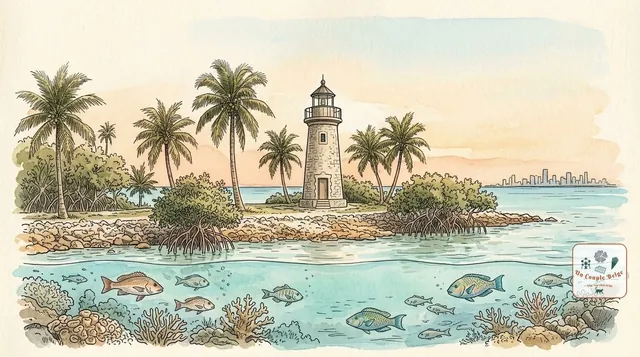
Biscayne: a national park that is 95% underwater, on Miami's doorstep
A national park almost entirely underwater, 45 minutes from Miami: a turquoise bay, mangroves, islands and the start of Florida's coral reef.
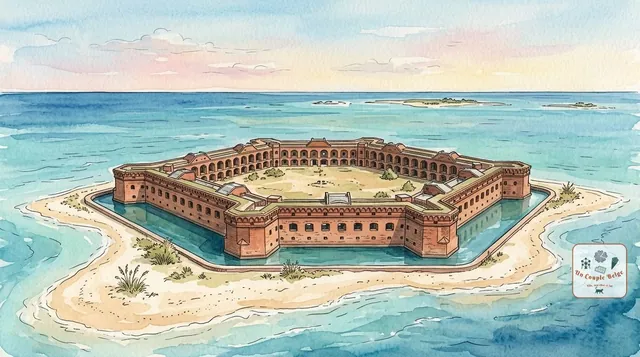
Dry Tortugas: a 19th-century fort alone in the open sea, 110 km from anything
A huge brick fort set on an islet, 110 km off Key West, in the middle of turquoise water. You can only get there by boat or seaplane.
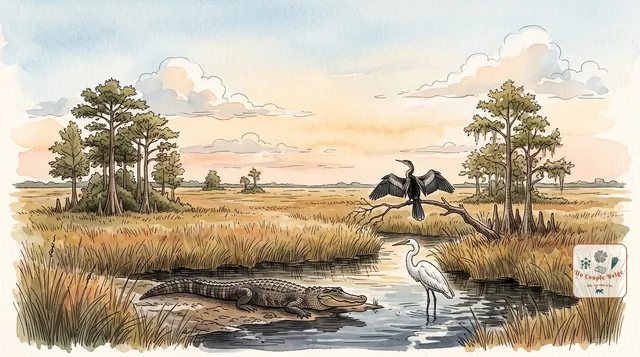
Everglades: the "river of grass" where alligators and crocodiles live side by side
A vast plain of grass and water in southern Florida, where you come across alligators a few metres from the path. It is also the only place in the world where they share their home with crocodiles.
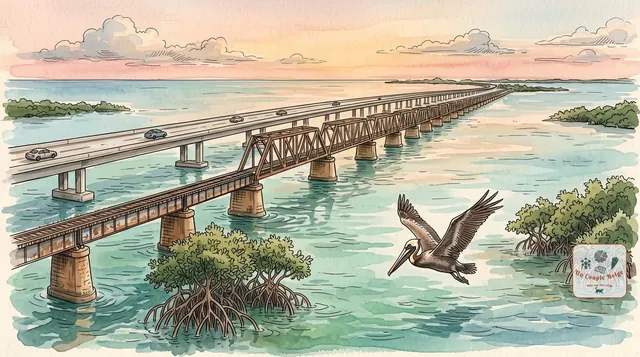
Florida Keys: 180 km of road above the ocean, all the way to Key West
One road, 42 bridges and the sea on both sides: the Overseas Highway hops from island to island, from the Seven Mile Bridge to the wooden houses of Key West.
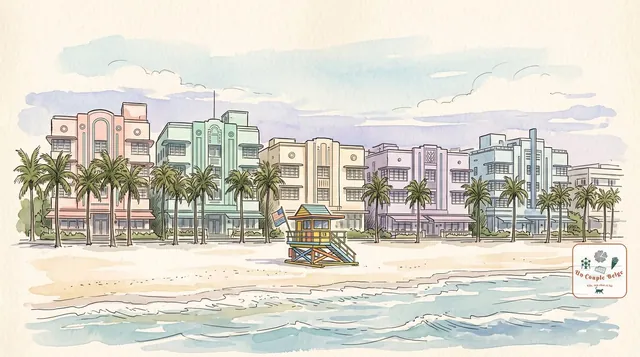
Miami: Art Deco, Latin culture and Atlantic beaches
The pastel façades and neon lights of South Beach, the Cuban cafés of Little Havana, the quiet beaches of Key Biscayne: there is more to Miami than its beach.