Travelling vegetarian, gluten-free or with allergies in the United States
Updated on
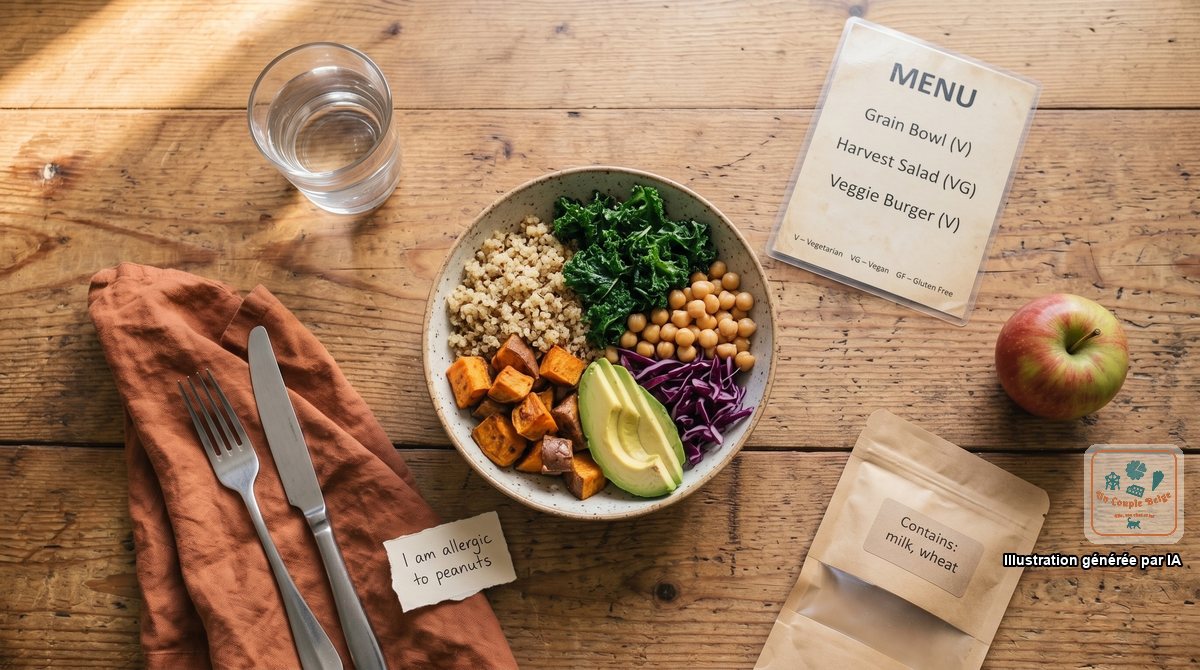
The United States has a reputation as the land of meat and melted cheese. It’s also one of the countries where it’s easiest to eat vegetarian, gluten-free or lactose-free: restaurants are used to special requests, labels are clear, and supermarkets are full of suitable products.
The difficulty lies elsewhere: in remote small towns and in a few dishes where meat is hiding.
The vocabulary
| What you mean | What you’ll read or say |
|---|---|
| Vegetarian | Vegetarian |
| Vegan | Vegan or plant-based |
| Gluten-free | Gluten-free (GF) |
| No lactose, no dairy products | Lactose-free, dairy-free |
| No nuts | Nut-free |
| Coeliac disease | Celiac disease |
| Allergy | Allergy |
| Nuts such as almonds, walnuts, hazelnuts | Tree nuts |
| Peanuts | Peanuts |
| Crustaceans and molluscs | Shellfish |
| Wheat | Wheat |
| Eggs | Eggs |
| Soya | Soy |
| Sesame | Sesame |
Useful phrases
- I’m vegetarian. Does this have any meat or meat broth in it?
- I have a severe peanut allergy.
- I have celiac disease. I can’t have any gluten.
- Is it cooked in the same fryer?
- Could you check with the chef?
At the restaurant
- Say so as soon as you order, clearly. The word allergy is taken very seriously: the server warns the kitchen, and a manager sometimes comes to the table to confirm.
- Distinguish an allergy from a preference. “I don’t eat” is a preference, “I’m allergic to” triggers precautions.
- Menus often flag dishes with symbols: V, VG, GF.
- You can change almost anything: remove the bacon, swap the bread, have the sauce on the side. Nobody is surprised.
- Chains publish their allergen charts online, dish by dish.
- Say thank you with a good tip when the server has gone to some trouble.
Cross-contamination. Ask whether the fries share oil with breaded products, and whether gluten-free pasta is cooked in separate water. An honest kitchen will tell you it can’t guarantee anything.
The dishes where meat is hiding
- Beans (refried beans, baked beans) are often cooked with lard or bacon.
- Southern vegetables (collard greens, green beans) are simmered with pork.
- Vegetable soups are made with chicken or beef stock.
- The rice in Mexican restaurants is sometimes cooked in chicken stock.
- Salads arrive with crumbled bacon.
- Caesar dressing contains anchovies, and so does Worcestershire sauce.
- Pies and biscuits may contain lard.
- Marshmallows and many sweets contain gelatine.
The regions, from easiest to trickiest
- Very easy: California, Oregon, Washington State, New York, Colorado, big cities in general. Vegan restaurants are plentiful there.
- Easy: urban Florida, the Northeast, university towns.
- Harder: the rural South, Texas outside the cities, the Great Plains, the small towns of the West near the parks, where the menu comes down to burgers, steaks and ribs.
Even there, you can almost always find a plant-based burger, a salad, a pizza or a baked potato.
The handy chains on the road
For vegetarians and vegans
- Chipotle and the other Mexican chains: bowls and burritos assembled in front of you, with beans, rice, vegetables and guacamole.
- Taco Bell: almost everything can be ordered in a vegetarian version.
- Plant-based burgers (Impossible, Beyond) are on the menu at many chains, including Burger King.
- Panera Bread, Sweetgreen, Cava: salads, soups and bowls.
- Indian, Thai, Ethiopian and Mediterranean restaurants, found in every city.
- Subway: vegetable sandwiches everywhere, even in the middle of nowhere.
For gluten-free
- Chipotle: almost everything, except the wheat tortillas.
- In-N-Out and Five Guys: a burger wrapped in lettuce instead of a bun (protein style or lettuce wrap).
- Steakhouses: grilled meat, baked potato, vegetables.
- Pizzerias often offer a gluten-free base, though baked in the same oven.
- Mexican restaurants, with corn tortillas.
At the supermarket
Labelling. The law requires nine allergens to be clearly flagged: milk, eggs, fish, crustacean shellfish, tree nuts, peanuts, wheat, soy and sesame. They appear in bold in the list of ingredients or in a “Contains:” line just below it.
- Gluten isn’t on that list: only wheat is. Barley and rye can therefore go unnoticed. Look for the words Gluten-Free or the logo of a certification body.
- The wording “May contain” or “Processed in a facility that also processes” is optional. Its absence guarantees nothing.
- The Certified Vegan and Certified Gluten-Free logos are reliable.
Where to shop
- Trader Joe’s and Whole Foods have the widest choice of vegan and gluten-free products.
- Walmart, Kroger, Safeway and Target all have a dedicated, well-stocked section.
- Plant milks, tofu, hummus and veggie patties are found everywhere.
See grocery shopping.
In the national parks
This is where the choice is thinnest: a cafeteria, a general store, sometimes a single restaurant 30 km away.
- Shop before you go in, in the last big town.
- Bring a cooler and what you need for your picnics.
- Lodges generally have one or two vegetarian dishes, and adapt on request.
- With a stove or a kitchenette, you’re self-sufficient (see cooking in a van).
On the plane
Order your special meal (vegetarian, vegan, gluten-free) from the airline at least 48 hours before the flight. Bring something to eat all the same: mistakes happen, and the second meal service is rarely adapted.
In the event of a severe allergy
- Bring your adrenaline auto-injector, two of them, in the cabin, with the prescription and a certificate in English. In the United States it’s known as an EpiPen, is sold on prescription only, and is very expensive.
- Carry a card in English describing your allergy and the treatment.
- If you have a reaction, use the injector and call 911: say “anaphylaxis”.
- Check your travel insurance: a known allergy must be declared (see insurance and getting medical care).
- Tell the airline about a peanut allergy.
Halal and kosher
- Kosher food is easy to find in New York, Miami and Los Angeles. A great many supermarket products carry a certification symbol: a U or a K in a circle.
- Halal food is available in the big cities, notably New York, Chicago, Houston and Detroit, and in Middle Eastern and South Asian restaurants.
- Elsewhere, vegetarian options and fish will see you through.
The apps
- HappyCow lists vegetarian and vegan restaurants all over the world.
- Find Me Gluten Free does the same for gluten-free, with reviews from people with coeliac disease.
- The chains’ apps show the allergens in each dish.