Travelling in the United States with children: paperwork, car seats and pace
Updated on
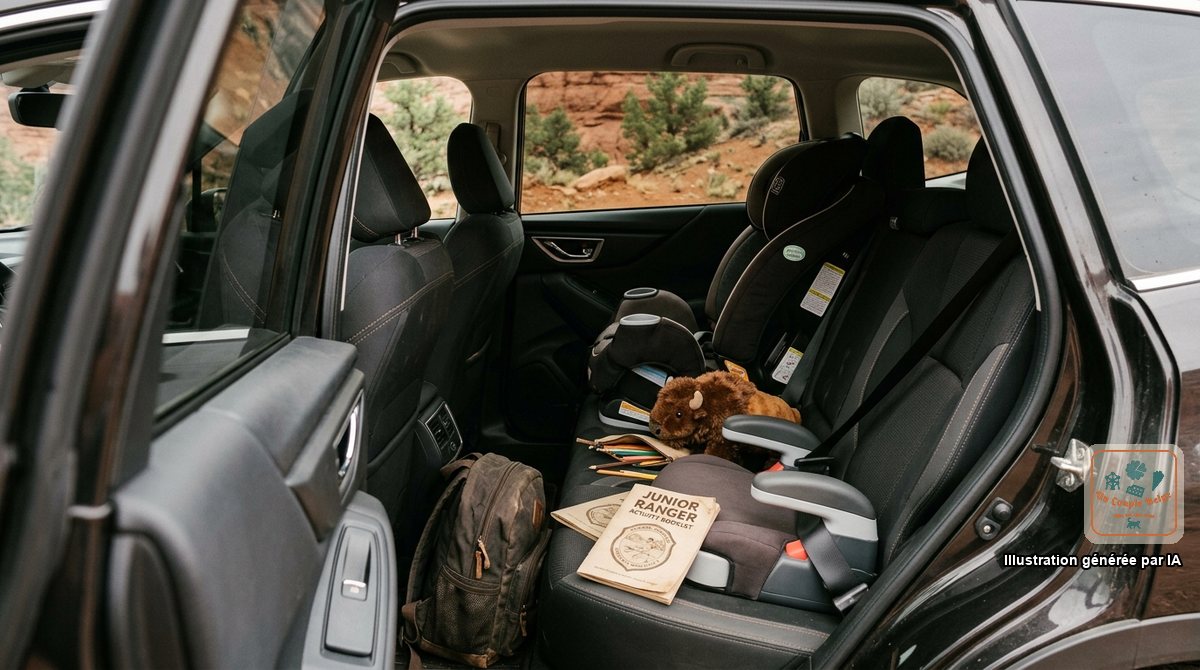
The United States is an easy destination for families: everything is geared to children, from menus to rooms with two big beds, and the national parks are an immense playground for these junior rangers.
What needs attention is the paperwork before you leave, safety in the car and the pace of the days.
The paperwork
- One passport per child, babies included. Waiting times get longer before summer: apply early.
- One ESTA per child, whatever their age. The application is made in the same way as for an adult (see the procedure).
- A child travelling with only one parent, or with other adults: take a written authorisation from the other parent or from both, in English, with their contact details and a copy of their identity document. US customs strongly recommends it, and the airline may ask for it at boarding. Your town hall can certify the signature.
- A surname different from that of the accompanying parent: add a copy of the birth certificate.
- Travel insurance must cover each child (see insurance).
Car seats
All fifty states require an appropriate seat. The rules vary, but all follow the same pattern:
| Age or height | Equipment |
|---|---|
| Up to about 2 years | Rear-facing seat |
| From 2 to 4 or 5 years | Forward-facing seat with a harness |
| Up to 8 years, or 1.45 m | Booster seat |
| Up to 13 years | Back seat recommended |
Three solutions
- Renting the seat with the car: 10 to 15 dollars a day, capped at 70 or 90 dollars per rental. Quality and cleanliness are uneven, and the model you reserved isn’t always available.
- Buying one there: a booster costs 20 to 40 dollars at Walmart or Target, a full seat 60 to 120 dollars. Over three weeks, that’s often cheaper than renting.
- Bringing your own: most airlines carry it free in the hold. Be aware that a seat approved in Europe doesn’t carry the American certification. In the event of a check or an accident, that can cause problems.
American cars have the LATCH anchoring system, compatible with Isofix fittings.
The pace
This is what makes or breaks the trip.
- Two to three hours of driving a day on average, four at most, with a proper break in the middle.
- Two or three nights per stop rather than a new hotel every evening.
- One big activity a day, not three.
- Pool time in the late afternoon: nearly all motels have one, and it’s often the children’s best memory.
- One day without the car each week.
In the national parks
The Junior Ranger programme. In every park, children are given a free activity booklet at the visitor center: observing, drawing, answering questions. Once it’s filled in, they take an oath in front of a ranger and receive a wooden or metal badge. Many children then want to collect one per park. The booklets are in English, but the rangers are lenient.
Short trails. Every park has flat walks of one to two hours, often paved: the Riverside Walk at Zion, the rim trail at Bryce Canyon and the Grand Canyon, Lower Yosemite Fall, the geyser boardwalks at Yellowstone.
Prices. Entry is free for under-16s, and the surcharge applied to foreigners in the eleven big parks doesn’t concern them (see the parks guide).
Safety
- Water and sun: a child dehydrates faster than an adult. Hat, sun cream, a water bottle each.
- Cliffs: guard rails are rare. Hold little ones by the hand at every viewpoint.
- Animals: you don’t go near them and you don’t feed them, not even a squirrel (see wildlife).
- Altitude: above 2,500 metres, plan quiet days.
Sleeping
- The standard room with two queen beds sleeps a family of four at no extra charge. Children generally stay free up to the age of 17.
- A cot (crib) is requested when booking, often free of charge.
- Suites with a kitchenette (Residence Inn, Homewood Suites, Embassy Suites) let you prepare meals.
- KOA campgrounds have playgrounds and pools.
Eating
- Children’s menus (kids menu) cost 6 to 10 dollars, with crayons and colouring. Some restaurants offer children’s meals free on certain evenings.
- High chairs and booster seats are available everywhere.
- Adult portions are easy to share.
- Supermarkets sell everything for babies: nappies, milk, jars of baby food. The brands differ: bring enough to last the first few days.
- Changing tables are found in almost all toilets, including the men’s.
The flight and jet lag
- Up to the age of 2, a baby travels on your lap for about 10% of the fare, without a seat. Ask for a bassinet when booking.
- Bring food and things to keep them busy: headphones, a charged tablet, small games.
- Jet lag is easier to get over heading west. For the first few days the children will be up at 5am: plan morning activities and an early bedtime (see our advice).
In the car
- A cooler with water and snacks within reach.
- Sunshades for the rear windows.
- Audiobooks and playlists downloaded in advance: there’s no signal in the parks.
- One bag per child, with their own things.
- Never leave a child alone in the car, not even for two minutes. It’s dangerous in the heat, and it’s an offence in many states.
The ideas children love
- Animals: the bison of Yellowstone, the alligators of the Everglades, the sea lions of San Francisco.
- Unusual nights: a cabin, a tipi, a tent at Yosemite.
- Theme parks (see our article).
- The free museums of Washington, including the Air and Space Museum.
- The beaches of Florida and California.
- A baseball game (see our article).