A typical day in a big American national park
Updated on
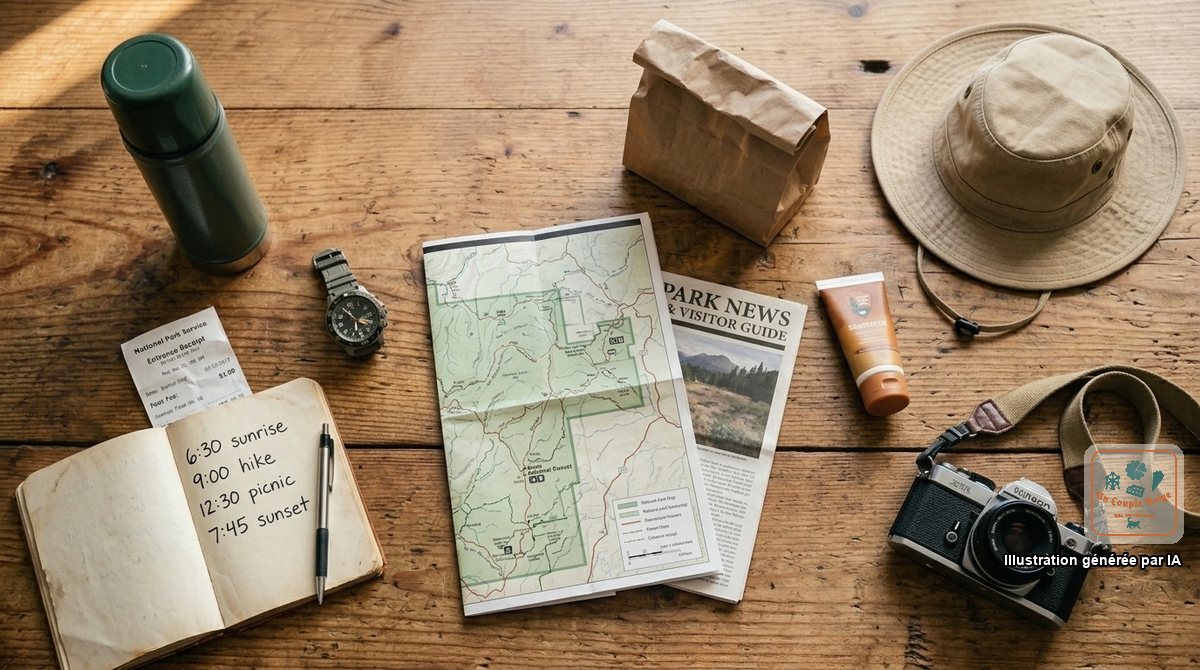
In the busiest parks, the same day can be magnificent or a trial depending on the time you arrive. At 7am, you park at the foot of the trail and walk almost alone. At 10am, you circle a full car park for forty minutes.
Here’s how we organise our days, with what we learned at Zion, Yosemite, Bryce Canyon and the Grand Canyon.
The evening before
- Choose two or three activities, not six: one main hike in the morning, one or two viewpoints, a sunset.
- Check the alerts on the park’s page and in the official app: closed roads, closed trails, river levels, flood risk.
- Look at the weather and the sunrise and sunset times.
- Fill up with fuel: there’s almost never any in the parks, or only at a very high price.
- Prepare the picnic, fill the water bottles and put them somewhere cool.
- Download the park map offline.
- Pack the bags so that you can leave without thinking.
🌅 5.30am to 7am: leaving early
It’s the most useful piece of advice on this whole site. Before 8am:
- there’s no queue at the entrance station;
- the trailhead car parks are empty;
- the light is at its most beautiful;
- it’s cool, which matters in the desert;
- the animals are out and about.
Jet lag helps for the first few days: you’re awake at 5am anyway.
If you’re sleeping 45 minutes from the park, factor in the drive. At Yosemite, Oakhurst is more than an hour from the valley: a night on site, for example in the tents at Curry Village, changes the morning.
A sunrise is worth the alarm at least once per park. At Bryce Canyon, we went back on the morning we left, and at Monument Valley, we watched it from our cabin.
🥾 7am to 11am: the big hike
We schedule the main walk for the morning, when it’s cool and we have energy.
- Use the toilets at the car park: there are none on the trails.
- Take more water than you think you’ll drink.
- Note your turnaround time before setting off, and stick to it.
At Zion, we did the climb towards Angels Landing on the first day, then the Emerald Pools and the Narrows the next. At Yosemite, we devoted one day to Upper Yosemite Falls, and the following one to the Mist Trail.
The advice on preparation is in hiking in the parks.
The shuttles
In several parks, the main road is closed to cars in season, and a free shuttle replaces it.
- Zion: the canyon shuttle leaves from the visitor center, from roughly March to November. The first sets off at around 6am, and the queue soon grows. If the park’s car park is full, you park in Springdale and take the town shuttle.
- Grand Canyon, South Rim: several lines along the rim, including the one on Hermit Road, which is closed to cars for much of the year.
- Bryce Canyon: shuttle recommended in summer, not compulsory.
- Yosemite: free shuttle in the valley.
🧺 11am to 3pm: the slack hours
This is when it’s hot, the light is harsh and the crowds are at their peak. We use the time to do something else.
- Picnic in the shade, at a designated area. Park cafeterias are expensive, average and overrun at midday.
- Call at the visitor center: exhibition, introductory film (often very well made, in an air-conditioned room), relief map, questions for the rangers.
- Drive the scenic road, with its viewpoints.
- Go back to the hotel for a nap or the pool, if you’re staying near the park.
- Visit a lesser-known corner: in every park, one area stays quiet when the rest is overflowing. At Zion, it’s Kolob Canyons; at Yosemite, the Tioga Road; at the Grand Canyon, Desert View.
Refill your water at the visitor center fountains before setting off again.
🌤️ 3pm to 6pm: the second outing
The heat eases, the day trippers leave, the car parks empty.
- A short hike of one to two hours.
- The viewpoints missed in the morning.
- A swim where the park lends itself to it.
🌇 Sunset
Choose the viewpoint in advance, and arrive forty-five minutes beforehand: the best spots get taken, and the light begins to change well before the sun disappears. Stay for twenty minutes afterwards: that’s often when the sky catches fire.
Bring a fleece and a head torch for the walk back to the car.
🌙 The evening
- Eat early. In the gateway towns, restaurants are full at 7pm and close at around 8.30 or 9pm. Book, or arrive before 6pm.
- Drive carefully: at dusk, deer and elk cross everywhere.
- Look at the sky if there’s no moon (see stargazing).
- Go to a ranger talk: many parks offer a free evening presentation by a ranger, in an open-air amphitheatre.
- Recharge everything: phones, batteries, water bottles, cooler.
At the park entrance
- Have the pass and your passport within reach (see the parks guide).
- Take the map and the newspaper the ranger hands you: shuttle timetables, activity programme, closed trails.
- The entrance ticket is valid for seven days. Keep the receipt on the dashboard.
- Ask your questions at the visitor center rather than at the entrance station, where the queue is waiting.
How many days per park?
| Park | Minimum | To make the most of it |
|---|---|---|
| Bryce Canyon | 1 day | A day and a half, with a sunrise |
| Zion | 1 day | 2 days |
| Grand Canyon, South Rim | 1 day | 2 days |
| Arches | 1 day | A day and a half |
| Yosemite | 2 days | 3 to 4 days |
| Yellowstone | 3 days | 4 to 5 days |
| Death Valley | 1 day | 2 days |
| Monument Valley | Half a day | A night on site |
Our guides cover each park in detail: Zion, Yosemite, Bryce Canyon, Grand Canyon, Yellowstone.
Avoiding the crowds, in short
- Before 8am and after 4pm, the park is yours.
- On weekdays rather than at the weekend, and never over an American long weekend (see the calendar).
- Ten minutes’ walk from the car park, there’s nobody left.
- On the second best-known trail, not the first. Ask the rangers for their favourite.
- Out of season: May, September and October are the best months in most parks of the West.