Hiking in the American parks: preparation, permits and safety
Updated on
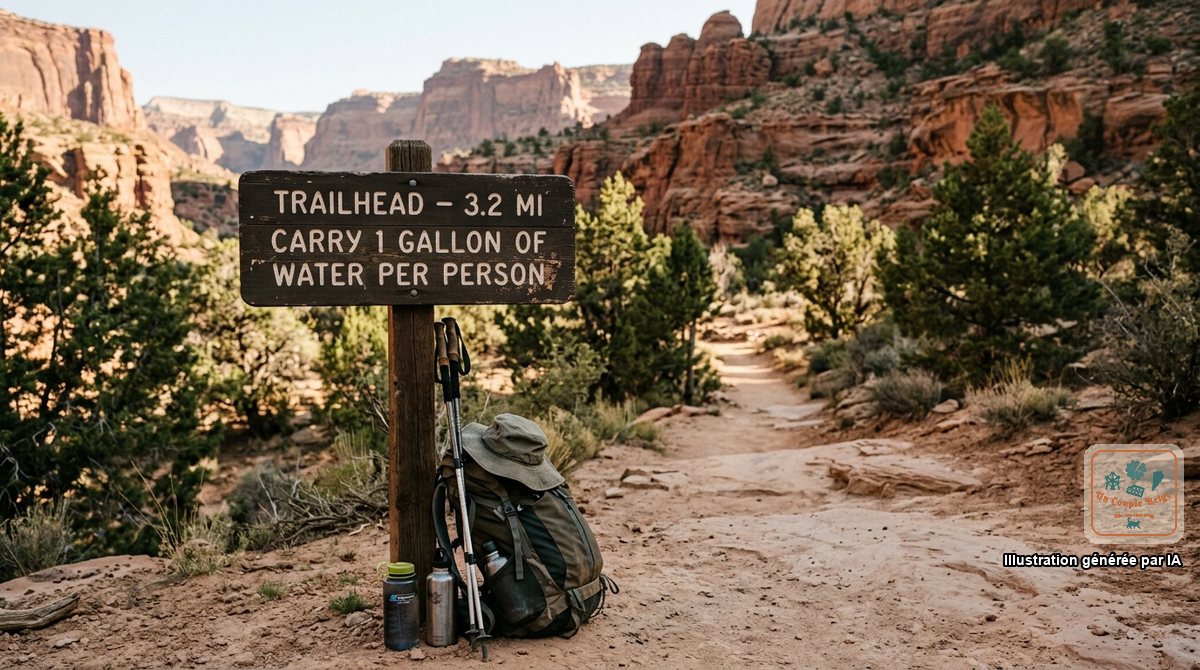
You don’t really see a national park from its viewpoints. It’s by walking down among the hoodoos of Bryce Canyon, climbing to the top of Yosemite’s waterfalls or wading up the river in the Narrows that you bring back the best memories.
American trails are very well maintained and marked. They still call for a different kind of preparation from a stroll in the Ardennes.
Choosing your trail
The reliable sources
- The park newspaper handed out at the entrance and the nps.gov website, with the official list of trails.
- The rangers at the visitor center: tell them your level and how much time you have, and they know the state of the trails that day.
- AllTrails, for recent reviews and tracks (see useful apps).
Reading a trail description
- Distance is in miles, elevation in feet (see the conversion sheet).
- Round trip or out and back: there and back by the same path. Loop: a circuit. One way: a linear route, for which you need a shuttle to get back.
- Easy, moderate, strenuous: a strenuous trail really is.
- Elevation gain: the total amount of climbing.
Water, above all
Lack of water is one of the leading causes of rescue call-outs in the parks of the Southwest.
- Half a litre to a litre per hour of walking per person, depending on the heat. For a day in the desert, we set off with three to four litres each.
- Drink before you’re thirsty, in small, regular sips.
- Eat salty food. Drinking a lot without eating makes the salt level in your blood drop, which is as dangerous as dehydration. Crisps, peanuts, pretzels or electrolyte tablets.
- Don’t count on water along the trails: water points are rare and sometimes turned off. River water has to be filtered.
Heat
In summer, at the bottom of the Grand Canyon, at Zion or at Arches, it’s 35 to 45°C in the shade, and there is no shade.
- Walk early: set off at sunrise, be back before 10 or 11am. Start again after 4pm if you wish.
- Cover up: a brimmed hat, light long sleeves, sunglasses, sun cream.
- Wet your cap and T-shirt whenever you come across water.
- The warning signs: headache, nausea, dizziness, cramps, no longer sweating. Stop in the shade, drink, wet yourself down. If the person becomes confused, it’s an emergency: call 911.
Altitude
Many parks in the West are high up: 2,100 metres on the South Rim of the Grand Canyon, 2,400 to 2,700 metres at Bryce Canyon, more than 3,600 metres on the road through Rocky Mountain. You get out of breath faster, sleep less well, and sometimes have a headache.
- Plan the easy hikes for the first few days.
- Drink more, and limit alcohol.
- The sun burns much faster.
- Mornings are cold, even in May and September: at Bryce Canyon, it was decidedly cold at sunrise.
Storms and flash floods
- In the mountains, storms break in the afternoon in summer. Be back down from the ridges and summits before 1pm.
- In narrow canyons, a downpour thirty kilometres away can make the water rise in a few minutes. Check the flood risk posted at the visitor center, and give up if it’s high.
See our article on extreme weather.
Permit hikes
A few very popular trails are subject to a lottery on Recreation.gov. The fees below are those noted in October 2026: check on the official page.
| Hike | How it works | Fees |
|---|---|---|
| Angels Landing (Zion) | Seasonal lottery, several months ahead, and a day-before lottery | $6 per application, then $3 per person |
| Half Dome (Yosemite) | Preseason lottery in March, then a daily lottery two days ahead. Cables in place from roughly late May to mid-October | $10 per application, then $10 per person |
| The Wave (Coyote Buttes North) | 64 people a day. Lottery four months ahead, and a daily lottery two days ahead, from a phone located in the Kanab and Page area | $6 or $9 per application, then $7 per person |
At Angels Landing, the permit only concerns the final section, the ridge fitted with chains. You can climb without a permit as far as Scout Lookout, up the switchbacks of Walter’s Wiggles, and the view is already well worth the effort.
Other rules to know:
- The Narrows at Zion, from the bottom up, need no permit. The river is closed when the flow is too strong, and the park publishes alerts when there are toxic bacteria in the water. You rent shoes and a walking stick in Springdale.
- Any night in the backcountry requires a permit.
- Antelope Canyon and part of Monument Valley can only be visited with a Navajo guide (see Navajo lands).
In the backpack
- Water and salty snacks
- Hat, sunglasses, sun cream
- A warm layer and a windbreaker
- Paper map of the park, offline maps on your phone
- Head torch, even for a day hike
- Small first-aid kit, blister plasters
- Power bank
- Bag for carrying out your rubbish
On your feet, walking shoes with a grippy sole: sandstone is slippery as soon as there’s sand on it. Flip-flops on the trails at Zion are a great classic of rescue call-outs.
The rules of the trail
The parks apply the Leave No Trace principles:
- Stay on the trail. In the desert, the black crust covering the ground is alive and takes decades to recover.
- Carry everything out, including peelings and tissues.
- Don’t collect anything: no stones, no flowers, no petrified wood.
- Don’t feed any animal, squirrels included. At Zion and the Grand Canyon, they are the ones that bite the most visitors.
- Don’t stack stones and don’t carve anything into the rock.
- Give way to those climbing, and to mules and horses, by standing on the uphill side.
- Dogs are banned on almost all national park trails.
- Drones are banned (see taking photos and filming).
For encounters with animals, read wildlife.
Our favourite hikes
On our first road trip, the hikes we did included:
- the loop among the hoodoos of Bryce Canyon, as far as Wall Street;
- the climb towards Angels Landing, the Emerald Pools and the Narrows at Zion;
- Upper Yosemite Falls and the Mist Trail to Nevada Fall at Yosemite;
- Mosaic Canyon in Death Valley.
Our three favourites, across all our trips: Angels Landing in Zion, the Yosemite Falls (Upper and Lower) and Cascade Canyon in Grand Teton.