First road trip in the United States: twelve mistakes to avoid
Updated on
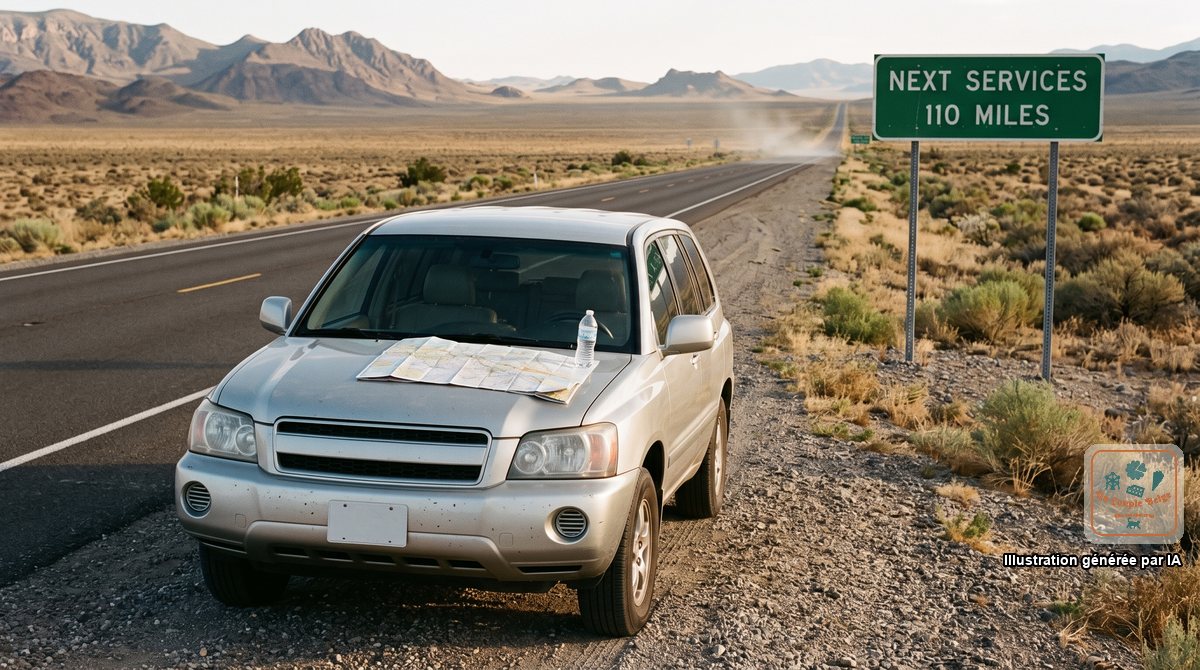
You learn a lot in three road trips, often by getting things wrong. Here are the most common mistakes on a first trip to the United States, our own and those we see cropping up among other travellers. Each one links to the guide that covers the subject in detail.
1. Wanting to see everything
On a map, Los Angeles, the Grand Canyon, Yellowstone and San Francisco fit in the palm of your hand. In reality, there are whole days of driving between each of them.
Do this instead: choose one region, limit yourself to five or six must-sees for two weeks, and sleep at least two nights in the big parks. That doesn’t rule out long legs. On our second road trip, we strung together two full days of driving to get from Washington to Florida, including a 900 km leg. It was planned and we went in knowing it, and in that case there’s no problem: sometimes it’s better to “lose” a full day on the road so you can enjoy the rest without rushing.
2. Trusting Google Maps journey times
The calculation doesn’t count fuel stops, viewpoints, queues at park entrances or the 40 km/h limits inside.
Do this instead: add a quarter to the time given, and aim to arrive an hour before sunset.
See driving in the United States and a typical day in a park.
3. Forgetting that prices exclude tax and the tip
The price tag, the menu and the room rate don’t include tax. At restaurants, the 18 to 20% tip comes on top of that. A 20-dollar dish costs 26.
Do this instead: mentally add 30% at restaurants, 10% in shops, 15% at hotels.
See the budget and tipping.
4. Leaving without serious travel insurance
A broken leg or appendicitis costs tens of thousands of dollars. A bank card’s cover is often capped well below that.
Do this instead: take out insurance with high medical cover and assistance, and save its number in both phones.
See travel insurance and getting medical care there.
5. Accepting every option at the rental desk
Duplicate insurance, a higher category, prepaid fuel, sat nav: the agent is paid on commission, and the bill can double.
Do this instead: know before you arrive what your booking covers, politely decline the rest, and photograph the car from every angle before leaving the car park.
See renting a car.
6. Waiting for the warning light before filling up
In the West, the next station may be 150 km away, and the one that does exist in the middle of the desert sells a gallon for one to two dollars more, sometimes beyond that.
Do this instead: fill up as soon as the gauge drops below half, and always before entering a park.
See fuel and remote roads.
7. Keeping the car in big cities
In New York, San Francisco, Boston or Chicago, the car costs 40 to 70 dollars a day in parking and serves no purpose.
Do this instead: rent it when you leave the city, or return it when you arrive. In New York, we did everything on foot and by subway for four days.
See parking in cities and getting around without a car.
8. Leaving something visible in the car
Smashing a window takes fifteen seconds. San Francisco and the car parks at California’s viewpoints are known for it.
Do this instead: nothing inside the car, suitcases in the boot before you reach the car park, passports and cameras on you.
See safety.
9. Counting on the mobile network
In the parks and on the roads of the West, there’s no signal for hours. With no map stored, the phone can no longer guide you.
Do this instead: download offline maps and the parks in the official national parks app (NPS App) before you leave, and save your bookings as PDFs.
See useful apps and phone and internet.
10. Underestimating the heat and the water you need
Setting off at 11am for a desert hike with a small bottle is one of the most common causes of rescue call-outs in the desert parks.
Do this instead: walk early in the morning, take three to four litres per person for the day, and keep a jug in the boot.
See hiking in the parks and extreme weather.
11. Booking what is scarce too late
Park lodges, Antelope Canyon, Alcatraz, hiking permits, campgrounds: all of these are booked months ahead in high season.
Do this instead: lock in these few bookings first, then build the rest around them, with free cancellation.
See when to book what.
12. Getting the time wrong
Arizona doesn’t change its clocks, the Navajo Nation does, and Utah is an hour ahead of Nevada. Page stays on Arizona time, Monument Valley follows Navajo time: in summer, there’s an hour’s difference between the two. You can miss a guided tour while convinced you’re early.
Do this instead: note appointment times with the name of the time zone, and set your phone by hand around Page and Monument Valley.
See time difference and time zones and Navajo lands.
And a few more, in no particular order
- Too many clothes. A week’s worth and a wash along the way are enough (see packing).
- An ESTA applied for the day before, or on an intermediary site that charges three times the price (see the application).
- Believing the parks pass covers everything. Monument Valley, Antelope Canyon and the state parks have their own ticket desks (see our article).
- Paying in euros when the terminal offers it: always choose dollars (see money and payments).
- Forgetting your passport when ordering a beer: you can be asked for it even at 50 (see our article).
- Planning a big day right after you arrive, in the middle of jet lag (see jet lag).
- Packing nothing warm for a trip to the sun: the air conditioning is icy everywhere (see packing).
- Ignoring the driving rules that catch you out: the four-way stop, the stopped school bus, the right turn on red (see driving).
- Forgetting the plug adapter, or bringing a device that can’t handle 110 V (see electricity and plugs).
- Driving through cashless tolls without a thought: the rental company bills them back with fees (see tolls).
What we never regret
- Getting up early. The sunrises at Monument Valley and Bryce Canyon, and all those that followed, remain among our most beautiful moments.
- Keeping a day with no programme each week.
- Stopping when something intrigues us beside the road: a ghost town, a state park, a giant petrol station.
- Talking to people. Rangers, servers and the people at the next table give the best advice, and they are all friendly and always ready to help.